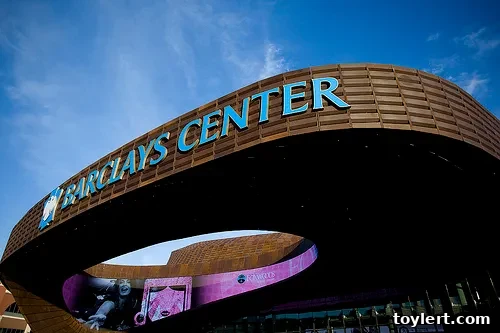
Capturing Brooklyn’s Modern Landmark: A Photojournalist’s Unique Gaze at the Barclays Center
The Brooklyn skyline underwent a dramatic transformation with the arrival of the Barclays Center. More than just a sports arena or concert venue, it quickly established itself as a pivotal landmark, sparking both admiration and debate across the borough. In the vibrant world of urban photojournalism, capturing the essence of such a monumental structure requires not only technical skill but also a keen eye for narrative and context. Esteemed photojournalist Will Holloway, renowned for his ability to find fresh perspectives in familiar settings, turned his lens towards this architectural marvel, offering views that resonate deeply even with the most seasoned observers. His captivating series invites us to look beyond the steel and glass, revealing the soul of Brooklyn’s contemporary hub.
The Barclays Center: An Architectural Statement in Brooklyn
Opened in 2012, the Barclays Center is far more than just a venue; it’s a testament to Brooklyn’s ongoing evolution and its dynamic spirit. Designed by SHoP Architects, with significant contributions from AECOM (formerly Ellerbe Becket), its most striking feature is its weathered steel facade, a material chosen to evoke Brooklyn’s industrial past while presenting a thoroughly modern aesthetic. This distinctive exterior, intentionally designed to rust to a stable, rich patina, creates a powerful visual statement that changes with the light and seasons, offering endless photographic possibilities. Nestled at the intersection of Flatbush and Atlantic Avenues, the arena anchors the ambitious Pacific Park (formerly Atlantic Yards) development, aiming to revitalize a significant portion of downtown Brooklyn.
The construction of the Barclays Center was not without its share of controversy, a point Holloway himself acknowledges. Debates raged over eminent domain, the displacement of residents and businesses, and the project’s overall impact on the neighborhood’s character. Yet, upon its completion, the arena undeniably became a new focal point for activity, drawing in crowds for NBA games, major concerts, and diverse cultural events, solidifying Brooklyn’s place on the global stage. It transformed a previously underutilized area into a bustling nexus, altering traffic patterns, generating new businesses, and fostering a unique urban energy that continues to define its surroundings.
Will Holloway’s Vision: Unearthing Fresh Perspectives
Will Holloway’s approach to photographing the Barclays Center exemplifies the art of urban photojournalism. His motivation was simple yet profound: “I’m always looking for subjects to photograph, and have been particularly interested in how this controversial new arena would look when completed.” This curiosity, coupled with an awareness of the building’s public discourse, drove him to explore its completed form, not just as a structure, but as a living entity within the city’s fabric. Holloway’s photos are lauded for their “fresh” look, a quality stemming from his deliberate methodology.
For Holloway, the key to capturing compelling images lies in patience and observation. “As with photographing anything, the important thing is to stick around for a while and see what happens as the light changes,” he explains. This philosophy underscores a fundamental truth in photography: light is everything. By waiting for the golden hour, the soft glow of dusk, or the dramatic shadows of late afternoon, Holloway could reveal textures, reflections, and moods that a quick snapshot would miss. His commitment to this patient approach allows him to transcend mere documentation, transforming his images into evocative narratives that convey the building’s presence and its interaction with its environment.
The Art of Urban Photojournalism: Techniques and Adaptability
Holloway’s toolkit for urban exploration combines professional-grade equipment with an unwavering spirit of improvisation. He typically wields a Canon 5D Mark II, a full-frame DSLR camera renowned for its image quality and versatility, making it a favorite among photojournalists and fine art photographers alike. Paired with generally wide-angle lenses, this setup is ideal for capturing expansive architectural facades and the broad sweep of cityscapes, allowing him to encompass the Barclays Center’s grandeur within its urban context.
His work also touches upon the fascinating realm of night photography. While expressing a growing interest in this discipline, Holloway notes a common challenge: “in this case I didn’t have a tripod to stabilize the camera while shooting with a slow shutter speed.” This situation highlights a photojournalist’s need for adaptability. Instead of being deterred, Holloway ingeniously utilized “what was available — the sidewalk, bollards, trash cans, etc.” as makeshift supports. This resourcefulness is a hallmark of true photojournalism, where unexpected circumstances often demand creative solutions to get the shot. Photographing at night introduces a completely different dynamic, with artificial lights casting dramatic glows and reflections, transforming familiar scenes into ethereal landscapes. His ability to adapt, even without specialized gear, speaks volumes about his skill and dedication.
A Deeper Look: The Barclays Center Through Holloway’s Lens
When viewing Holloway’s photographs, one can anticipate a visual journey that goes beyond typical tourist shots. His deliberate process of observing light and context means his images likely emphasize the arena’s unique materiality—the rich, rusty hues of the weathered steel juxtaposed against the often-grey concrete of the city, or the sharp lines of its structure cutting through the soft, ambient light of late afternoon. He might capture the reflections of the surrounding buildings in its many panels, or the dynamic interplay of shadows that dance across its undulating surface as the sun dips below the horizon.
Furthermore, Holloway’s interest in the Barclays Center as a “new center of activity” suggests his photographs may also hint at the human element, even if subtly. Perhaps a lone figure walking past the imposing facade, or the distant glow of interior lights hinting at the energy within. His lens doesn’t just record a building; it seeks to convey its integration into Brooklyn’s daily life, its role as a magnet for people, and its undeniable presence as a modern urban landmark. By focusing on light and perspective, he manages to present a structure that, while sometimes viewed with controversy, undeniably stands as a powerful and beautiful addition to the borough’s architectural tapestry.
The Legacy and Future of the Barclays Center
Years after its inauguration, the Barclays Center continues to be a defining feature of Brooklyn. It has successfully established itself as a premier destination for sports and entertainment, drawing millions of visitors annually and contributing significantly to the local economy. Beyond its functional role, its architectural boldness has undeniably carved out a distinct identity for itself, becoming an emblem of contemporary Brooklyn’s ambitious spirit and its willingness to embrace the new while acknowledging its past.
Photography, especially the insightful work of photojournalists like Will Holloway, plays a crucial role in documenting and shaping the public’s perception of such significant urban developments. His ability to capture the arena’s aesthetic appeal, its contextual presence, and its evolving role in the community provides an invaluable visual record. Holloway’s work reminds us that even highly debated structures can possess a profound beauty and become integrated, both physically and metaphorically, into the soul of a city.
Explore More of Will Holloway’s Work
To fully appreciate the depth and breadth of Will Holloway’s perspective, we encourage you to visit his dedicated platforms. His photographs offer a timeless glimpse into the character of the Barclays Center and Brooklyn itself.
Artist Web Site [Will Holloway]
Barclays Photo Set [Flickr]