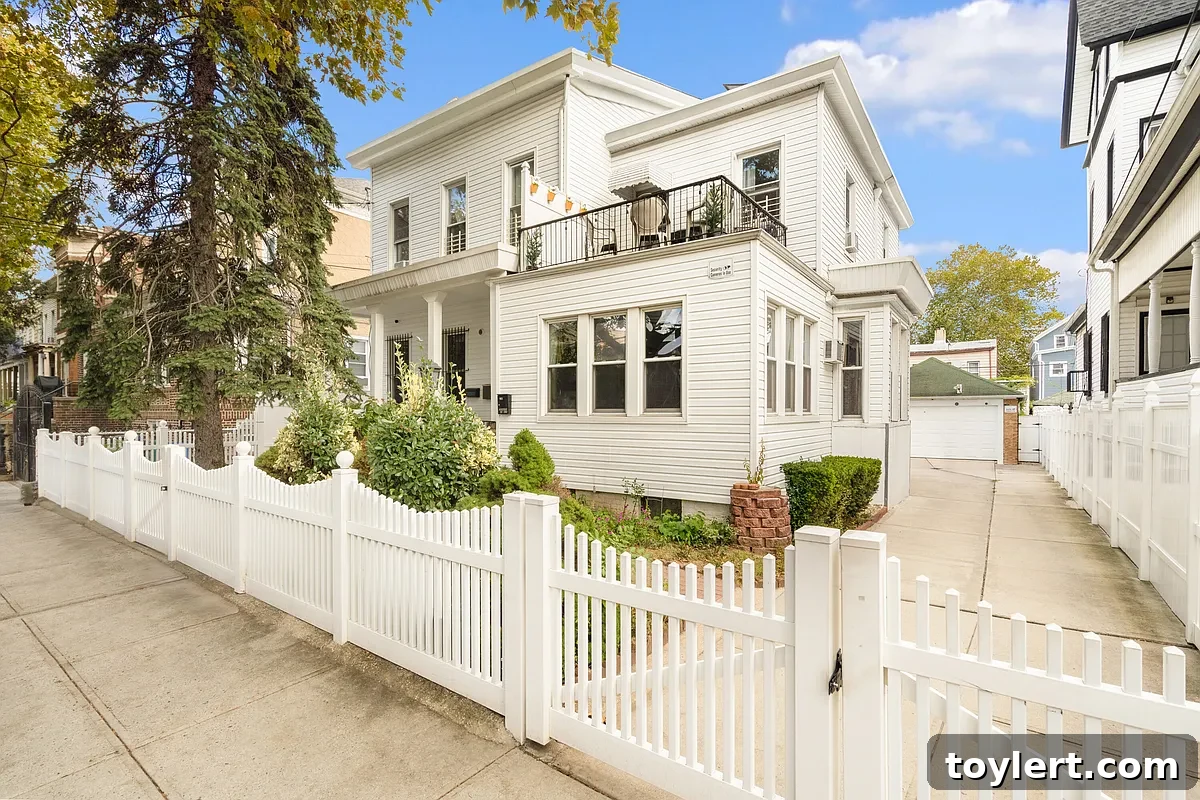
Nestled within the vibrant Cypress Hills neighborhood, the charming residence at 107 Miller Avenue stands as a subtle yet significant architectural narrative. While its Italianate cottage origins might not immediately jump out to the casual observer due to more than a century of modifications, the building’s distinctive silhouette and several preserved interior details offer an intriguing glimpse into its construction circa 1879 to 1881. This two-family dwelling not only provides a comfortable home but also paints a vivid picture of Brooklyn’s late 19th-century residential expansion and the enduring appeal of historic properties. Its exterior, marked by a classic picket fence that encloses a welcoming yard, leads to a private driveway and a convenient garage, blending timeless charm with contemporary urban practicality.
The Italianate style, popular in America from the 1840s to the 1880s, often drew inspiration from 16th-century Italian Renaissance villas. Key characteristics typically include low-pitched roofs, wide eaves with decorative brackets, tall narrow windows, and often a prominent porch. At 107 Miller Avenue, the foundational structure and proportions subtly echo these design principles, even as later alterations have softened some of the more overt decorative elements. The silhouette, with its gentle rooflines and sturdy form, hints at the original vision. Architectural historians and preservationists often find immense value in such homes, as they represent adaptive reuse and the evolution of urban landscapes, showcasing how buildings change with families and eras while retaining their inherent character.
The period between 1879 and 1881 was a dynamic time for Brooklyn, particularly for burgeoning residential areas like Cypress Hills. The Brooklyn Daily Eagle, a prominent newspaper of the era, frequently featured articles chronicling the rapid development and new construction projects along avenues such as Miller Avenue. This flurry of activity was fueled by several factors: an expanding population seeking homes outside the increasingly dense city center, improved transportation links making suburban living more accessible, and a growing middle class eager to invest in their own piece of the American dream. Homes like 107 Miller Avenue were part of this wave, contributing to the establishment of stable, family-oriented communities that defined much of Brooklyn’s residential identity. The ability to own a detached or semi-detached home, complete with a yard, was a significant aspiration, and developers worked tirelessly to meet this demand, crafting neighborhoods that offered both space and community.
Further insights into the home’s original grandeur are revealed through historical records, including a circa 1940 tax photo. This invaluable photographic document captures details that have since evolved, notably showcasing prominent bracketed cornices along the eaves. These decorative wooden or metal supports are a hallmark of Italianate architecture, providing a distinct visual flourish beneath the roofline and adding to the building’s overall elegance. The photograph also indicates an already altered porch, suggesting that even by the mid-20th century, the house had undergone modifications to suit the changing tastes and needs of its inhabitants. Such transformations are a common thread in the story of historic homes, each alteration adding another layer to its rich tapestry of history and adaptation. Understanding these changes helps us appreciate both the original architectural intent and the subsequent lives lived within its walls.
By 1898, 107 Miller Avenue had become the cherished home of Louis H. and Mary Stagg, a couple deeply rooted in the Cypress Hills community. Both Louis and Mary had grown up on Miller Avenue, fostering a strong sense of belonging and continuity within the neighborhood. Mary’s father, Frederick W. Hearn, a successful “butter and egg man,” had himself commissioned the construction of a home on Miller Avenue in 1879, indicating a family tradition of investing in and developing the area. His profession was vital to the local economy, supplying essential goods to a growing urban population, and his success likely contributed to the Stagg family’s ability to establish their own household on the same street. Census records from 1900 further emphasize the close-knit nature of the community, revealing that both Louis and Mary continued to have extended family living along Miller Avenue, a testament to the strong social fabric and familial bonds characteristic of Brooklyn neighborhoods at the turn of the 20th century. This intergenerational presence would have enriched their daily lives, offering support, camaraderie, and a shared history that made their house more than just a structure, but a true home within a vibrant family network.
Louis Stagg was not just a homeowner; he was a dedicated musician and an educator, operating Stagg’s Studio of Music. His studio offered lessons in piano and violin, playing a significant role in the cultural life of Cypress Hills. In an era before widespread recorded music, live music and the ability to play an instrument were highly valued forms of entertainment and personal expression. Louis Stagg’s studio would have been a hub for aspiring musicians, providing a structured environment for learning and fostering a love for the arts. Advertisements and articles from the early 20th century provide fascinating glimpses into the studio’s operations, indicating a flexible arrangement where lessons were sometimes conducted from 107 Miller Avenue and at other times from his childhood home at 115 Miller Avenue. This adaptability likely allowed Louis to maximize his reach within the community and serve his students efficiently, perhaps offering different types of instruction or catering to varying schedules at each location. The legacy of Stagg’s Studio of Music suggests a life dedicated to artistry and education, deeply embedding the Stagg family not only within the residential landscape but also within the cultural fabric of Cypress Hills.
The Stagg family’s time at 107 Miller Avenue spanned several significant decades, witnessing tremendous societal and economic changes in America. Louis Stagg’s passing in 1931 marked the end of an era for the family and the music studio. His death occurred at the height of the Great Depression, a period of immense economic hardship that impacted communities and families across the nation. The following years presented significant challenges, and a deed records that Mary Stagg eventually sold 107 Miller Avenue in 1936. This transaction occurred at a time when families often had to make difficult decisions regarding their assets in the face of financial instability. The sale likely reflected not just the personal loss of Louis but also the broader economic pressures of the mid-1930s. Despite these changes, the home’s story continued, passing into new hands and embarking on its next chapter, each owner contributing to its ongoing history. The property at 107 Miller Avenue thus serves as a silent witness to the ebb and flow of Brooklyn life, from the optimism of late 19th-century development to the resilience required during challenging economic times.
Today, 107 Miller Avenue continues to stand proudly in Cypress Hills, a testament to enduring architectural quality and community spirit. Its two-family configuration highlights the practical evolution of historic homes in urban settings, allowing them to remain relevant and functional for contemporary living. The presence of a private driveway and garage, a rare and highly sought-after amenity in many parts of Brooklyn, significantly enhances its appeal. These features blend seamlessly with the home’s historic charm, offering both convenience and value in today’s competitive real estate market. The house is more than just bricks and mortar; it is a repository of memories, a link to the past, and a living piece of Cypress Hills history. From its initial construction fueled by Brooklyn’s late 19th-century boom, through its time as the Stagg family residence and the home of a vibrant music studio, to its present-day role as a comfortable two-family dwelling, 107 Miller Avenue exemplifies the rich, layered narrative of New York City’s historic neighborhoods. It invites passersby to imagine the lives lived within its walls and to appreciate the enduring beauty and character of Brooklyn’s architectural heritage, a true gem in a borough celebrated for its distinct neighborhoods and timeless charm.