Editor’s note: An updated version of this post can be viewed here.
1 Main Street, DUMBO: A Landmark Transformed at the Heart of Brooklyn’s Waterfront
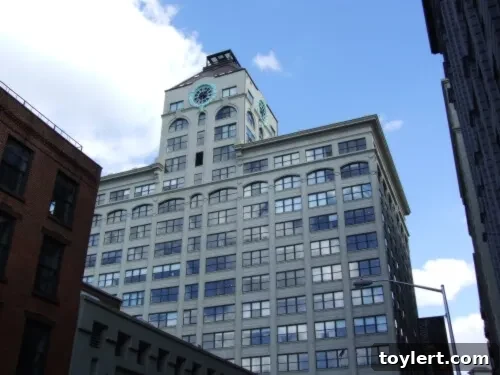
Nestled at the vibrant intersection of Plymouth and Water Streets, 1 Main Street stands as an undisputed icon of Brooklyn’s DUMBO neighborhood. More than just a magnificent edifice, this building, with its distinctive clock tower, symbolizes the dramatic evolution of one of New York City’s most sought-after waterfront districts. From its origins as a pioneering industrial powerhouse to its current status as a beacon of luxury residential living, 1 Main Street embodies DUMBO’s remarkable journey through history, architecture, and urban transformation. Its prominent position and rich heritage make it a focal point for understanding the area’s transition from a bustling manufacturing hub to a stylish, expensive, and utterly desirable destination for residents and visitors alike.
The significance of 1 Main Street is multifaceted, rooted in its innovative construction, the entrepreneurial spirit of its founder, and its pivotal role in the development of the DUMBO area. Today, it’s not merely a residence; it’s a living testament to Brooklyn’s industrial past and its dynamic present, offering breathtaking views of the Manhattan skyline, the Brooklyn Bridge, and the East River. Its story is one of innovation, adaptation, and enduring appeal, making it a true architectural gem within the DUMBO Historic District.
Building Profile: 1 Main Street
Address: 1 Main Street, corner Plymouth Street, corner Water Street
Neighborhood: DUMBO (Down Under the Manhattan Bridge Overpass)
Year Built: 1914
Architectural Style: Industrial Neo-Classical
Architect: William Higginson
Landmark Status: Yes, part of the DUMBO Historic District, designated in 2007.
The Enduring Symbol of DUMBO’s Transformation
When one imagines DUMBO, the majestic sight of 1 Main Street and its iconic clock tower often comes to mind. It is arguably the most recognizable and photographed building in the neighborhood, standing as the tallest and most prominent structure among the collection of formidable buildings developed by Robert Gair. This impressive edifice, particularly its distinctive clock tower and the luxury apartment nestled behind it, has become a powerful symbol of DUMBO’s dramatic resurgence. Once an industrial wasteland, DUMBO has reinvented itself as a hip, happening, and increasingly exclusive residential enclave, drawing residents who appreciate its unique blend of historic charm, artistic vibrancy, and unparalleled waterfront access.
The transformation of 1 Main Street mirrors the broader narrative of DUMBO itself. What was once a bustling center of manufacturing and trade has, over the decades, evolved into a premier residential and commercial district. The building’s conversion into luxury housing exemplifies this shift, showcasing how Brooklyn’s industrial heritage can be seamlessly integrated with modern urban living. The residential units within 1 Main Street offer residents not just homes, but a piece of history, complete with awe-inspiring vistas and access to a vibrant community. The appeal lies not only in the high-end finishes and spacious layouts but also in the rich historical context and the prestige of living within a true Brooklyn landmark.
Beyond its residential appeal, the building also contributes significantly to DUMBO’s cultural identity. Its presence anchors the neighborhood, providing a visual cue that speaks to both its past and its future. As visitors stroll through Brooklyn Bridge Park or along the cobblestone streets, the clock tower of 1 Main Street serves as a constant reminder of the area’s rich legacy and its successful reinvention. This powerful visual presence makes 1 Main Street not just a building, but a central character in the ongoing story of Brooklyn’s DUMBO.
Robert Gair: The Visionary Behind DUMBO’s Industrial Empire
The story of 1 Main Street is intrinsically linked to the extraordinary life and vision of Robert Gair. A Scotsman who arrived in the United States at the tender age of 14 in the mid-19th century, Gair possessed an entrepreneurial spirit and a keen eye for innovation that would ultimately reshape an entire industry and significantly contribute to the development of an entire Brooklyn neighborhood. His journey began humbly, but his genius for invention quickly propelled him to the forefront of American manufacturing.
In 1867, Gair, alongside a business partner, embarked on the manufacture of flat-bottomed paper bags. This initial venture laid the groundwork for his groundbreaking contributions to the packaging industry. Gair was more than just a businessman; he was a brilliant inventor, constantly seeking ways to improve and automate paper manipulation processes. His most significant breakthroughs occurred in the early 1870s. In 1870, he invented a revolutionary machine for making corrugated cardboard, a material that would become indispensable for shipping and protecting goods. Shortly thereafter, he patented another pivotal invention: a machine specifically designed for folding boxes. This ingenious device could simultaneously cut and crease paperboard, efficiently producing flat-packed boxes ready for assembly. This innovation was a game-changer, perfectly timed with the advent of the manufactured and packaged food industry.
The impact of Gair’s inventions cannot be overstated. At a time when Brooklyn’s “merchant princes” were rapidly developing and manufacturing a myriad of new consumer products – from tinned coffee and soap to chewing gum, cereals, and crackers – Gair provided the essential means to package them safely, efficiently, and attractively. His folding boxes became the ubiquitous solution for countless companies across America. The Robert Gair firm rapidly ascended to become the largest manufacturer of boxes in the United States, a testament to the immense demand for his innovative packaging solutions.
By 1913, Robert Gair’s operations in DUMBO were immense, employing over 1,700 people within his complex of buildings. Gair was not just an industrialist; he was also a shrewd real estate developer who played a crucial role in shaping much of the DUMBO area. While he ran portions of his own extensive business out of many of these buildings, others were strategically leased to generate additional revenue and support the burgeoning industrial ecosystem of the waterfront. His vision for a fully integrated industrial district helped lay the foundation for the DUMBO we recognize today, a neighborhood built on the bedrock of his industrial legacy.
Architectural Grandeur: The Pioneering Design of 1 Main Street
Constructed in 1914, 1 Main Street was a marvel of its era, a testament to advanced engineering and a distinctive architectural vision. Designed by the accomplished architect William Higginson, the building proudly showcases the Industrial Neo-Classical style. This architectural approach expertly blends the functional requirements of a large-scale industrial facility with the aesthetic elegance and dignified proportions often associated with classical design. Higginson’s choice of this style provided a sense of grandeur and stability to what was essentially a highly practical and utilitarian structure, befitting Gair’s status as an industrial titan.
Beyond its stylistic attributes, 1 Main Street achieved remarkable engineering distinction. Upon its completion, it held the prestigious title of being the tallest reinforced concrete building in the entire world. This was a groundbreaking achievement, highlighting the innovative use of reinforced concrete as a primary construction material. The benefits of concrete for industrial applications were numerous: it offered superior fire resistance compared to timber, immense structural strength to support heavy machinery and vast quantities of stored goods, and was relatively cost-effective for large-scale construction. These characteristics were vital for a building intended to house extensive manufacturing, storage, and administrative operations.
With an impressive footprint of 275,000 square feet of space, the building was designed for immense capacity and operational efficiency. Its robust construction and expansive interiors were perfectly suited to the demands of a burgeoning industrial enterprise. The choice of reinforced concrete not only symbolized modernity but also ensured the longevity and resilience of a structure that would adapt through various industrial and commercial transformations, ultimately allowing it to endure into the modern era as a cherished landmark.
From Mail Order to Modern Luxury: 1 Main Street’s Evolving Identity
While 1 Main Street initially served as a cornerstone of Robert Gair’s industrial empire, its utility evolved with the changing tides of American commerce. By the 1920s, the building found a new tenant in the Charles Williams Stores, a prominent general mail-order firm. This transition marked a significant shift in the building’s function, moving from manufacturing and storage primarily for Gair’s own products to becoming the bustling headquarters of a major retail operation.
Interestingly, the Charles Williams Stores had a close connection to the DUMBO ecosystem; the company was owned by John Arbuckle, a personal friend of Robert Gair and the proprietor of Yuban coffee, another significant DUMBO-based enterprise. This intertwining of business interests underscores the close-knit network of industrialists and entrepreneurs who shaped Brooklyn’s waterfront economy during the early 20th century. The Charles Williams Stores operated much like a contemporary of the famous Sears Roebuck, offering a vast array of goods directly to consumers through catalogs.
Under its new occupancy, 1 Main Street became known as Charles Williams Building Number 5, also referred to as the Executive Building. This designation reflected its critical role as the administrative and operational heart of the company. The building housed the offices for the company president and other key officers, along with general administrative offices and departments dedicated to apparel merchandise. The lower two floors were strategically utilized for robust shipping operations, reflecting the high volume of goods being dispatched. The remaining expansive floors were meticulously organized to accommodate various crucial functions, including product testing facilities to ensure quality, ordering and buying departments managing inventory, inspection rooms maintaining standards, and comprehensive billing and receiving operations facilitating the flow of goods and finances.
Today, the building has undergone its most dramatic transformation yet. No longer an industrial plant or a mail-order fulfillment center, 1 Main Street has been meticulously redeveloped into highly coveted luxury housing. This monumental undertaking was spearheaded by the Walentas family’s Two Trees empire, a development firm renowned for its visionary projects and its pivotal role in the revitalization of DUMBO. The conversion has preserved the building’s historic facade and industrial character while introducing modern amenities, sophisticated interiors, and unparalleled living spaces. The former industrial behemoth is now considered the crown jewel of DUMBO’s residential offerings, drawing discerning residents seeking a unique blend of historical significance, architectural grandeur, and contemporary urban luxury.
DUMBO Today: A Legacy Preserved, A Future Embraced
The story of 1 Main Street is a microcosm of DUMBO’s incredible evolution. What was once a gritty industrial waterfront, characterized by factories, warehouses, and the relentless machinery of commerce, has been thoughtfully reimagined and revitalized. Today, DUMBO is celebrated globally as one of New York City’s most desirable neighborhoods, known for its creative industries, high-end boutiques, gourmet dining, and stunning public spaces like Brooklyn Bridge Park.
The designation of the DUMBO Historic District in 2007, encompassing 1 Main Street, was a crucial step in preserving the area’s distinctive character and architectural integrity. This landmark status ensures that while the neighborhood continues to evolve, its rich industrial past and unique aesthetic remain protected for future generations. The success of developments like 1 Main Street, under the stewardship of firms like Two Trees Management, demonstrates a masterful balance between historical preservation and innovative urban development. These projects have transformed utilitarian structures into vibrant living and working spaces, contributing to DUMBO’s dynamic blend of old and new.
Living at 1 Main Street or simply visiting the area offers a tangible connection to this layered history. Residents enjoy not only luxurious homes but also a vibrant community, unparalleled access to waterfront recreation, and breathtaking views that are truly world-class. The iconic clock tower, once a marker for industrious workers, now stands as a symbol of DUMBO’s elegance and its enduring appeal as a premier destination for those seeking the quintessential Brooklyn lifestyle. 1 Main Street is more than just a building; it is a monument to American ingenuity, architectural foresight, and the power of urban regeneration, continuing to inspire and captivate all who encounter its grandeur.