The Enduring Legacy of Atlantic-Flatbush: Brooklyn’s Ever-Evolving Crossroads
Few intersections in New York City encapsulate the dynamic spirit of urban transformation quite like Brooklyn’s Atlantic-Flatbush Junction. More than just a convergence of major avenues, this iconic crossroads has served as a pulsating heart of transportation, commerce, and community for over a century. A mere hundred years can witness monumental shifts in a city’s landscape, and the story of Atlantic-Flatbush is a vivid testament to Brooklyn’s relentless evolution. From bustling turn-of-the-century transit hubs to modern commercial epicenters, this corner of Brooklyn has continually reinvented itself, yet always retained its fundamental role as a nexus of connectivity.
Join us on a journey through time, as we peel back the layers of history at Atlantic-Flatbush, examining its architectural milestones, transportation revolutions, and the relentless march of progress that has shaped its present-day identity. We’ll delve into the specific structures that once defined this area and compare them with the contemporary landmarks that stand tall today, offering a comprehensive “then and now” perspective on one of Brooklyn’s most vital intersections.
A Glimpse into the Past: Atlantic-Flatbush in 1910
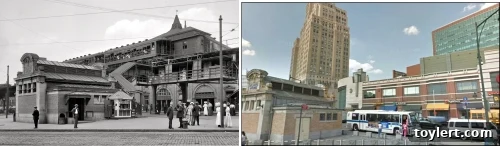
Stepping back to 1910, the Atlantic-Flatbush Junction presented a vastly different, yet equally vibrant, scene. The photograph from that era captures a moment when Brooklyn was rapidly expanding, with new infrastructure being laid to support its burgeoning population and economic growth. This snapshot from the early 20th century showcases a robust transportation network that was cutting-edge for its time, dominated by two significant architectural and engineering marvels: a distinctive subway kiosk and a grand railroad terminal, all overshadowed by a sprawling elevated train line.
The Heins and LaFarge Subway Kiosk: A Gateway to the Underground
Prominently featured in the 1910 image, and still a recognizable fixture today, is the remarkable 1908 Heins and LaFarge subway kiosk. Designed by the renowned architectural firm Heins & LaFarge, celebrated for their work on the New York City Subway system’s original stations, this kiosk was more than just a functional entrance; it was a symbol of modernity and urban progress. Its distinctive design, often incorporating intricate details and robust materials, marked the gateway to the city’s rapidly expanding underground network. At a time when subway travel was relatively new, these kiosks served as welcoming beacons, guiding commuters into the futuristic realm beneath the city streets. The enduring presence of this kiosk underscores its architectural significance and its ability to withstand the test of time, adapting its role while maintaining its structural integrity.
The Original LIRR Terminal: An Arched Grandeur
Behind the labyrinthine network of elevated tracks in the 1910 scene stood the original Long Island Rail Road (LIRR) terminal, which first opened its doors in 1907. This terminal was a majestic structure, characterized by its impressive arched entryways that exuded a sense of grandeur and permanence. It served as a critical nexus for thousands of daily commuters traveling between Long Island and Brooklyn, facilitating the borough’s growth and cementing its status as a major residential and commercial center. The terminal was a hive of activity, a constant ebb and flow of passengers, steam, and the rhythmic clang of trains. Its design spoke to an era of monumental public works, aiming to inspire civic pride and provide efficient, albeit bustling, transit.
The 5th Avenue Elevated Train Line: An Artery Above
Dominating the skyline of 1910 was the imposing structure of the 5th Avenue Elevated Train Line. This elevated railway was an essential artery in Brooklyn’s early transit system, providing swift connections across the borough. Its journey began by coming up from the Myrtle Avenue El, snaking its way along Hudson Avenue, making a crucial stop at the bustling junction of Atlantic and Flatbush, and then continuing its southern trajectory along 5th Avenue all the way to 3rd Avenue and 65th Street. The elevated train offered a bird’s-eye view of the city below, its roar a constant companion to the street-level activities. It was a marvel of engineering that allowed for rapid transit above congested streets, connecting diverse neighborhoods and facilitating the daily commutes of countless Brooklynites. The presence of the El, with its steel framework and active trains, profoundly shaped the urban fabric and the sounds of the junction.
The Winds of Change: From Elevated Tracks to Underground Networks
The first half of the 20th century brought significant technological advancements and shifts in urban planning that would dramatically reshape Atlantic-Flatbush. The very infrastructure that defined the 1910 landscape began to give way to newer, more efficient, and often less intrusive forms of transportation. The vision for a modern metropolis favored subterranean routes over overhead behemoths, setting the stage for profound changes at this key junction.
The Demise of the El: 1941 and the Rise of the Subway
The majestic 5th Avenue Elevated Train Line, once a symbol of progress, eventually met its end. In 1941, the El was torn down, a casualty of the ongoing modernization of New York City’s public transit system. The primary reason for its removal was the burgeoning success and expansion of the underground subway network. Subways offered faster, quieter, and more weather-resistant travel, and their development signaled a move towards more integrated and efficient urban planning. In this specific case, the N/R line, which runs along 4th Avenue to Bay Ridge, provided a more streamlined and extensive alternative. The removal of the El transformed the streetscape, opening up light and air that had long been obscured by its towering tracks and steel supports. This transition marked a definitive step away from the industrial aesthetic of the early 20th century towards a more contemporary urban design, though it undoubtedly altered the daily routines and visual experience of local residents.
A Period of Flux: The LIRR Terminal’s Legacy and Replacement
The LIRR station, with its distinctive arched entryways, served the community for over eight decades before facing its own transformation. In 1988, the original 1907 terminal was torn down. This decision was driven by a need for modernization, increased capacity, and improved accessibility, reflective of the evolving demands of a rapidly growing region. The space it once occupied, however, did not immediately see a replacement structure. For over two decades, the area experienced a significant period of transition, often remaining an open space or a site of ongoing construction and planning. This interim phase, though perhaps appearing as an emptiness to long-time observers, was a crucial prelude to the comprehensive redevelopment that would ultimately redefine the junction for the 21st century. It was a time of urban re-evaluation, where various proposals and visions for the site were debated, reflecting the complexities of large-scale urban renewal projects in a dense metropolitan area like Brooklyn.
Atlantic-Flatbush Today: A Modern Metropolis Reborn
Fast forward to the early 2010s and beyond, and the Atlantic-Flatbush Junction has once again been dramatically reimagined. While honoring its historical roots, the area has undergone a significant facelift, emerging as a vibrant, multi-functional hub that caters to the demands of contemporary urban life. The present-day landscape blends preserved history with cutting-edge architecture and commercial development, standing as a testament to Brooklyn’s continuous renaissance.
The Enduring Kiosk: From Function to Art
Remarkably, the 1908 Heins and LaFarge subway kiosk continues to stand proudly at the intersection. While its primary function as a direct subway entrance may have evolved over the decades, its architectural significance has only grown. Today, it stands as an architectural art installation, a cherished historical landmark that bridges the past and the present. It serves as a visual anchor, a silent witness to the profound changes that have occurred around it, reminding residents and visitors of the area’s rich transit heritage. Its preservation highlights a growing appreciation for historical urban design and the importance of maintaining connections to a city’s foundational periods, even as progress marches forward.
A New Era for the LIRR: The Modern Terminal
After more than two decades, the void left by the demolition of the old LIRR terminal was filled with a state-of-the-art replacement. The new LIRR terminal, which officially opened in 2010, represents a significant upgrade in terms of design, capacity, and commuter experience. This modern facility is designed to handle the increasing volume of passengers, offering improved accessibility, expanded concourses, and a more streamlined flow for travelers. Its contemporary architecture integrates seamlessly with the surrounding urban environment, reflecting the forward-looking vision for Brooklyn’s transportation infrastructure. The new terminal not only serves as a vital transportation link but also anchors the rejuvenated commercial and residential developments in the immediate vicinity, symbolizing a renewed commitment to efficient and comfortable public transit.
The Atlantic Terminal Mall: A Commercial and Social Epicenter
Complementing the new LIRR terminal and further solidifying the junction’s status as a commercial powerhouse is the Atlantic Terminal Mall. This expansive retail complex has transformed the area into a bustling shopping and dining destination, attracting visitors from across Brooklyn and beyond. Featuring a diverse range of stores, restaurants, and entertainment options, the mall serves as a central point for daily errands, leisure activities, and social gatherings. Its development has spurred economic growth, created numerous jobs, and injected new vitality into the surrounding neighborhoods. The Atlantic Terminal Mall is a prime example of successful urban redevelopment, demonstrating how integrated commercial spaces can enhance the appeal and functionality of a major transit hub, turning a utilitarian space into a vibrant community asset.
Atlantic-Flatbush: A Microcosm of Brooklyn’s Resilience
The journey of the Atlantic-Flatbush Junction over the past century is a powerful narrative of resilience, adaptation, and continuous growth. From its early days as a cutting-edge transportation hub, defined by elevated trains and grand terminals, to its modern incarnation as a dynamic confluence of mass transit, retail, and preserved history, this intersection has consistently reflected the broader trajectory of Brooklyn itself. The elimination of the El, the demolition and rebuilding of the LIRR terminal, and the rise of commercial centers like the Atlantic Terminal Mall are not just isolated events; they are chapters in a larger story of urban evolution driven by technological progress, shifting societal needs, and ambitious urban planning initiatives. Today, Atlantic-Flatbush stands as a vibrant testament to the enduring spirit of Brooklyn—a borough that honors its past while relentlessly innovating for its future. It remains a crucial nexus, a place where the pulse of the city beats strongest, inviting residents and visitors alike to experience its rich history and dynamic present.
Whether you’re exploring its architectural relics, utilizing its modern transit options, or enjoying its diverse commercial offerings, the Atlantic-Flatbush Junction continues to be a compelling focal point in the heart of Brooklyn. Its narrative serves as a reminder that urban landscapes are living entities, constantly changing, adapting, and finding new ways to serve the communities that depend on them.
View on Google Maps