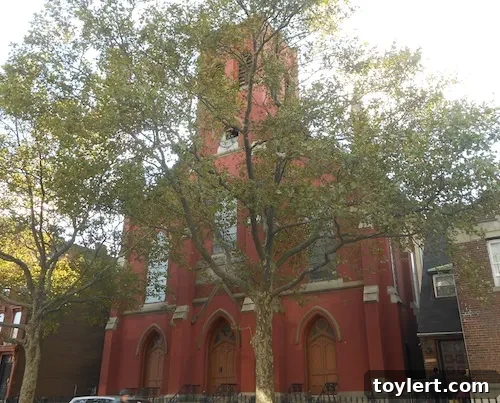
Historic Brooklyn Church Faces Partial Demolition: A Battle Between Preservation and Progress in Bed-Stuy
The vibrant and historically rich neighborhood of Bedford-Stuyvesant, Brooklyn, is once again at the crossroads of preservation and development. A significant piece of its architectural and community fabric, the beautiful church building located at 261 Skillman Street, prominently situated at the intersection with Bedford Avenue, is currently undergoing demolition. This project has sparked considerable concern among local residents and historical preservationists who fear the loss of another cherished landmark in a rapidly evolving borough. The building, a testament to Brooklyn’s rich past, was sold to a developer back in 2008 for a reported $4,100,000, setting the stage for its current transformation.
The plans for the site, as documented by the New York City Department of Buildings (DOB), outline a project involving “Interior demolition, partial demolition and build out of the uses.” This phrasing often signals a complex undertaking where parts of an existing structure are removed or altered to accommodate new functions, while other elements are retained. According to permits filed concurrently with the sale in 2008, the ambitious project proposes the creation of 48 apartment units, with renowned architect Karl Fischer at the helm. Fischer, known for his prolific work in New York City’s real estate development landscape, often designs residential buildings that aim to maximize density and modern amenities.
Uncertainty Surrounds the Church’s Iconic Facade
One of the most pressing questions for the community and preservation groups concerns the fate of the church’s distinctive front exterior. While demolition activities are visibly underway at the rear of the building, there is no explicit clarity within the DOB records regarding the preservation of the front façade. This ambiguity leaves room for both hope and apprehension. Historically significant structures, particularly those with intricate architectural details like many of Brooklyn’s old churches, contribute immensely to the character and identity of a neighborhood. Losing such a façade could irrevocably alter the streetscape of Skillman Street and Bedford Avenue.
The Bedford Stuyvesant Society for Historical Preservation has voiced its deep concern over this ongoing demolition. Their primary worry revolves around whether the project will result in a “hack job” – a development insensitive to the building’s historical integrity and aesthetic value – or a “sensitive build-out” that thoughtfully integrates the old with the new. The society, like many residents, remains unsure about the future of the front exterior, underscoring the broader challenges faced by preservation efforts in areas experiencing intense development pressure. The possibility of an insensitive conversion is indeed sad news for those who value architectural heritage and community identity.
The Delicate Balance: Historic Preservation vs. Urban Development
The narrative of the Skillman Street church is a microcosm of a larger, ongoing debate in cities like New York: how to balance the urgent need for housing and economic development with the imperative to preserve historical landmarks and architectural heritage. Historic churches, in particular, often represent more than just buildings; they are repositories of community memory, architectural marvels, and symbols of enduring cultural significance. Their demolition or drastic alteration can be perceived as a loss of identity for a neighborhood.
Adaptive reuse, a practice that involves repurposing existing buildings for new uses while retaining their historical character, often emerges as a preferred alternative to outright demolition. A “sensitive build-out” would likely entail preserving the church’s most distinctive architectural features, especially its façade and perhaps some interior elements, while transforming the internal space into modern residences. This approach not only conserves valuable architectural details but also contributes to sustainable development by minimizing waste and preserving the embodied energy of the original structure. Successful examples of adaptive reuse abound in cities, where former churches have been transformed into unique residential lofts, cultural centers, or vibrant community spaces, each telling a story of thoughtful evolution.
The Developer’s Perspective and Economic Realities
From a developer’s standpoint, acquiring a property like the Skillman Street church in a sought-after neighborhood like Bed-Stuy presents both immense opportunities and significant challenges. The demand for housing in Brooklyn remains consistently high, driving up property values and making residential conversions highly lucrative. The $4.1 million purchase price in 2008 reflects the property’s prime location and development potential. Karl Fischer’s involvement further suggests an emphasis on creating market-rate or luxury apartments designed to appeal to the area’s evolving demographic.
However, developing historic properties is fraught with complexities. Structural challenges, compliance with modern building codes, and the inherent difficulties of working with aged materials can drive up construction costs. Additionally, navigating zoning regulations and responding to community concerns requires a delicate touch. Developers often walk a tightrope, aiming to deliver a profitable project while ideally minimizing friction with local residents and preservationists. The vague language of “partial demolition” and “build out of the uses” in the permits could indicate an attempt to offer flexibility in the development process, allowing the developer to adapt to unforeseen conditions while adhering to a basic framework.
Bedford-Stuyvesant: A Neighborhood in Transition
Bedford-Stuyvesant itself is a neighborhood renowned for its majestic brownstones, tree-lined streets, and rich African American history. Over the past two decades, it has experienced significant gentrification, attracting new residents and investments. This transformation has brought new amenities and economic vitality but has also raised concerns about displacement, affordability, and the erosion of its unique cultural landscape. The demolition and redevelopment of the Skillman Street church fit squarely into this broader narrative of change.
The church, having stood for decades, likely served as a social and spiritual anchor for its congregation and the wider community. Its potential conversion into apartments symbolizes the shift in how space is valued and utilized in urban environments. For long-term residents, the loss of such a landmark can feel like a profound change, impacting their sense of place and belonging. For newcomers, these new apartment units represent desirable living spaces in a vibrant, well-connected neighborhood. The challenge lies in finding a path that honors the past while building for a sustainable and inclusive future.
The Role of Regulatory Bodies and Community Advocacy
The Department of Buildings plays a crucial role in overseeing construction and demolition projects in New York City, primarily focusing on safety and adherence to building codes. While the DOB ensures structural integrity and public safety, its mandate often doesn’t extend to architectural aesthetics or historical preservation unless a building is specifically designated as a landmark. This gap often necessitates the intervention of local advocacy groups like the Bedford Stuyvesant Society for Historical Preservation.
These organizations serve as vital watchdogs, bringing public attention to at-risk properties, advocating for landmark designation, and engaging with developers and city officials to promote sensitive development practices. Their concerns about the Skillman Street church highlight the ongoing need for robust community engagement and transparent communication throughout the development process. When permits are vague, it becomes even more critical for these groups to push for clarity and accountability, ensuring that development projects align with community values as much as with financial imperatives.
Looking Ahead: Hopes for a Thoughtful Outcome
The situation at 261 Skillman Street serves as a poignant reminder of the ongoing tension between preserving our collective past and building for our future. While the demolition proceeds at the back of the church, the hope remains that the project architect, Karl Fischer, and the developer will ultimately opt for a design that prioritizes a “sensitive build-out.” This would entail a creative approach that honors the building’s historical and architectural significance, potentially preserving the iconic front exterior as a nod to its past, while ingeniously transforming the interior into modern, functional residences.
Such an outcome would not only be a win for architectural preservation but also demonstrate how urban development can proceed with respect for heritage. The community of Bedford-Stuyvesant, with its deep roots and evolving character, deserves development that enhances rather than erases its unique identity. The watchful eyes of the Bedford Stuyvesant Society for Historical Preservation and concerned residents underscore the importance of ongoing dialogue and advocacy in shaping the future landscape of one of Brooklyn’s most cherished neighborhoods.
For more details on the initial sale and community discussions:
Bed-Stuy Church Sold to Developer [Brownstoner]
GMAP
Visuals of the Demolition in Progress
These images capture the ongoing demolition work at the rear section of the historic church building, providing a clear visual of the transformation taking place. They highlight the initial stages of the “partial demolition” mentioned in the Department of Buildings permits, underscoring the scale of the structural changes being implemented on the site.