The Ever-Evolving Bed-Stuy Real Estate Market: A Deep Dive into Price Trends and Property Dynamics
Bedford-Stuyvesant, affectionately known as Bed-Stuy, stands as one of Brooklyn’s most iconic and dynamically evolving neighborhoods. Renowned for its stunning brownstones, tree-lined streets, and rich cultural heritage, Bed-Stuy has witnessed a dramatic transformation in its real estate landscape over the past decade. Recent public records vividly illustrate a significant upward surge in property values, particularly in the areas situated east of Malcolm X Boulevard. This vibrant market activity underscores Bed-Stuy’s sustained appeal to a diverse range of buyers, from families seeking spacious historic homes to astute investors looking for promising opportunities in one of New York City’s most desirable boroughs.
The latest sales data paints a clear picture of this escalating demand, with transactions consistently pushing price points to new heights. The neighborhood’s unique architectural character, combined with its increasingly robust amenities and improving infrastructure, continues to attract considerable attention. As we delve into specific examples, it becomes evident that while the market is buoyant, it also presents nuanced dynamics, with distinct price gradients and varying property conditions playing crucial roles in valuation.
Unpacking the Surge: Notable Sales East of Malcolm X Boulevard
One block east of the historic Stuyvesant Avenue, an exceptional sale at 421 Decatur Street, nestled between Patchen Avenue and Malcolm X Boulevard, perfectly encapsulates the rapid appreciation seen in this segment of Bed-Stuy. This elegant property commanded a sale price of an impressive $789,000 in January. What makes this particular transaction stand out is its intriguing history. Public records reveal that prior to this recent sale, the property had entered lis pendens (a formal notice of a pending lawsuit) and subsequently changed hands for a mere $50,000 in July of the previous year. This staggering increase in value within a relatively short period highlights both the potential for significant returns in a rapidly appreciating market and the impact of investor activity, often involving the acquisition of distressed properties for substantial renovation and resale.
Further demonstrating the market’s strength, another noteworthy brownstone, celebrated for its remarkable preservation of original details, was sold for $675,000 in December. This particular residence, located at 534 Decatur Street, between Howard Avenue and Ralph Avenue, had previously been featured as a “House of the Day” (HOTD) on Brownstoner.com, a testament to its unique charm and architectural integrity. The allure of such properties lies in their ability to transport residents back in time, offering intricate period features like elaborate fireplace mantels, original woodwork, plaster moldings, and mosaic tile entryways, which are highly coveted by buyers seeking authentic historic living experiences. For those wishing to appreciate its bygone grandeur, the captivating photographs of this brownstone remain accessible on Streeteasy, showcasing its exquisite details and the care taken in its preservation.
Navigating the Price Gradient: Towards Broadway
As one ventures further east within Bed-Stuy, moving closer to the bustling thoroughfare of Broadway, a discernible shift in pricing becomes apparent. This geographical distinction often correlates with varying levels of development, access to specific transportation lines, and historical neighborhood characteristics, contributing to a natural decrease in property values. For instance, in August, a house situated at 615 Decatur Street, nestled between Saratoga Avenue and Howard Avenue, sold for $570,000. While still a significant sum, this price point reflects the subtle yet impactful gradient that defines the Bed-Stuy real estate landscape, offering slightly more accessible options for buyers who are willing to explore areas a little further afield from the established core.
The Interplay of Preservation and Modernization: A Tale of Two Houses
The market’s narrative is not solely about rising prices; it also encompasses ongoing dialogues about architectural preservation versus modernization, as exemplified by several properties. We were particularly intrigued to learn that the distinctive wood-frame house at 770 MacDonough Street is now in contract. This property garnered attention following a minor price adjustment, dropping from its initial asking price of $675,000 to $669,000. This house is especially notable because its well-preserved original exterior, a characteristic feature of many early Bed-Stuy homes, was recently controversially covered over with brick veneer. This decision sparked considerable debate among preservationists and neighborhood residents, highlighting the ongoing tension between maintaining historical authenticity and adapting to contemporary aesthetic preferences or structural needs.
Beyond its exterior transformation, 770 MacDonough Street, which also enjoyed the distinction of being a “House of the Day” (HOTD), has undergone a similar overhaul internally. While some charming original elements, such as the fireplace mantels and window trim, have been thoughtfully retained, other period features like the crown and baseboard moldings appear to have been removed. This approach to renovation often aims to blend historic charm with modern functionality, yet it inevitably alters the original character of the space. The property is situated between Thomas Boyland Street and Saratoga Avenue, on a block predominantly characterized by larger tenement apartment buildings, offering a unique juxtaposition of housing styles.
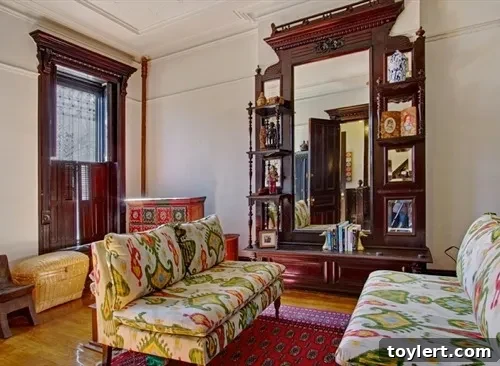
Another compelling property currently in contract is 585 MacDonough Street, located between Ralph Avenue and Howard Avenue, and notably featured in the image above. With an asking price of $899,000, this residence boasts an array of incredible period details that speak to its rich history and architectural pedigree. Among its standout features are exquisite Aesthetic Movement fireplace mantels and intricate tile work, showcasing the craftsmanship and design sensibilities of a bygone era. The Aesthetic Movement, known for its emphasis on “art for art’s sake” and its embrace of beauty and refined design, left an indelible mark on interior architecture during the late 19th century, and these elements are highly prized by discerning buyers.
Despite these magnificent details, the property appears to be a work in progress, suggesting it could still benefit from a degree of “polishing.” Observations indicate that the wall separating the kitchen and dining room, along with the kitchen ceiling, seem to be mid-construction, and some plaster surfaces look like they require skim coating to achieve a flawless finish. These aspects suggest that while the home possesses immense potential and undeniable charm, it also presents an opportunity for a new owner to infuse their personal vision and complete the renovation to their exact specifications. Such properties, offering a blend of historic grandeur and renovation potential, are often highly sought after in the Bed-Stuy market.
The Flipper’s Gambit and Hope for Discerning Buyers
For potential buyers who may feel disheartened by the rapid escalation in Bed-Stuy property prices, there might still be rays of hope within the market, particularly in the realm of “fixer-uppers” and properties that attract a specific type of investor. Consider the case of 605 Decatur Street, a property asking for $675,000, but crucially, demanding an “all cash” offer. This particular house, another “House of the Day” (HOTD) feature, remains on the market, presenting an interesting opportunity for those with the means and vision to undertake a significant renovation project.
As previously highlighted when it was featured as a HOTD, this property last traded to an LLC in December for a modest $300,000. This price point is largely what one would expect for a house that, at the time, lacked working kitchens and bathrooms, rendering it ineligible for conventional financing. Such properties are often categorized as distressed assets, acquired by investors or “flippers” who specialize in purchasing undervalued homes, undertaking comprehensive renovations, and then reintroducing them to the market at a significantly higher price. The strategy hinges on adding substantial value through modernization and repair, capitalizing on the strong demand for move-in-ready homes in desirable neighborhoods like Bed-Stuy.
The success of these flipping ventures, particularly for unrenovated properties located further east in Bed-Stuy, remains a focal point of market analysis. While flippers have historically enjoyed remarkable returns in areas closer to established, pricier neighborhoods like Clinton Hill, where property values are consistently higher and demand is insatiable, the feasibility of replicating such profit margins in the eastern reaches of Bed-Stuy is still being determined. The market here, while appreciating, might be more sensitive to the costs of renovation versus the achievable resale price, making the investment landscape subtly different. It is not yet entirely clear whether investors will be able to consistently double their money on unrenovated properties this far east, mirroring the rapid gains observed in Bed-Stuy closer to the more historically affluent and gentrified areas.
Bed-Stuy’s Enduring Appeal and Future Outlook
The Bed-Stuy real estate market continues to be a dynamic and fascinating ecosystem, driven by a confluence of factors including its unique architectural heritage, vibrant community spirit, and strategic location within Brooklyn. The demand for its iconic brownstones, whether meticulously preserved or ripe for renovation, shows no signs of waning. Buyers are drawn not just by the bricks and mortar but by the lifestyle and the sense of belonging that Bed-Stuy offers.
For prospective homeowners, understanding the nuances of the various sub-markets within Bed-Stuy is paramount. From the rapidly appreciating blocks east of Malcolm X Boulevard to the more accessible areas approaching Broadway, each segment offers distinct opportunities and challenges. Investors, meanwhile, continue to play a critical role, injecting capital and driving renovation efforts that contribute to the neighborhood’s revitalization, albeit sometimes at the cost of altering its historic fabric.
As Bed-Stuy continues its journey of transformation, its real estate market will undoubtedly remain a subject of keen interest. The interplay of historic preservation, modern development, and investor activity will shape its future, ensuring that this cherished Brooklyn neighborhood continues to be a vibrant and highly sought-after place to call home.