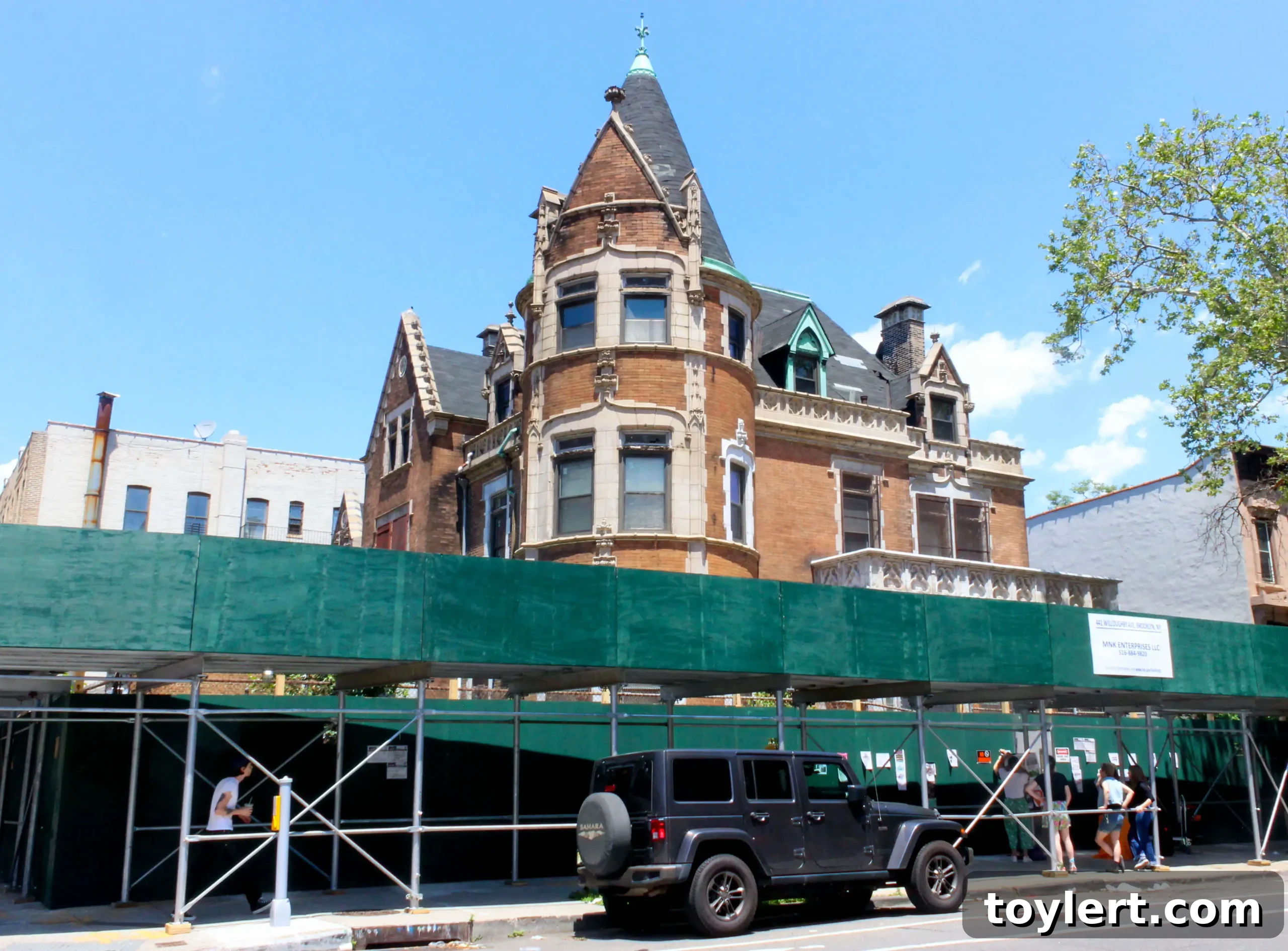
The Battle for Bed-Stuy’s Heritage: The Jacob Dangler Mansion at a Crossroads
The air outside the circa 1897 French Gothic Jacob Dangler mansion was thick with a mixture of frustration, hope, and determination. Standing before the majestic structure at 441 Willoughby Avenue in Bed-Stuy, Brooklyn, locals and politicians gathered on a recent Sunday, united by a singular purpose: to save a piece of their neighborhood’s soul. The two powerful questions that echoed through the crowd perfectly encapsulated the community’s anguish and resolve:
“Why didn’t you come to us first?” directed at the current owner, the United Grand Chapter Order of the Eastern Star.
And, “How much would it take for you to walk away from this building?” posed to Tomer Erlich, the developer poised to acquire and potentially demolish the historic property.
These pointed inquiries were the climax of a heated community meeting, expertly organized by local New York City Council Member Chi Ossé. The gathering served as a crucial platform, allowing the property’s owner and the prospective developer to present their plans to the community, while also affording residents the opportunity to voice their profound concerns and unwavering commitment to preserving the mansion. This pivotal discussion unfolded just days before a critical Landmarks Preservation Commission (LPC) hearing, where the fate of this cherished historic building would begin to be decided.
A Community Rises: Confronting Demolition at 441 Willoughby Avenue
The Sunday meeting was far more than a routine public forum; it was a rallying cry from a community deeply invested in its architectural heritage. The sight of neighbors, activists, and elected officials standing together against the threat of demolition underscored the deep emotional connection many Bed-Stuy residents feel towards the Jacob Dangler mansion. For many, this isn’t merely about bricks and mortar; it’s about the tangible embodiment of their neighborhood’s history, its unique character, and its irreplaceable sense of place.
The Heated Sunday Gathering: A Clash of Visions
The atmosphere at 441 Willoughby Avenue on that Sunday was charged with anticipation. Residents listened intently as representatives from the United Grand Chapter Order of the Eastern Star, the long-standing owners of the mansion, explained their decision to sell the property. While the specifics of their financial motivations weren’t fully detailed, the community’s question, “Why didn’t you come to us first?”, revealed a deep sense of disappointment and a perceived lack of transparency. Many felt that local organizations, preservation groups, or even the community itself, could have offered alternative solutions if given the chance before a developer stepped in. This sentiment highlighted a recurring tension in rapidly developing urban areas: the perceived disconnect between institutional owners and the communities they serve.
Developer Tomer Erlich also addressed the crowd, presenting his vision for the site, which, as anticipated, involved the demolition of the existing mansion to make way for a new residential development. While developers often highlight the need for new housing and economic growth, his proposal was met with skepticism and outright opposition from many who saw the destruction of the Dangler Mansion as an irreparable loss. The question, “How much would it take for you to walk away from this building?”, boldly put forth by a community representative, wasn’t just a rhetorical challenge. It was a testament to the community’s determination, suggesting a willingness to explore all avenues, even financial ones, to prevent the irreversible loss of a local icon.
The Enduring Legacy of the Jacob Dangler Mansion
To understand the depth of the community’s fight, one must appreciate the Jacob Dangler Mansion itself. Erected in 1897, this magnificent structure stands as a prime example of French Gothic architecture, a style rarely seen with such grandeur in Brooklyn. Its ornate details, soaring lines, and imposing presence have made it a distinguished landmark within the diverse architectural landscape of Bed-Stuy, capturing the essence of an opulent bygone era.
Architectural Grandeur and Historical Roots
The mansion was originally commissioned by Jacob Dangler, a prosperous German immigrant who built a fortune in the meatpacking industry. Dangler’s choice of the French Gothic style for his residence was audacious for its time and place, departing from the more common Romanesque Revival or Queen Anne styles prevalent in turn-of-the-century Brooklyn. Characterized by its intricate stonework, pointed arches, steep gables, and often asymmetrical facades, the Dangler Mansion exemplifies the elegance and craftsmanship of late 19th-century design. Its unique architectural fingerprint not only enriches the Willoughby Avenue streetscape but also serves as a living history book, narrating tales of Bed-Stuy’s past prosperity and diverse cultural influences. Preserving such a building is not just about saving an old house; it’s about maintaining a tangible link to the neighborhood’s foundation and the broader architectural history of New York City.
From Private Residence to Community Hub: The Eastern Star’s Stewardship
Over its long history, the Jacob Dangler Mansion transitioned from a private residence to a vital community asset. For decades, it has been home to the United Grand Chapter Order of the Eastern Star, a fraternal organization dedicated to charity, truth, and loving kindness. Under their stewardship, the mansion has served as a meeting place, a center for social gatherings, and a beacon of community service. The organization’s decision to sell, while likely driven by financial pressures or changing operational needs, deeply saddened many locals who valued the mansion’s continued role as a community space. The heartfelt question, “Why didn’t you come to us first?”, truly underscored the community’s belief that a collaborative solution could have been found to ensure the Eastern Star’s financial stability while simultaneously preserving the historic building for future generations.
The Looming Threat: Development Plans and Community Resistance
The confrontation at 441 Willoughby Avenue highlights a ubiquitous challenge facing historic neighborhoods across New York City: the relentless pressure of real estate development. As urban areas grow and demand for housing intensifies, developers often eye larger, older properties for their potential to be replaced by high-density, multi-unit residential buildings. While urban renewal and housing development are critical for a growing city, the cost often comes at the expense of irreplaceable historical structures and the unique character of established communities.
Developer Tomer Erlich’s Proposal
Developer Tomer Erlich’s stated intention is to demolish the Jacob Dangler Mansion and erect a new apartment building in its place. While the specifics of his proposed development were not fully detailed at the meeting, such projects typically aim to maximize usable space, often leading to structures that are out of scale with the surrounding historic streetscape. For Erlich, the property represents an economic opportunity, a chance to contribute to the city’s housing stock and generate profit. From his perspective, the existing building, while historic, might be seen as functionally obsolete or too costly to maintain or adapt for modern residential use. This economic rationale often clashes directly with the intangible values of history, aesthetics, and community identity championed by preservationists.
The Community’s Plea: “Why didn’t you come to us first?”
The poignant question directed at the Eastern Star — “Why didn’t you come to us first?” — encapsulates a deep sense of betrayal and missed opportunity. For many community members, it implied that a dialogue with local groups could have explored alternative solutions long before a demolition threat emerged. Options like adaptive reuse, where the mansion could be repurposed for new functions while retaining its architectural integrity (e.g., a community center, cultural institution, or even unique residential units), were perhaps never fully explored in consultation with those who care most about its fate. This plea underscores the importance of early community engagement and transparency in decisions involving significant local landmarks.
The Challenge to the Developer: “How much would it take for you to walk away?”
The audacious query posed to developer Tomer Erlich — “How much would it take for you to walk away from this building?” — speaks volumes about the community’s fervent desire to save the Dangler Mansion. It’s an attempt to turn the tables, to frame the preservation effort in economic terms that the developer might understand. While it might seem like a long shot, it opens the door to potential solutions such as a community-led acquisition, a preservation easement buyout, or finding a preservation-minded developer who would commit to renovating and adapting the existing structure. This question highlights the profound commitment of local residents and their willingness to consider unconventional approaches in their fight for historic preservation.
The Crucial Role of the Landmarks Preservation Commission
The stage for the next act in the Dangler Mansion drama is the New York City Landmarks Preservation Commission (LPC). The LPC is the city agency responsible for protecting New York City’s architecturally, historically, and culturally significant buildings and sites by granting them landmark status. The upcoming hearing is a critical juncture, as its decision holds the power to either protect the mansion indefinitely or clear the path for its demolition.
Understanding the Landmarking Process
The process of landmark designation is thorough and involves several steps. It typically begins when a community group or individual submits a Request for Evaluation (RFE) to the LPC. If the property meets initial criteria, the LPC “calendars” it for a public hearing. At this hearing, commissioners listen to testimony from property owners, developers, community members, preservation experts, and elected officials. They consider various criteria, including the building’s architectural significance, historical importance, and its role in the cultural development of the city or neighborhood. Following the hearing, the commissioners deliberate and then vote on whether to designate the property as a landmark. If designated, the building becomes subject to LPC review for any proposed exterior alterations, ensuring its historic fabric is protected. The Jacob Dangler Mansion, with its distinctive French Gothic architecture and over a century of history, clearly presents a strong case for landmark status.
The Impending Hearing: A Decisive Moment
The upcoming LPC hearing is arguably the most critical moment for the Jacob Dangler Mansion. Community leaders and preservation advocates will present a compelling case for the building’s architectural and historical merits, hoping to convince the commissioners that its loss would be an irreversible blow to Bed-Stuy’s heritage. Expert testimonies regarding the mansion’s unique design and its contribution to the neighborhood’s character will be crucial. Simultaneously, the owner and developer will present their arguments against landmarking, likely focusing on property rights, economic viability, and the potential for new development to address housing needs. The outcome of this hearing will determine whether this magnificent 19th-century edifice will stand as a preserved testament to Brooklyn’s past or become another casualty of urban redevelopment.
Bed-Stuy’s Identity: Preservation vs. Progress
The struggle over the Jacob Dangler Mansion is emblematic of a larger narrative unfolding across Bed-Stuy and other historic Brooklyn neighborhoods. As these areas experience rapid growth and gentrification, the delicate balance between progress and preservation becomes increasingly challenging. Developers see untapped potential in older, larger lots, while long-time residents and preservationists fight to retain the very character that makes these neighborhoods desirable.
The Economic and Cultural Value of Historic Architecture
Beyond aesthetic appeal, historic buildings like the Dangler Mansion contribute significantly to a neighborhood’s economic and cultural vitality. They attract tourism, support local businesses, and often increase surrounding property values. More importantly, they foster a strong sense of community identity and continuity. A neighborhood’s historic architecture tells its story, connects generations, and provides a unique backdrop that cannot be replicated by new construction. Preserving these structures through adaptive reuse can also be a sustainable approach to urban development, reducing waste and minimizing the environmental impact associated with new building materials and construction. The Dangler Mansion represents an opportunity for Bed-Stuy to champion sustainable urban planning that respects its past while thoughtfully planning for its future.
What Lies Ahead for the Jacob Dangler Mansion?
The fate of the Jacob Dangler Mansion hangs in the balance, resting largely on the decision of the Landmarks Preservation Commission. If the LPC votes to designate the mansion as a landmark, it will gain crucial protections against demolition and unsympathetic alterations, ensuring its survival for generations to come. This would be a monumental victory for community activists, Council Member Chi Ossé, and all who believe in the power of preservation.
A Call for Sustainable Urban Development
Should the mansion be landmarked, the challenge would then shift to finding a viable, long-term plan for its adaptive reuse. This could involve exploring partnerships with non-profit organizations, cultural institutions, or even a preservation-minded developer committed to restoring the building and giving it a new purpose that benefits the community. If, however, the LPC declines to landmark the property, the path to demolition would become significantly clearer, paving the way for developer Tomer Erlich’s proposed apartment complex. Even in that scenario, community advocacy would likely continue, exploring legal challenges or seeking alternative funding to acquire the property.
Regardless of the immediate outcome, the passionate fight for the Jacob Dangler Mansion has illuminated the vital importance of community engagement in urban planning and preservation efforts. It serves as a powerful reminder that a city’s growth should not come at the expense of its irreplaceable heritage. The questions asked on Willoughby Avenue—”Why didn’t you come to us first?” and “How much would it take for you to walk away from this building?”—will continue to resonate, symbolizing the ongoing struggle to protect the soul of Bed-Stuy and other historic neighborhoods from the relentless march of development.