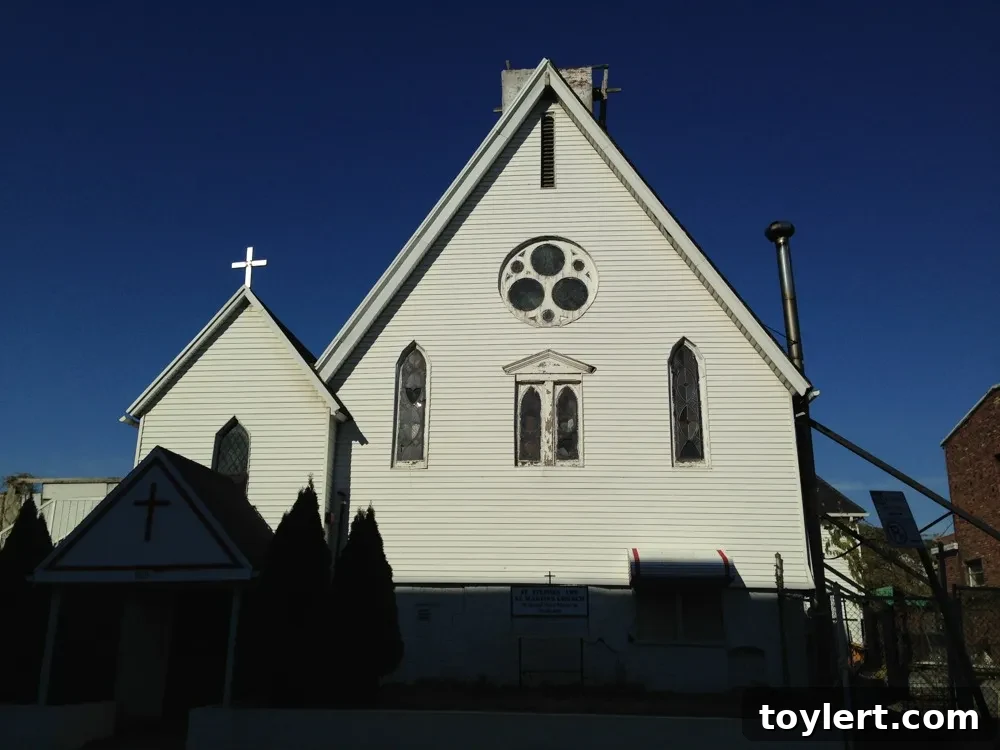
A Vanishing Legacy: Bed Stuy’s Pre-Civil War Carpenter Gothic Church Faces Demolition
Brooklyn, a borough renowned for its rich history and vibrant architectural tapestry, is once again at a crossroads where progress clashes with preservation. The relentless construction boom, a defining characteristic of New York City’s recent decades, has unfortunately set its sights on one of Bed Stuy’s most historically significant and architecturally unique structures: the pre-Civil War-era Carpenter Gothic (or New England Gothic) wood frame church located at 809 Jefferson Avenue. This venerable building, which makes an appearance on an 1854 map and is believed to date back as far as the 1840s, stands as one of the oldest surviving structures within the Bedford-Stuyvesant neighborhood, a silent testament to a bygone era.
The Echoes of a Bygone Era: A Glimpse into Bed Stuy’s Past
The area surrounding 809 Jefferson Avenue, situated in the northeast quadrant of Bed Stuy, retains a unique, almost anachronistic charm. For generations, it has been characterized by a quietude, a sleepy and somewhat sparse landscape dotted with occasional mid-19th-century wood frame buildings that whisper tales of early Brooklyn. This distinct character stands in stark contrast to the rapidly evolving urban fabric seen elsewhere in the borough. The church itself, with its distinctive architectural style, offers a tangible link to a period when Brooklyn was still transitioning from a collection of independent towns into a bustling urban center, long before the Civil War reshaped the American landscape.
Its origins in the 1840s or 1850s place it squarely in an foundational period for what would become modern Brooklyn. During this era, neighborhoods like Bed Stuy were beginning to develop beyond their agricultural roots, with new communities and institutions forming. A church from this period wasn’t merely a building; it was often the heart of a nascent community, a focal point for social gatherings, spiritual guidance, and the forging of local identity. Its very existence today is a miracle of survival, having withstood over a century and a half of urban development, economic shifts, and the relentless march of time.
Architectural Rarity: The Carpenter Gothic Style in Brooklyn
The architectural designation of Carpenter Gothic, sometimes referred to as New England Gothic, is particularly significant. This style, an American interpretation of the more elaborate stone Gothic Revival, utilized wood and the skills of local carpenters to mimic the pointed arches, steep gables, and decorative tracery typically found in masonry cathedrals. It embodies a uniquely American ingenuity, making grand architectural statements accessible through more modest materials and craftsmanship. Features often include board-and-batten siding, intricately cut bargeboards along eaves, and pointed-arch windows and doors. In a city increasingly dominated by brick, stone, and now glass, a wood frame structure of this age and style is a remarkable and rare find, especially one that has maintained its integrity for so long.
While Carpenter Gothic churches are cherished in rural New England and parts of the American South, their presence in an dense urban environment like Brooklyn, and particularly in a historically working-class neighborhood like Bed Stuy, is exceptionally uncommon. This rarity underscores its immense historical and architectural value. It represents a specific aesthetic and construction methodology that largely predates the widespread industrialization of building materials and techniques. The craftsmanship required to create its intricate details speaks volumes about the artisans of the era and the community’s dedication to beauty and permanence.
The Inevitable March of Progress: A Neighborhood Under Siege
The quiet and historic character of the area around Jefferson Avenue is precisely what now makes it vulnerable. Unlike many other historically rich enclaves in Brooklyn, this specific section of Bed-Stuy has not been designated as a landmarked district. This lack of protective status leaves individual historic buildings like the Carpenter Gothic church exposed to the whims of the market and the unyielding pressures of real estate development. Without the legal safeguards that landmarking provides, developers are free to acquire, demolish, and rebuild, often with little regard for the existing architectural heritage or the community’s desire to preserve its past.
The prediction is stark and unsettling: it wouldn’t be surprising if, within the next decade, this currently “sleepy and bare” stretch transforms utterly, giving way to “Williamsburg-style glassy mid-rise apartment buildings.” This phrase encapsulates a specific type of rapid gentrification and architectural homogenization that has swept through parts of Brooklyn. It signifies a shift from unique, historically resonant structures to generic, often uninspired modern developments that prioritize density and profit over historical context and neighborhood character. The visual and cultural landscape of areas undergoing such transformations changes irrevocably, often erasing the visual cues that tell the story of a place.
The Price of Progress: What Is Lost When History Falls?
The demolition of a structure like the church at 809 Jefferson Avenue is more than just the removal of an old building; it represents a profound loss on multiple levels. Architecturally, it means the eradication of a rare and beautiful example of a distinctive American style, depriving future generations of the opportunity to appreciate the craftsmanship and design sensibilities of the mid-19th century. Historically, it severs a tangible link to Bed Stuy’s pre-Civil War past, diminishing the collective memory of the neighborhood and erasing a critical piece of its narrative. Each such demolition chips away at the unique character of Brooklyn, contributing to a growing sense of sameness across urban landscapes.
Furthermore, these developments often have significant social implications. The construction of new, high-density apartment buildings typically caters to a higher-income demographic, leading to increased rents and property values. This, in turn, can displace long-term residents and businesses, fundamentally altering the social fabric of the community. The cultural heritage, the stories embedded within the old buildings, and the sense of identity that defines a neighborhood are all at risk. The “construction boom,” while often hailed as a sign of economic vitality, carries a heavy price when it comes at the expense of irreplaceable historical assets.
A Call for Awareness: Balancing Growth with Preservation
The fate of the Carpenter Gothic church on Jefferson Avenue serves as a poignant reminder of the ongoing challenges in urban preservation. It highlights the urgent need for a more proactive approach to identifying and protecting historically significant sites before they fall prey to development pressures. While growth and modernization are inevitable aspects of urban evolution, they should not necessitate the wholesale erasure of the past. Sustainable urban development demands a delicate balance – one that respects the architectural heritage and cultural identity of a community while accommodating its future needs.
As Brooklyn continues its rapid transformation, the story of 809 Jefferson Avenue becomes a crucial cautionary tale. It prompts us to reflect on what we value as a society: the transient benefits of new construction, or the enduring legacy of our historical and architectural treasures? The quiet disappearance of such an old and distinct building would not just be a loss for Bed Stuy, but for the collective memory and unique identity of Brooklyn itself. It underscores the importance of public awareness, community advocacy, and robust preservation policies to ensure that the borough’s rich tapestry of history is not unraveled brick by brick, or in this case, plank by plank, leaving behind a homogenized landscape devoid of its soulful past.