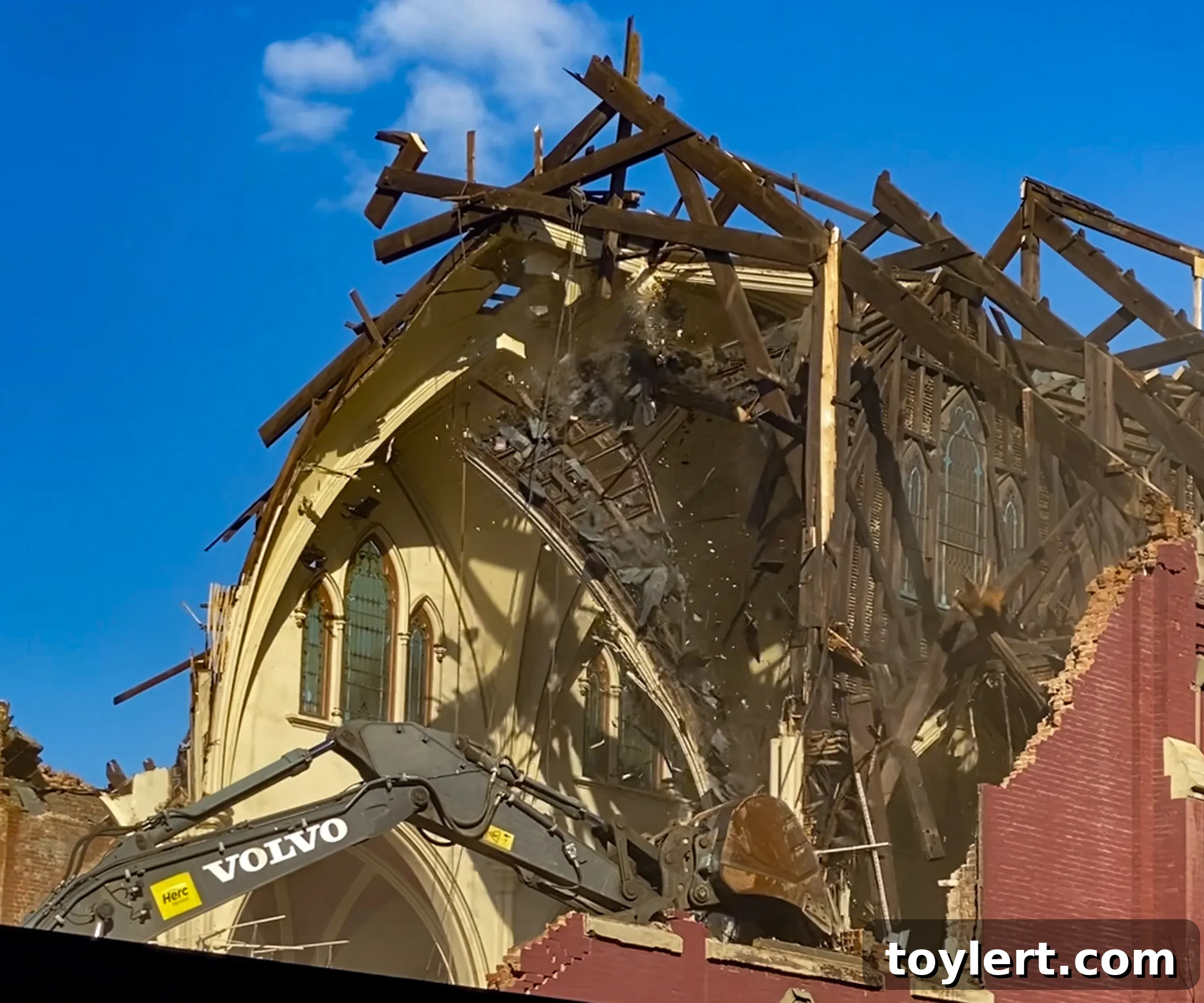
The Demolition of St. Lucy-St. Patrick Church: A Vanishing Landmark in Bed-Stuy’s Evolving Landscape
A cloud of dust rose above Willoughby Avenue in Bed-Stuy this past Monday, signaling the irreversible erasure of a historic fixture that had graced the Brooklyn neighborhood since 1856. The St. Lucy-St. Patrick Roman Catholic Church, an architectural marvel and a spiritual anchor for generations, met the wrecking ball, succumbing to the relentless march of urban development. Its demolition, undertaken over recent days, makes way for a new chapter in the area’s ever-changing narrative: modern housing.
The iconic red-brick Gothic Revival church edifice, located at 920 Kent Avenue (also known as 295 Willoughby Avenue), along with a charming attached three-story structure combining Second Empire and Italianate architectural styles with its distinctive mansard roof, were the specific targets of this recent demolition. This event marks a continuation of a disconcerting trend, joining a growing list of religious institutions along this historic thoroughfare that have faced similar fates. Amidst the debris and the profound sense of loss, one piece of the church’s historical footprint was spared: its four-story Second Empire/Italianate rectory, also featuring a mansard roof, situated at 285 Willoughby Avenue, on the corner of Taaffe Place. Its reprieve offers a glimmer of the past amidst an otherwise stark transformation.
A Storied Past: St. Lucy-St. Patrick Church’s Enduring Legacy in Bed-Stuy
For over 160 years, the St. Lucy-St. Patrick Roman Catholic Church stood as an unwavering symbol of faith, community, and architectural splendor in Bed-Stuy. Erected in 1856, during a period of rapid growth and demographic shifts in Brooklyn, the church quickly became more than just a place of worship. It served as a focal point for successive waves of immigrant communities, from Irish and Italian families to later Caribbean and African American residents, providing spiritual guidance, social support, and a sense of belonging in a bustling borough.
Its striking Gothic Revival architecture, characterized by pointed arches, ribbed vaults, and ornate details, was a testament to the craftsmanship of its era. This style, popular in the mid-19th century, aimed to rekindle the majesty and spiritual reverence associated with medieval European cathedrals. The church’s red-brick facade and intricate detailing contributed significantly to the historic character of Willoughby Avenue, offering a visual connection to Bed-Stuy’s rich past. The attached structure, with its Second Empire and Italianate influences and a prominent mansard roof, spoke to the evolving architectural tastes of the time, blending grandeur with residential elegance. Together, these buildings formed a cohesive complex that spoke volumes about the neighborhood’s history and development.
The Wrecking Ball’s Verdict: Details of the Recent Demolition
While reports of a contract agreement in July hinted at the impending fate of the church, the visual reality of its demolition still sent shockwaves through the community. Williamsburg-based developer Watermark Capital Group had entered into a contract to acquire the two sites, specifically the parcels housing the main church building and the attached Second Empire/Italianate structure. The demolition, though anticipated by some familiar with the real estate market trends in Brooklyn, nonetheless prompted strong reactions from passersby, who expressed surprise and dismay as the venerable structure was systematically dismantled.
The decision to demolish these structures underscores the intense development pressures gripping Bed-Stuy and other rapidly gentrifying Brooklyn neighborhoods. The land, once home to a spiritual institution, is now destined to accommodate new residential units, aiming to capitalize on the soaring demand for housing in the borough. The contrast between the church’s long-standing historical presence and its swift removal highlights the tension between preserving architectural heritage and facilitating urban growth. The specific addresses, 920 Kent Avenue and 295 Willoughby Avenue, will soon be known not for their historical church but for the modern residential complex that will take its place.
Watermark Capital Group’s Vision: Reshaping the Bed-Stuy Landscape
The acquisition and subsequent demolition by Watermark Capital Group represent a significant investment in the future of this particular Bed-Stuy block. While specific details of the proposed housing development have yet to be fully disclosed, the common trajectory for such prime locations in Brooklyn often involves multi-unit residential buildings, ranging from market-rate apartments to luxury condominiums. The developer’s focus on “making way for housing” aligns with the broader push to address housing demands in New York City, but it invariably comes at the cost of existing, historically significant structures.
Such projects promise new residents, increased foot traffic, and a potential boost to the local economy through new retail spaces on the ground floor. However, they also raise critical questions about affordability, displacement, and the preservation of neighborhood character. The introduction of large-scale modern housing developments can dramatically alter the aesthetic and social fabric of an area, transforming once quiet, historically rich streets into dense, contemporary urban corridors. For many long-time residents and preservationists, this transformation often feels like a loss, as the unique identity of Bed-Stuy begins to homogenize with other rapidly developing parts of the city.
Beyond Shock: Community Voices and the Wave of Demolitions
The sight of the St. Lucy-St. Patrick Church being reduced to rubble was, for many, deeply unsettling. The immediate “shock” among passersby speaks to a deeper emotional connection that communities often have with their historic buildings. Churches, in particular, are not just structures; they are repositories of memories, milestones, and communal identity. For generations, these walls witnessed baptisms, weddings, funerals, and countless weekly services, forming the backdrop of personal and collective histories.
This demolition is far from an isolated incident. Indeed, the article notes it as “the latest in a string of demolitions of religious buildings along the thoroughfare.” This broader trend reflects a complex interplay of factors: declining congregational numbers, escalating maintenance costs for aging structures, the lack of robust landmark protections for many religious sites, and, crucially, the skyrocketing value of real estate in desirable Brooklyn neighborhoods. As congregations shrink and budgets tighten, the immense value of their land often becomes an irresistible asset for developers, leading to difficult decisions for religious organizations. The impact of this trend is multifaceted: it erases architectural heritage, dismantles community gathering places, and further fuels the gentrification that is rapidly reshaping Bed-Stuy.
Preservation vs. Progress: The Unprotected Legacy of Bed-Stuy Churches
The fate of St. Lucy-St. Patrick Church brings into sharp focus the ongoing battle between preservation efforts and the pressures of urban development in New York City. Unlike many historically significant buildings that are protected by landmark status, a considerable number of religious properties, including this church, often remain undesignated. This lack of protection leaves them vulnerable to sale and subsequent demolition, especially when the property owner, in this case, the church itself or the diocese, opts to sell to a developer.
The process of landmarking is often complex and can be contentious, particularly when it involves private religious institutions. While preservation groups advocate for the architectural and historical significance of these sites, religious organizations sometimes argue for autonomy over their property and the right to make decisions that best serve their current needs, which may include selling valuable assets to fund other ministries or consolidate operations. The absence of a robust, proactive landmarking strategy for such sites in areas undergoing rapid change means that developers can acquire and demolish them with relative ease, changing the very fabric of the city block by block. The demolition of St. Lucy-St. Patrick serves as a stark reminder of these challenges and the constant vigilance required to protect Brooklyn’s invaluable architectural heritage.
The Future of Bed-Stuy: Balancing Growth and Heritage
As the dust settles on the site of the former St. Lucy-St. Patrick Church, Bed-Stuy faces a critical juncture. The neighborhood, renowned for its stately brownstones, tree-lined streets, and vibrant cultural history, is experiencing unprecedented growth and transformation. While new housing and commercial developments bring investment and new residents, they also pose a significant threat to the area’s distinct identity. The loss of a landmark like St. Lucy-St. Patrick Church is not merely the removal of an old building; it represents the erosion of a tangible link to the past, a piece of the neighborhood’s soul.
The balance between embracing necessary urban progress and safeguarding historical integrity is a delicate one. Community leaders, urban planners, and residents must collectively confront how to accommodate growth without sacrificing the unique character that makes Bed-Stuy so appealing. This involves exploring creative solutions for adaptive reuse of existing structures, implementing more stringent landmarking policies, and fostering open dialogue between developers, residents, and preservationists. The memory of St. Lucy-St. Patrick Church, though physically gone, should serve as a powerful reminder of what is at stake and inspire a renewed commitment to thoughtfully shaping Bed-Stuy’s future while honoring its extraordinary past.
A Farewell to a Landmark: Reflecting on Bed-Stuy’s Changing Horizon
The demolition of the St. Lucy-St. Patrick Roman Catholic Church marks the end of an era for Willoughby Avenue and Bed-Stuy. What once stood as a testament to 19th-century architecture and a spiritual home for generations is now an empty lot, soon to be filled by the structures of the 21st century. While the economic forces driving such changes are undeniable, the cultural and historical cost is immeasurable.
The event serves as a poignant illustration of the rapid transformation occurring across Brooklyn, where cherished landmarks are increasingly vulnerable to the pressures of real estate development. As Bed-Stuy continues to evolve, the memory of St. Lucy-St. Patrick Church will undoubtedly linger, a reminder of the delicate balance between progress and preservation, and the continuous effort required to maintain the unique character and rich history of one of New York City’s most iconic neighborhoods.