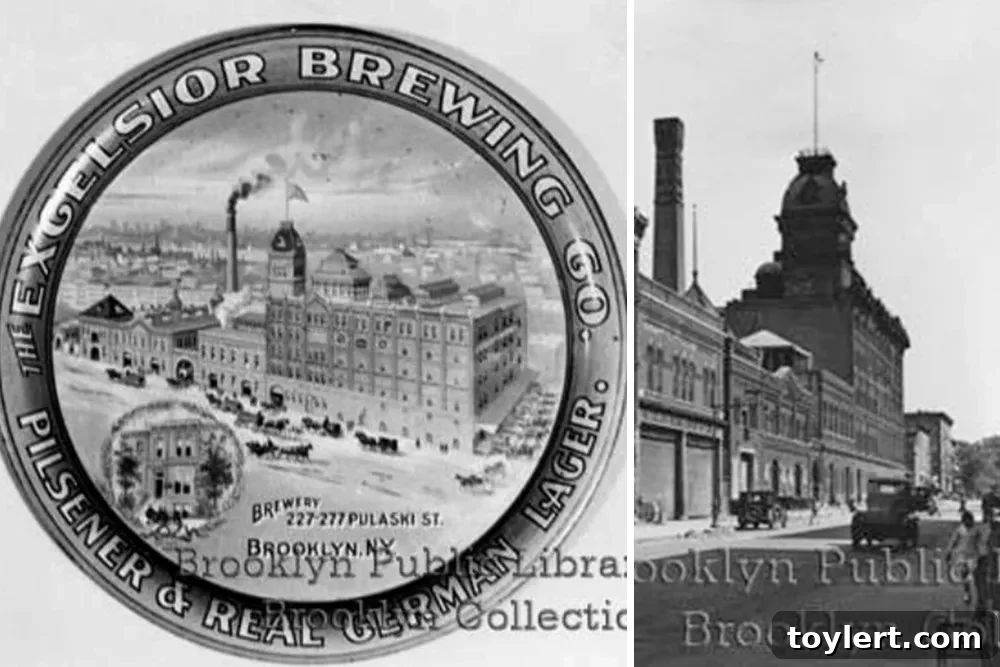
The Excelsior Brewing Company: Bed Stuy’s Audacious Stand Against Prohibition
Nestled within the vibrant landscape of Bed Stuy, Brooklyn, the Excelsior Brewing Company stands as a compelling, albeit less heralded, chapter in the rich tapestry of American brewing history. While it may not have rivaled the sheer scale or widespread fame of Brooklyn’s most colossal breweries, Excelsior carved out its unique niche, particularly through its remarkably audacious and ultimately ill-fated attempts to navigate the stringent era of Prohibition. Its story is a fascinating blend of entrepreneurial spirit, desperate measures, and the harsh realities of a nation grappling with a controversial alcohol ban.
Before the shadows of Prohibition loomed large, Brooklyn reigned supreme as the undisputed brewery capital of the United States. In its early 20th-century heyday, the borough boasted an astonishing concentration of over 50 breweries, a veritable empire of beer production. Half of these brewing powerhouses were densely packed into the bustling neighborhood of Bushwick alone, transforming it into a sensory spectacle of malty aromas and clinking bottles. However, as Bushwick reached its saturation point, offering limited space for expansion, many ambitious breweries, including the Excelsior Brewing Company, began to seek new horizons in more expansive and developing neighborhoods like Bed Stuy.
Brooklyn’s Brewing Golden Age: A Metropolis of Malt and Hops
The turn of the 20th century marked an extraordinary period for Brooklyn, solidifying its reputation as the global epicenter of beer brewing. This remarkable boom was fueled by a convergence of factors, most notably the massive influx of German immigrants who brought with them not only centuries-old brewing traditions but also a fervent demand for their beloved lagers. Brooklyn’s strategic location, with its abundant access to fresh water from aquifers and a sophisticated transportation network of waterways and railroads, provided the perfect infrastructure for large-scale production and efficient distribution. Breweries like Trommer’s, Schaefer, Piel’s, and Rheingold became household names, their products a staple in homes and taverns across the city and beyond. The sheer volume of beer produced was staggering, transforming Brooklyn’s industrial landscape and contributing significantly to its economic prosperity.
As competition intensified and land became scarcer in Bushwick’s brewing heartland, the need for larger facilities and access to new markets spurred a decentralization trend. Breweries began to look outward, identifying burgeoning neighborhoods with ample space for expansion and a growing working-class population eager for local brews. Bed Stuy, with its rapidly developing residential areas and convenient access to the elevated train lines, presented an ideal opportunity for companies like Excelsior to establish a strong presence, serving a burgeoning community while still tapping into Brooklyn’s broader beer-loving demographic.
The Excelsior Brewing Company: Crafting Community and Lager in Bed Stuy
While specific foundational details about Excelsior Brewing Company are somewhat obscured by time, its establishment in Bed Stuy reflected a strategic move to capitalize on the neighborhood’s growth. Unlike some of the industrial giants, Excelsior likely started as a more community-focused brewery, producing a range of popular beers tailored to local tastes. Lager was unequivocally the city’s brew of choice, a crisp, refreshing, and widely accessible beer that perfectly suited the palates of Brooklyn’s diverse population. Excelsior would have specialized in this style, alongside other common ales and seasonal offerings, building a loyal customer base among Bed Stuy residents and nearby communities. Its brick facades and bustling delivery wagons would have been a familiar sight, a symbol of local industry and the vibrant social life that revolved around the neighborhood’s taverns and gathering places.
The pre-Prohibition era was a time of robust competition and innovation within the brewing industry. Breweries not only focused on product quality but also on community engagement, often sponsoring local events, sports teams, and social clubs. Excelsior, though perhaps not the largest, was undoubtedly an integral part of Bed Stuy’s commercial and social fabric, providing employment, contributing to the local economy, and playing a vital role in the daily lives of its patrons. This deep integration into the community would later inform the desperate measures it took to survive the impending dry spell.
The Unforeseen Crisis: Prohibition’s Stranglehold on American Brewing
The passage of the Volstead Act in 1919, which enacted the 18th Amendment and prohibited the manufacture, sale, and transportation of alcoholic beverages, sent shockwaves through the entire American brewing industry. Overnight, an industry that had thrived for centuries found itself staring down the barrel of extinction. Brooklyn’s bustling breweries, once symbols of economic might, faced an existential crisis. Many were forced to shutter their doors permanently, laying off thousands of workers and dismantling intricate production lines. Others attempted to pivot, producing “near beer” (with an alcohol content below 0.5%), malt syrup for home use (often winkingly understood as a key ingredient for illegal home brewing), or even venturing into entirely unrelated industries like soft drinks, ice cream, or industrial alcohol production.
This period of national prohibition, lasting from 1920 to 1933, fostered an environment of both desperation and ingenious, often illegal, innovation. The demand for alcohol didn’t disappear; it simply went underground, creating a lucrative black market. This illicit economy gave rise to speakeasies, bootleggers, and a shadowy network of clandestine producers. For many breweries with existing infrastructure and skilled personnel, the temptation to continue brewing illegally, even at great risk, became overwhelming. The financial pressures were immense, and the thought of abandoning decades of tradition and investment spurred some to adopt increasingly elaborate and dangerous schemes to keep their operations alive.
Excelsior’s “Strange Scheme”: A Gamble in the Shadows
It was within this context of widespread defiance and covert operations that the Excelsior Brewing Company devised one of the strangest schemes to survive Prohibition. While the specifics of their plan are shrouded in the clandestine nature of the era, such “strange schemes” typically involved sophisticated methods of illicit brewing and distribution. This could have ranged from manufacturing highly concentrated malt extract that could be easily fermented into illegal beer by consumers, to operating a fully functional, albeit hidden, brewing operation. Some breweries would use secret tunnels, false walls, or disguised deliveries, often bribing local officials or even federal agents to look the other way.
Excelsior’s scheme, whatever its exact nature, was undoubtedly born out of a desperate desire to protect its business, its employees, and its legacy in Bed Stuy. They likely maintained the facade of producing “legal” non-alcoholic products while secretly channeling their true output into the burgeoning underground market. This required intricate logistics, a network of trusted individuals, and a constant cat-and-mouse game with law enforcement. The brewery’s history, embedded within a community that valued its product, might have provided a layer of local protection or complicity, but the federal authorities were relentless in their pursuit of major operations.
The Inevitable Fall: Excelsior Gets Caught
Unfortunately for Excelsior, their elaborate plan, however ingenious, did not escape the vigilant eyes of Prohibition enforcement. The text simply states, “Unfortunately, Excelsior got caught.” This stark sentence encapsulates the harsh reality faced by many breweries that dared to defy federal law. Getting caught often meant swift and severe consequences: federal raids, the confiscation of brewing equipment and product, hefty fines, and the arrest of key personnel, including owners and master brewers. The ensuing legal battles were costly and often futile, leading to further financial ruin and indelible damage to the company’s reputation.
The capture of Excelsior served as a powerful reminder of the risks involved in operating illicitly. Whether through an informant, a meticulous investigation by agents, or a simple mistake in their elaborate cover, the brewery’s secret activities were exposed. This event would have sent ripples through the Bed Stuy community, marking the definitive end of an era for the local institution and signaling the complete collapse of its audacious bid for survival. Its demise contributed to the broader narrative of Brooklyn’s once-thriving brewing industry being systematically dismantled by the force of law.
Beyond Prohibition: The Echoes of Excelsior’s Legacy
The repeal of Prohibition in 1933 brought a wave of relief and hope, but for many breweries like Excelsior, the damage was irreversible. The years of dormancy, the dismantling of infrastructure, and the loss of market share made restarting operations an insurmountable challenge. Many of the pre-Prohibition giants either never reopened or struggled to regain their former glory. The physical sites of these once-bustling operations often found new lives as warehouses, factories for other goods, or were eventually demolished to make way for new developments.
While the Excelsior Brewing Company never truly recovered to its former prominence, its story remains a poignant reminder of Brooklyn’s rich industrial heritage and the enduring human spirit of enterprise. Its efforts to navigate Prohibition, however ill-fated, speak to the deep cultural significance of beer in American society and the lengths to which businesses would go to preserve their craft. Today, as Brooklyn experiences a remarkable resurgence in craft brewing, with microbreweries and taprooms blossoming across neighborhoods, stories like Excelsior’s take on renewed importance.
Modern brewers in Bed Stuy and across Brooklyn are not merely creating new beers; they are unconsciously (or consciously) echoing the traditions and challenges faced by their predecessors. They are building upon a foundation laid by companies like Excelsior, whose struggles and triumphs shaped the very identity of a borough deeply intertwined with beer. The legacy of Excelsior, though perhaps not celebrated in grand monuments, lives on in the collective memory of Brooklyn’s past, a testament to the cycles of boom, bust, and eventual rebirth that define its vibrant history.
Conclusion: Excelsior, a Microcosm of Brooklyn’s Brewing Journey
The tale of the Excelsior Brewing Company is more than just a footnote in history; it is a microcosm of Brooklyn’s expansive and often tumultuous brewing journey. From the unparalleled peak of early 20th-century production, through the desperate gambles of the Prohibition era, to the eventual quiet fade into memory, Excelsior embodies the spirit of an industry that defined a borough. Its location in Bed Stuy, its commitment to lager, and its daring attempt to defy the dry laws paint a vivid picture of a time when beer was not just a beverage, but a cornerstone of community, economy, and culture.
Understanding the Excelsior Brewing Company’s place in history helps us appreciate the resilience and innovation that characterized Brooklyn’s industrial past. Its strange scheme to survive Prohibition, though it led to its downfall, highlights the profound impact of national policies on local businesses and the lengths to which human ingenuity can stretch under duress. Today, as Bed Stuy continues to evolve, the ghost of Excelsior Brewing Company serves as a quiet reminder of the rich layers of history beneath its bustling streets, a testament to a time when malt and hops flowed freely, and even in defiance, contributed to the legendary narrative of Brooklyn beer.