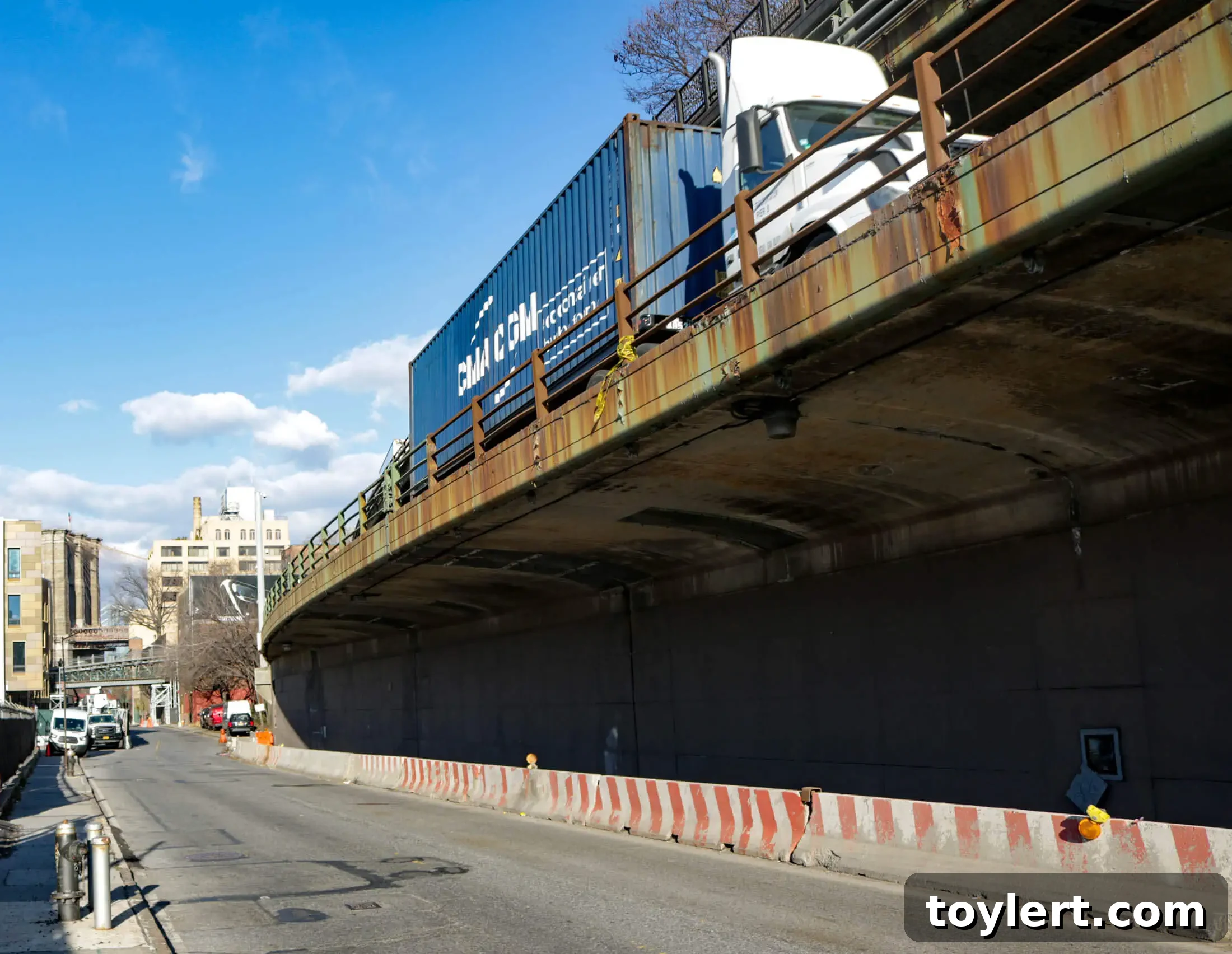
New York City Embraces Smart Technology to Protect the Brooklyn-Queens Expressway from Overweight Trucks
New York City’s Department of Transportation (DOT) is set to deploy advanced weigh-in-motion (WIM) sensor technology on the structurally critical Brooklyn-Queens Expressway (BQE) by the end of this year. This proactive measure aims to detect and penalize illegally overweight trucks, a significant contributor to the expressway’s accelerating decay, particularly its iconic and fragile triple-cantilever section.
The initiative follows the signing of a pivotal state legislative bill by Governor Kathy Hochul on December 22, launching a pilot program for this innovative WIM system. While the legislative framework is now in place, DOT spokesperson Vincent Barone confirmed to amNewYork Metro that the operational implementation of these crucial sensors is targeted for completion before the close of the current year. This move marks a significant step in the city’s ongoing efforts to preserve its vital infrastructure.
“We are actively working to commence our weight-in-motion pilot on the Brooklyn-Queens Expressway as swiftly as possible,” stated Barone. He underscored the profound importance of this undertaking, adding, “This critical project is essential for safeguarding the BQE’s distinctive triple cantilever and simultaneously advancing our broader objectives for cultivating a more sustainable and efficient freight network across the city.” The urgency behind this project reflects a growing recognition of the BQE’s precarious condition and the immediate need for robust intervention.
The BQE: A Crumbling Icon and Its Critical Triple Cantilever
The Brooklyn-Queens Expressway, often simply referred to as the BQE, stands as one of New York City’s most vital, yet most vulnerable, arteries. Designed by Robert Moses and largely completed in the 1950s and early 1960s, it was an engineering marvel of its time, a testament to post-war urban planning. However, decades of relentless traffic, vastly exceeding its original design specifications, have taken an immense toll on its structural integrity. The expressway, particularly its elevated sections, was not built to withstand the sheer volume and weight of today’s commercial freight traffic.
At the heart of the current crisis is the triple-cantilever section, an extraordinary feat of engineering that snakes along the Brooklyn Heights promenade. This three-tiered structure, with its roadways stacked one above the other, not only carries thousands of vehicles daily but also supports the beloved promenade itself, offering breathtaking views of the Manhattan skyline. Its unique design, clinging precariously to the cliffside, makes it exceptionally complex and costly to repair. Engineers have long warned that this section is in an advanced state of deterioration, with concrete spalling, rebar corrosion, and visible cracking becoming increasingly prevalent. The constant vibration and stress from heavy vehicles exacerbate these issues, pushing the structure closer to a point of no return.
The BQE’s decay is not merely an aesthetic concern; it poses significant risks to public safety and economic stability. As one of the primary conduits for goods entering and exiting New York City, any catastrophic failure or prolonged closure of the expressway would have devastating consequences for regional commerce and daily life. The cost of comprehensive repairs or, indeed, a complete rebuild, is estimated in the billions of dollars, making proactive preservation through innovative solutions like WIM technology an economically prudent and structurally necessary approach.
The Unseen Damage: Overweight Trucks and Infrastructure Decay
While the passage of time and general traffic contribute to infrastructure wear, illegally overweight trucks inflict disproportionately severe damage. These vehicles, exceeding legal weight limits, exert immense stress on bridge decks, roadbeds, and structural components. This excessive load accelerates fatigue in materials, leading to faster cracking, pothole formation, and the breakdown of concrete and asphalt surfaces. Over time, this constant strain can compromise the structural integrity of critical components, significantly shortening the lifespan of expressways and bridges.
The problem is compounded by the sheer volume of commercial traffic utilizing the BQE. Many freight carriers, in an effort to maximize efficiency or cut costs, may overload their trucks, often bypassing traditional weigh stations. Without consistent and effective enforcement, these vehicles act as mobile demolition units, quietly chipping away at the foundation of our infrastructure. The financial burden of repairing this damage falls squarely on taxpayers, translating into billions of dollars in maintenance and rehabilitation costs annually. Beyond the monetary aspect, there’s the critical issue of safety. A compromised bridge or expressway poses an inherent risk to all motorists, raising the specter of structural failure and catastrophic accidents.
Historically, enforcing weight limits has been challenging. Traditional weigh stations require trucks to pull over, which can cause significant traffic disruptions and are often easy for non-compliant drivers to avoid. The sporadic nature of such enforcement has allowed many overweight vehicles to traverse key routes like the BQE unimpeded, silently contributing to its “crumbling” state. This enforcement gap highlighted the urgent need for a more dynamic and less intrusive solution, paving the way for technologies like Weigh-In-Motion systems.
Weigh-In-Motion (WIM) Technology: A Smart Solution for Modern Infrastructure
Weigh-In-Motion (WIM) technology represents a significant leap forward in traffic management and infrastructure preservation. At its core, WIM systems involve specialized sensors embedded directly into the road surface. These sensors are designed to accurately measure the weight of a vehicle, including its axles and gross weight, as it passes over them at normal highway speeds, without requiring the vehicle to stop or even slow down. This non-invasive approach is a game-changer for effective enforcement and data collection.
The operational principle is relatively straightforward: piezoelectric sensors, load cells, or fiber optic sensors detect the pressure exerted by tires as they roll over the system. Advanced algorithms then process this data in real-time, calculating the vehicle’s weight. If a truck is found to be illegally overweight, the system can automatically capture photographic evidence, including license plates, allowing authorities to issue citations efficiently and accurately.
Key Benefits of WIM Technology:
- Real-time Data Collection: WIM systems provide continuous, accurate data on vehicle weights, traffic patterns, and freight composition. This invaluable information can inform long-term infrastructure planning, freight logistics, and maintenance scheduling.
- Efficient Enforcement: By eliminating the need for vehicles to stop, WIM dramatically increases the efficiency of weight enforcement. More violations can be detected and processed with fewer resources, reducing traffic congestion and improving overall flow.
- Deterrent Effect: The known presence of WIM sensors acts as a powerful deterrent. Trucking companies and drivers are more likely to comply with weight regulations when they know their vehicles are being constantly monitored, leading to a reduction in overweight loads.
- Reduced Infrastructure Damage: By identifying and penalizing overweight vehicles, WIM directly contributes to preserving road surfaces and structural components, extending the lifespan of vital infrastructure like the BQE’s triple cantilever.
- Enhanced Public Safety: Healthier infrastructure is safer infrastructure. By mitigating the damage caused by heavy loads, WIM technology helps prevent structural failures and improves overall road safety for all commuters.
- Fair Competition: For trucking companies that adhere to weight limits, WIM technology helps level the playing field by penalizing those who gain an unfair advantage by overloading their vehicles.
The deployment of WIM on the BQE marks a strategic shift towards smart infrastructure solutions, leveraging technology to tackle complex urban challenges more effectively. It represents a proactive investment in the longevity and safety of one of New York City’s most critical transportation assets.
The Legislative Path to Smart Infrastructure
The journey to implementing Weigh-In-Motion technology on the BQE was paved by significant legislative action. A bill introduced in the New York State Legislature specifically designed to launch a pilot program for WIM technology was successfully navigated through the intricate legislative process. This bill gained crucial support from lawmakers who recognized the urgency of protecting the BQE’s deteriorating sections, especially the triple cantilever.
The culmination of these legislative efforts came on December 22, when Governor Kathy Hochul officially signed the bill into law. This gubernatorial approval transformed the concept into a mandated program, providing the necessary legal framework and authorization for the Department of Transportation to proceed with the WIM pilot. Governor Hochul’s endorsement underscored the state’s commitment to modernizing its infrastructure management and addressing the long-standing issues plaguing the BQE.
While the bill has been signed, the “end of the year” timeline provided by DOT spokesperson Vincent Barone indicates the significant logistical and technical work still required for full deployment. A pilot program allows the DOT to test the technology’s effectiveness in a real-world urban environment, fine-tune its operational parameters, and assess its impact before any potential wider implementation. This phased approach is crucial for ensuring the system is robust, accurate, and seamlessly integrated into existing traffic management protocols.
A Sustainable Future for Freight and Urban Mobility
The implementation of WIM technology on the BQE carries implications far beyond simply issuing fines. As Vincent Barone articulated, this project is pivotal not only for “preserving the BQE’s triple cantilever” but also for “advancing our goals for a more sustainable freight network.” This broader vision encompasses several key aspects of urban planning and environmental responsibility.
Fostering a Sustainable Freight Network:
- Optimized Logistics: Real-time data from WIM sensors can provide invaluable insights into freight movement, allowing for better route planning, reduced empty backhauls, and more efficient use of resources. This can lead to decreased fuel consumption and lower operational costs for trucking companies.
- Reduced Environmental Impact: More efficient freight movement translates directly into reduced greenhouse gas emissions and air pollution. By ensuring trucks adhere to weight limits, the overall stress on road infrastructure is lessened, potentially reducing the frequency of road repairs, which are often carbon-intensive activities.
- Enhanced Infrastructure Planning: The rich dataset generated by WIM systems can help urban planners and transportation authorities make more informed decisions about future infrastructure investments. Understanding actual freight loads and patterns can guide the design of new roads, bridges, and maintenance schedules, ensuring that future infrastructure is built to last and meet real-world demands.
- Economic Benefits: A well-maintained and efficiently managed freight network is crucial for the economic vitality of New York City and the wider region. It ensures that goods can move swiftly and reliably, supporting businesses, supply chains, and consumer access to products. Furthermore, reduced damage to infrastructure minimizes costly repairs, freeing up public funds for other essential services.
This initiative represents a forward-thinking approach to urban logistics, recognizing that effective infrastructure management is intertwined with environmental sustainability and economic prosperity. By leveraging smart technology, New York City aims to create a transportation ecosystem that is not only resilient but also responsible and future-proof.
Community Impact and The Road Ahead
The BQE’s state of disrepair has long been a point of contention and concern for the communities it traverses, particularly the residents of Brooklyn Heights, whose homes overlook and are directly adjacent to the triple-cantilever section. For these communities, the issues extend beyond structural integrity to quality of life concerns, including noise pollution, exhaust fumes, and the constant vibration from heavy traffic. The deployment of WIM sensors offers a glimmer of hope that a concerted effort is finally being made to mitigate the negative impacts of the expressway and ensure its long-term viability, thus preserving the cherished Brooklyn Heights Promenade and the tranquility of the neighborhood.
The trucking industry, a critical stakeholder, will also experience the effects of this new enforcement. While responsible carriers who already comply with weight regulations may see little change, those who have historically flouted the rules will face increased scrutiny and penalties. This shift towards stricter enforcement encourages all freight operators to invest in proper load management, vehicle maintenance, and adherence to legal standards, fostering a fairer and safer environment for everyone on the road. It emphasizes that while the movement of goods is essential, it must not come at the cost of vital public infrastructure or safety.
Looking forward, the WIM pilot program on the BQE could serve as a blueprint for other critical infrastructure projects across New York City and beyond. If successful, this technology could be expanded to other expressways, bridges, and tunnels that are similarly burdened by heavy traffic and vulnerable to overweight vehicles. It signals a move towards a more data-driven, technologically advanced approach to urban infrastructure management, ensuring that New York City’s complex network of roads and bridges remains functional, safe, and sustainable for generations to come. This initiative is more than just about catching overweight trucks; it’s about proactively protecting the future of urban mobility and enhancing the quality of life for millions of New Yorkers.