Occupy Wall Street’s Brooklyn Outbursts: From ‘Occuparty’ to Foreclosure Action
The early 2010s were defined by a palpable sense of discontent with economic inequality and corporate influence, culminating in the rise of the Occupy Wall Street (OWS) movement. What began as a protest in Zuccotti Park quickly spread its message and methods across the United States, including deep into New York City’s boroughs. Brooklyn, with its diverse neighborhoods and rapidly evolving urban landscape, became a significant arena for OWS activists to voice their grievances and implement their strategies. A particularly eventful weekend saw two contrasting yet equally powerful demonstrations, showcasing the multifaceted nature of the movement’s engagement: a boisterous “occuparty” in a vacant Williamsburg condo and a more subdued, solidarity-driven action concerning a foreclosed home in East New York. These events not only highlighted the specific issues OWS aimed to address but also underscored the tactical flexibility and challenges faced by the burgeoning movement, offering a vivid glimpse into the heart of urban activism.
The Williamsburg ‘Occuparty’: A Bold Statement Against Corporate Ownership
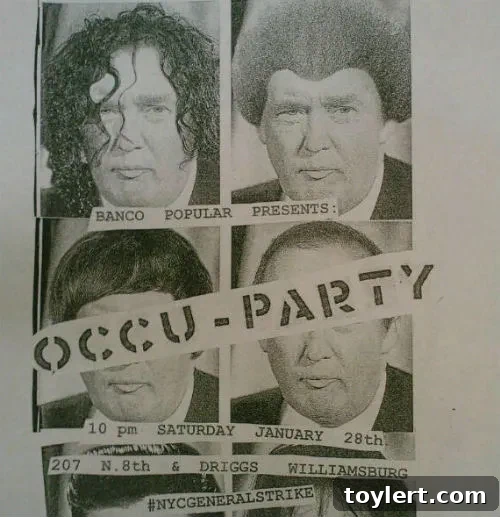
On a memorable Saturday night, the affluent and rapidly gentrifying neighborhood of Williamsburg became the backdrop for an audacious act of protest. Occupy Wall Street organizers orchestrated an event dubbed an “occuparty” at a vacant condo located at North 8th and Driggs streets. This was no mere social gathering; it was a deliberate and symbolic reclamation of space, intended to draw attention to the vast disparities in housing availability and ownership, particularly within a city grappling with both homelessness and an abundance of empty, investor-owned properties. The choice of location was strategic and resonant: a luxury condo, sitting empty for years, reportedly owned by a bank with a controversial portfolio of investments. This act of direct action aimed to shine a spotlight on the systemic issues of corporate greed and neglected assets, while simultaneously offering a momentary communal space for activists.
Behind the Doors: Activism Meets Defiant Celebration
Accounts from various news outlets, including the Daily News, described a scene where dozens of individuals converged, transforming the derelict space into a temporary hub of activism. Participants adorned the interior with festive Christmas lights, creating an ironic contrast with the building’s desolate state and the serious underlying issues. Walls, previously untouched by human habitation, became canvases for protest art and defiant slogans. Messages like “F–k the police” and “Life is Protest” were spray-painted, articulating the raw anti-establishment sentiment that fueled much of the OWS movement. Despite the provocative nature of the slogans, reports suggested a degree of organized defiance; attendees even managed to keep beer on ice, indicating a blend of celebratory energy with their confrontational message. This fusion of festivity and protest underscored the movement’s unique cultural footprint, challenging traditional notions of how social change is pursued.
The Symbolic Target: A Bank’s Controversial Holdings
The significance of the chosen property extended far beyond its vacant status. As Brokelyn published in advance of the event, organizers highlighted that the condo had “lain vacant for years now, and is owned by a bank known to invest in bio-, chemical, and nuclear weapons, as well as cluster bombs used specifically by Qaddafi against the 2011 insurgency.” This accusation served to broaden the protest’s scope, linking the local issue of empty housing to global geopolitical concerns and the financial institutions that profit from them. It encapsulated a core OWS principle: holding powerful banks accountable not just for economic crashes and the housing crisis, but for their broader ethical implications in international conflicts. The “occuparty” was, therefore, a direct challenge to the perceived moral bankruptcy of corporate finance, using direct action to expose its alleged complicity in both distant wars and immediate urban blight. It was a powerful statement about the interconnectedness of seemingly disparate global and local injustices.
Police Intervention and Aftermath: A Clash of Ideologies
Unsurprisingly, the spirited protest eventually drew the attention of law enforcement. The gathering was ultimately broken up by police, leading to a confrontational scene that quickly escalated. While the main party was dispersing, some protesters reportedly blocked traffic a few blocks away, creating further disruption and drawing more police presence. This secondary confrontation resulted in arrests, with the official count varying slightly across reports. The New York Times City Room blog reported four arrests, while other sources cited slightly different figures. More concerning were the reports of injuries: six officers were reportedly injured during the melee, a detail that quickly became a focal point for critics of the movement, highlighting the risks and potential for disorder inherent in direct action protests. This incident became a stark illustration of the tension between civil disobedience and law enforcement, a recurring theme throughout the Occupy movement’s history, further fueling public debate on the legitimacy and tactics of both sides.
East New York: A Different Approach to Housing Justice
Concurrently, on the same bustling weekend, another chapter of Occupy Wall Street’s engagement with housing issues unfolded in East New York, a neighborhood facing its own set of socio-economic challenges, particularly concerning foreclosures. Unlike the confrontational spectacle in Williamsburg, the events in East New York represented a more direct, supportive, and arguably less volatile form of activism, focusing on aiding individuals directly impacted by the housing crisis. This divergence in tactics demonstrated the movement’s flexibility and its capacity to respond to different manifestations of economic injustice with tailored strategies.
Occupying for Solidarity: A Home Under Threat
In East New York, OWS activists had previously taken over a house that was under severe foreclosure pressure. This action was part of a broader “Occupy Our Homes” initiative, a nationwide effort where activists would move into homes that were either abandoned due to foreclosure or were on the brink of being lost by their original owners. The primary goal was not to claim permanent residence but to prevent evictions, draw public attention to the devastating impact of the subprime mortgage crisis, and advocate for homeowners’ rights against predatory lending practices and unresponsive financial institutions. For the families involved, the presence of OWS offered a temporary reprieve and a powerful public statement against their impending displacement. These actions often involved negotiation with banks and authorities, aiming for a resolution that allowed families to remain in their homes or secure more favorable terms, showcasing a compassionate and pragmatic side of the movement.
A Peaceful Resolution: Returning the Keys
The New York Post reported that the occupiers in East New York were in the process of moving out, returning the property to its owner. This particular resolution contrasted sharply with the forceful police intervention in Williamsburg. The decision to vacate likely stemmed from various factors, including the specific agreement reached with the homeowner or bank, the tactical goals of the activists, or the strategic choice to avoid further escalation. While less dramatic than the “occuparty,” this action was equally significant, demonstrating OWS’s commitment to pragmatic, ground-level support for those most vulnerable to economic injustice. It highlighted a strategy of solidarity, working directly with affected individuals to prevent displacement, even if temporarily. The peaceful departure underscored the movement’s ability to adapt its methods, moving from confrontational property reclamation to organized, consensual withdrawal when conditions allowed, signifying a nuanced approach to achieving their objectives and demonstrating a powerful commitment to community-based solutions.
Contrasting Tactics, Unified Message: The Essence of Occupy Brooklyn
The events of that weekend in Brooklyn—the vibrant, defiant “occuparty” in Williamsburg and the purposeful, supportive withdrawal from a foreclosed home in East New York—offer a microcosm of Occupy Wall Street’s diverse tactical playbook. Both actions, despite their differing approaches, were united by a common thread: a profound dissatisfaction with economic inequality, corporate power, and a system perceived as unjust. The Williamsburg event was a loud, symbolic middle finger to the financial elite and their vacant assets, drawing attention through provocative public display and direct action. It generated headlines, sparked debate, and highlighted the frustrations of a generation feeling disenfranchised, serving as a powerful, if controversial, symbol of defiance. The East New York action, conversely, showcased a quieter, yet deeply impactful form of activism—one focused on immediate material support and solidarity with those suffering the most direct consequences of systemic failures, specifically the housing crisis that gripped the nation, demonstrating empathy and practical assistance as core tenets of the movement.
These incidents underscored the broader challenges and triumphs of the Occupy movement. They demonstrated the passion and creativity of its participants, their willingness to confront authority, and their dedication to supporting vulnerable communities. However, they also revealed the inherent tensions and difficulties in sustaining a leaderless, diffuse movement against well-entrenched power structures. The arrests and injuries in Williamsburg highlighted the physical and legal risks associated with direct action, while the ultimate vacating of the East New York home raised questions about the long-term impact and sustainability of such interventions. Despite these challenges, the movement’s ability to mobilize and adapt across different contexts, from festive defiance to quiet solidarity, spoke volumes about its enduring spirit and widespread appeal.
The Enduring Legacy of Occupy in Brooklyn and Beyond
Even years after its peak, the echoes of Occupy Wall Street continue to resonate, especially in cities like New York and neighborhoods like Brooklyn. The movement, through its various expressions from the disruptive to the supportive, succeeded in shifting the national conversation around economic inequality, corporate accountability, and social justice. It popularized terms like “the 99%” and “the 1%,” embedding a new lexicon into public discourse and profoundly influencing subsequent social movements. The Brooklyn events, in particular, serve as vivid reminders of how OWS localized its global message, adapting its tactics to address specific community needs and frustrations, whether through a celebratory yet defiant takeover of a symbol of corporate greed or a compassionate intervention to prevent a family’s displacement. These local actions exemplified the movement’s broad reach and its capacity to connect abstract economic theories with tangible human experiences.
The “occuparty” and the foreclosure action represent two sides of the same coin of activism. One was a raw expression of anger and rejection, a spectacle designed to shock and provoke thought, capturing media attention and public imagination. The other was a measured act of empathy and practical support, aimed at providing tangible relief while raising awareness about the human cost of economic policies. Together, they painted a comprehensive picture of a movement grappling with complex issues, experimenting with different forms of resistance, and striving to forge a more equitable future. These Brooklyn episodes remain integral to understanding the full scope of Occupy Wall Street’s innovative, often controversial, and undeniably impactful journey, leaving a lasting mark on the landscape of modern American activism.
Related News and Further Reading:
- Booze, Arrests At “Occuparty” In Williamsburg Last Night [Gothamist]
- Arrests at Occupy Party in Williamsburg [NY Daily News]
- An Occu-Party in Brooklyn Leads to 4 Arrests [The New York Times City Room]
- Occupation Party in Williamsburg Tomorrow [Brokelyn]
- Exiting Occupy Home [NY Post]
Flier photo by rosiegray/buzzfeed