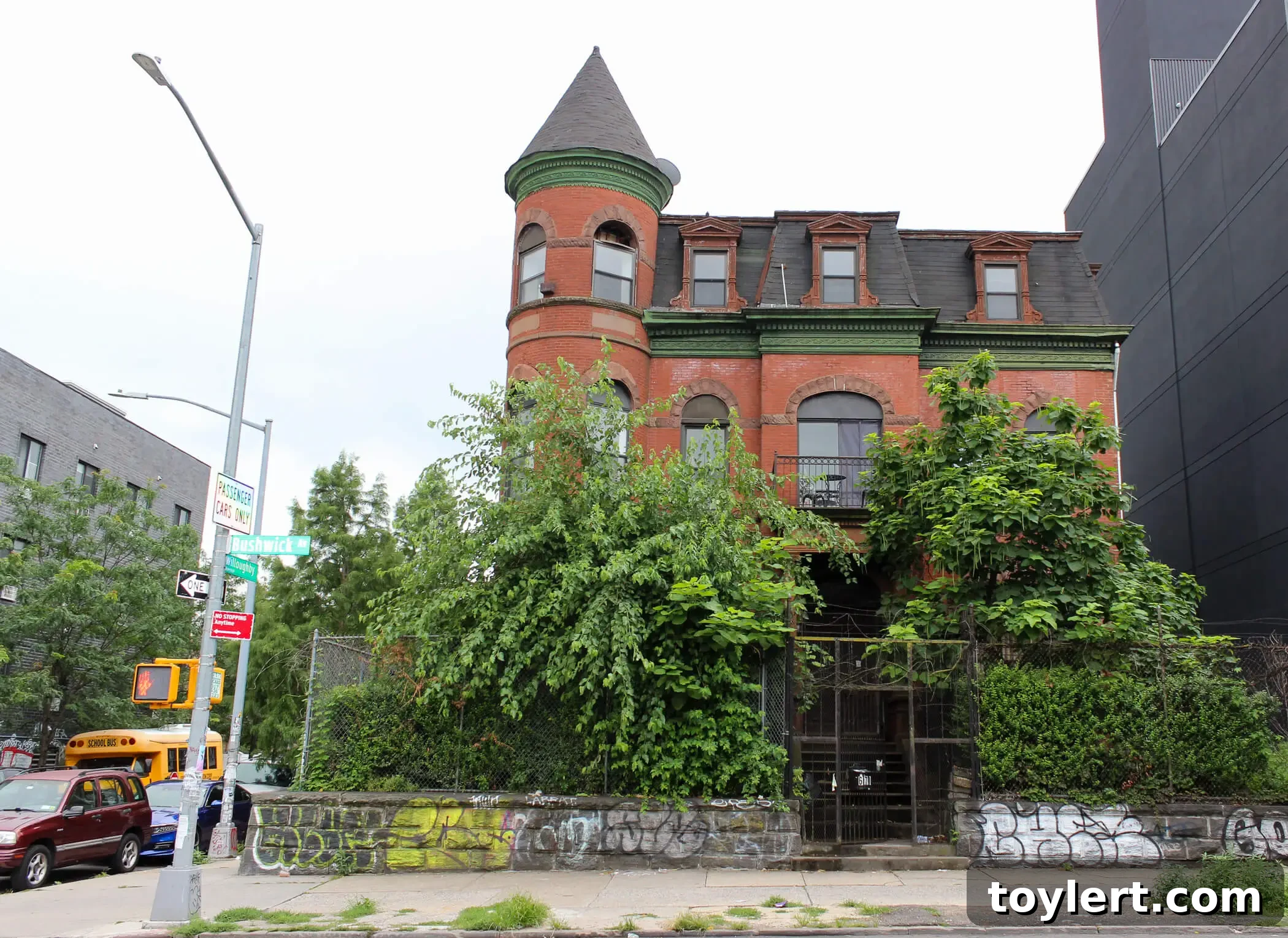
Safeguarding Bushwick’s Heritage: The Fight to Preserve Lipsius-Cook Mansion
A groundswell of community concern and fervent advocacy is currently centered on the venerable Lipsius-Cook Mansion, a magnificent Romanesque Revival structure that has graced Bushwick Avenue for over 130 years. On a recent Wednesday, community members and dedicated preservationists rallied emphatically outside this historic edifice, issuing a compelling plea to the Landmarks Preservation Commission (LPC). Their urgent message: take decisive action to protect the building from its alarming state of deterioration and ensure its architectural legacy endures for future generations.
The rally, meticulously organized by the Bushwick Historic Preservation Association (BHPA) and the Historic Districts Council (HDC), served as a vital call to arms. Organizers explicitly aimed to “light a fire” under the LPC, compelling the agency to leverage its authority and demand that the owner of the landmarked mansion at 670 Bushwick Avenue initiate essential repairs without further delay. Beyond immediate structural concerns, the community’s demands extend to a broader, more profound request: that the LPC integrate Bushwick’s distinctive history and vibrant culture into its designation decisions. This would entail employing a more nuanced and contextually sensitive assessment criterion, ensuring that the unique character of the neighborhood is truly acknowledged and protected.
A Jewel in Bushwick’s Crown: The Lipsius-Cook Mansion
The Lipsius-Cook Mansion stands not merely as a building, but as a tangible link to Bushwick’s rich and often overlooked past. Erected over a century ago, its Romanesque Revival architecture speaks volumes of a bygone era of affluence and distinctive craftsmanship. This style, characterized by its robust masonry, rounded arches, and often intricate detailing, was popular in the late 19th century, reflecting a period of significant growth and prosperity in Brooklyn. The mansion’s imposing presence and unique design elements make it an architectural anomaly in a borough that has seen much of its historical fabric altered or lost.
As Dina Alfano, a founding member of the Bushwick Historic Preservation Association, poignantly articulated, the Lipsius-Cook Mansion is “an incredibly important property in terms of Bushwick’s history, and there’s so precious little left.” This sentiment underscores the critical importance of preserving what remains. Bushwick, once a thriving industrial and residential hub, particularly renowned for its brewing industry, has undergone tremendous transformation. Many historic structures that once defined its streetscapes have been demolished, making the survival of the Lipsius-Cook Mansion all the more significant. It serves as a rare and invaluable testament to the neighborhood’s Gilded Age prosperity and architectural ambition.
Acknowledging its profound historical and architectural value, the Lipsius-Cook Mansion was officially landmarked in 2013. This designation, a crucial step in its protection, theoretically obligates the owner to maintain the property according to strict preservation guidelines. However, the current state of neglect demonstrates a stark failure to uphold these responsibilities, placing this irreplaceable piece of Brooklyn’s heritage in severe jeopardy. The community’s rally is a direct response to this perceived inaction and a desperate plea to enforce the very protections that were put in place a decade ago.
The Imperative of Action: Community Demands and LPC’s Role
The Bushwick Historic Preservation Association and the Historic Districts Council have not only shone a spotlight on the mansion’s physical decay but have also highlighted systemic issues within the landmarking process itself. Their demands are clear and multifaceted:
- Immediate Intervention for Repairs: The primary goal is to compel the current owner to undertake comprehensive repairs to halt the mansion’s accelerating deterioration. Neglect can lead to irreversible damage, structural instability, and ultimately, the complete loss of the building’s historical integrity.
- Accountability and Enforcement: The community expects the LPC to exercise its regulatory powers to ensure compliance. A landmark designation is meaningless without rigorous enforcement, and the ongoing deterioration of a designated landmark raises serious questions about the effectiveness of existing oversight mechanisms.
- Nuanced Assessment Criteria: Beyond this specific case, the advocates are pushing for a more thoughtful and contextual approach to landmarking decisions across Bushwick. They argue that a one-size-fits-all criterion may fail to capture the unique social, cultural, and architectural narratives embedded within Bushwick’s diverse building stock. This includes recognizing the significance of buildings that may not fit traditional aesthetic ideals but hold immense importance to the community’s identity and story.
The Landmarks Preservation Commission, established to protect New York City’s architecturally, historically, and culturally significant buildings, has a crucial mandate. When a property is landmarked, it receives a protective status that prevents demolition or inappropriate alterations without LPC approval. Furthermore, owners of landmarked properties are legally required to maintain them in good repair. The current rally serves as a powerful reminder to the LPC of its responsibility not only to designate but also to actively ensure the preservation of these irreplaceable assets. The community believes that proactive engagement and stringent enforcement are vital to prevent landmarked buildings from falling into such disrepair that their eventual restoration becomes prohibitively expensive or even impossible.
Bushwick’s Unique Tapestry: Beyond Bricks and Mortar
Bushwick is a neighborhood of profound historical depth and evolving character. From its origins as a Dutch settlement in the 17th century to its explosive growth in the 19th and early 20th centuries as an industrial powerhouse, particularly famous for its breweries, Bushwick has always been a place of dynamic change and resilience. Its streets tell stories of waves of immigration, industrial innovation, and vibrant community life.
This rich history is reflected in its architecture, which, while perhaps not always as grand as some other Brooklyn neighborhoods, offers a diverse palette of styles and scales. The call for “nuanced and contextual assessment criteria” acknowledges that Bushwick’s historical significance extends beyond singular grand mansions. It encompasses the collective narrative of its rowhouses, commercial buildings, former factories, and public spaces – each contributing to a unique urban fabric. Preservation in Bushwick is not just about saving individual structures; it’s about honoring the collective memory and cultural heritage that defines the neighborhood.
Losing buildings like the Lipsius-Cook Mansion diminishes this narrative. It erases tangible evidence of the past, making it harder for current and future residents to understand and connect with their community’s roots. In a rapidly gentrifying city, preserving these historical anchors becomes even more critical. They provide stability, character, and a sense of continuity amidst rapid change, helping to retain the very soul of Bushwick.
The Broader Implications of Neglect: A City’s Responsibility
The deterioration of a landmarked building, such as the Lipsius-Cook Mansion, carries significant implications that extend far beyond its immediate property lines. It represents a collective loss for the city, raising questions about urban planning, property ownership responsibilities, and the efficacy of preservation laws.
Firstly, significant neglect can lead to irreparable damage. Water infiltration, structural instability, and material degradation can reach a point where restoration becomes technically unfeasible or financially astronomical. In the worst-case scenario, the building might be deemed unsafe and face demolition, despite its landmark status. This would be a tragic and avoidable loss of a unique architectural specimen and a piece of Bushwick’s identity.
Secondly, a visible state of neglect can have a ripple effect on the surrounding neighborhood. It can contribute to a sense of decline, potentially impacting property values, discouraging investment in adjacent properties, and fostering an environment of disrepair. A landmarked building should be a source of pride, not a symbol of blight.
Finally, the case of the Lipsius-Cook Mansion serves as a stark reminder of the ongoing challenges in historic preservation. While landmark designation provides a legal framework for protection, consistent monitoring and enforcement are equally vital. Property owners of landmarked buildings bear a significant responsibility to be stewards of these historic assets. When this responsibility is neglected, the LPC and the community must collaborate to ensure that these invaluable legacies are not lost forever.
Community Empowerment and the Path Forward
The rally for the Lipsius-Cook Mansion exemplifies the power of community advocacy. Through their organized efforts, the Bushwick Historic Preservation Association and the Historic Districts Council are not only fighting for one building but are also championing a more robust and responsive approach to preservation across the city. Their activism demonstrates that local voices are essential in safeguarding the urban environment and ensuring that historical significance is not overshadowed by neglect or development pressures.
The hope now is that the LPC will heed the community’s impassioned call. A swift and decisive intervention to mandate repairs for the Lipsius-Cook Mansion would not only save a vital piece of Bushwick’s heritage but also reinforce public trust in the landmarking process. Furthermore, an adoption of more nuanced assessment criteria for Bushwick would set a precedent for more equitable and comprehensive preservation efforts in historically rich, yet rapidly changing, neighborhoods throughout New York City.
The future of the Lipsius-Cook Mansion, and indeed, much of Bushwick’s architectural heritage, rests on the collective will of its residents, the vigilance of preservation organizations, and the proactive engagement of regulatory bodies. Only through sustained effort and a shared commitment can these invaluable links to the past be secured for the enlightenment and enjoyment of generations to come.