The Rheingold Brewery Redevelopment: A Landmark Battle for Affordable Housing in Bushwick
The proposed redevelopment of the historic Rheingold Brewery site in Bushwick, Brooklyn, ignited a significant community controversy when its plans were presented to the City Council in November 2013. Read Property, the developer spearheading this ambitious project, encountered fierce opposition from local residents and political leaders who argued that the proposal failed to deliver genuinely affordable housing solutions for the existing Bushwick community. This crucial moment highlighted the persistent challenges of urban development, the pervasive issue of gentrification, and the ongoing struggle for equitable housing opportunities within New York City’s rapidly transforming neighborhoods.
Understanding the Initial Development Proposal for Rheingold
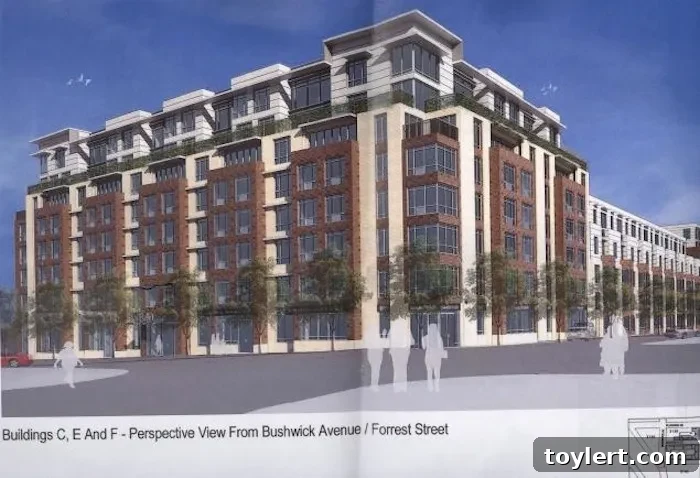
Read Property’s initial vision for the sprawling 1,000,000-square-foot Rheingold Brewery site was expansive and multi-faceted. The comprehensive plan envisioned a massive mixed-use complex featuring 977 residential units, complemented by dynamic ground-floor retail spaces and a highly anticipated new public park designed to enrich the neighborhood’s green infrastructure. Of the nearly one thousand residential units, 242 were designated as “affordable apartments,” constituting approximately 24 percent of the total development. This commitment, while appearing substantial on paper, quickly became the central point of intense criticism and spirited debate among community stakeholders.
The Disconnect: Affordability Metrics Versus Local Economic Reality
The core of the community’s profound concern revolved around the very definition of “affordable.” According to Read Property’s initial proposal, the designated affordable units were priced for households earning 60 percent of the city’s median wealth level. In 2013, this translated to an income of $51,544 for a family of four. However, Councilwoman Diana Reyna, a powerful advocate for Bushwick residents, promptly highlighted a critical disparity: the median income for a family of four specifically in Bushwick was considerably lower, standing at approximately $34,000. This stark economic divergence meant that the proposed “affordable” housing would, in reality, remain financially inaccessible for a significant portion of the very community it was intended to benefit.
Jose Lopez, a prominent housing organizer associated with Make the Road, a leading community advocacy organization, powerfully articulated the community’s widespread frustration. He stated unequivocally, “Basically what the proposal is offering is that zero percent of Bushwick residents will access this housing.” This impactful statement vividly illustrated the profound disconnect between city-wide affordability benchmarks and the tangible economic realities experienced by specific neighborhoods such as Bushwick. Community activists demanded a more equitable and localized approach, advocating vehemently for apartments to be priced within reach of residents earning less than 30 percent of the city’s median wealth. Furthermore, they vigorously pushed for a substantial increase in the overall number of affordable apartments, proposing that they should comprise at least 35 percent of the development, a significant leap from the initial 24 percent.
The Broader Context: Gentrification and Housing Inequality in Bushwick
The Rheingold Brewery redevelopment project did not emerge in isolation. Bushwick, like numerous other Brooklyn neighborhoods, had been undergoing rapid and transformative gentrification for the better part of two decades. This complex process, fueled by escalating property values and a steady influx of new residents, frequently results in the displacement of long-term, lower-income residents who are subsequently priced out of their evolving communities. Large-scale developments such as Rheingold, while often promising economic revitalization and modern amenities, have the potential to exacerbate these detrimental trends if they are not meticulously planned with the existing community’s intrinsic needs at the forefront.
The impassioned battle over the Rheingold site thus became a powerful symbol of this broader, ongoing struggle. Residents expressed legitimate fears that the development, as initially conceived, would predominantly cater to more affluent newcomers, thereby further increasing living costs for existing families and eroding the unique cultural fabric that defined Bushwick. The persistent push for genuinely affordable housing was not merely about securing a greater number of units; it was fundamentally about preserving the community’s distinct identity and ensuring that development yielded benefits for all residents, rather than exclusively serving a select demographic.
The Indispensable Role of Community Advocacy in Shaping Development
The robust and highly organized opposition from Bushwick residents, spearheaded by influential figures like Councilwoman Reyna and dedicated groups such as Make the Road, played an absolutely critical role in elevating these pressing issues to the forefront of public discourse. Community advocacy is an indispensable force in holding developers and city officials accountable, ensuring that large-scale urban projects genuinely align with the broader public interest. Through a concerted strategy of protests, active participation in public hearings, strategic media engagement, and sustained lobbying efforts, these groups effectively amplify the voices of those most directly affected by significant development decisions.
Their demands transcended simple adjustments to unit counts or income thresholds. They sought a fundamental paradigm shift in how “affordable” housing is conceptualized and practically implemented. They ardently argued for policies that meticulously consider neighborhood-specific income levels rather than relying on broad, potentially misleading city-wide averages, thereby ensuring that affordable units are truly accessible to the local population. This form of advocacy is not merely reactive; its overarching aim is to proactively sculpt urban planning policies to foster the creation of more inclusive, equitable, and sustainable cities for all residents.
Navigating the Path to a More Equitable Outcome
The initial presentation of the Rheingold Brewery plan to the City Council marked the commencement, not the conclusion, of intricate negotiations for the site. Large-scale urban development projects of this magnitude typically involve prolonged and often complex discussions among developers, community boards, elected officials, and various advocacy groups. The substantial pressure exerted by the community frequently leads to significant revisions in initial plans, ultimately reflecting a more balanced and community-responsive approach to development.
Historically, developers in similar urban development scenarios have often found themselves compelled to increase their affordable housing commitments, adjust income eligibility tiers, or offer additional community benefits in order to secure essential project approval. This intricate negotiation process forms a cornerstone of democratic urban planning, wherein diverse stakeholders strive diligently to reconcile competing interests. In the case of the Rheingold project, the powerful and sustained community push eventually resulted in a revised plan that dramatically increased the number of genuinely affordable units and meticulously tailored them to local income levels, serving as a powerful demonstration of the enduring efficacy of persistent and organized advocacy.
Long-Term Impact and Crucial Lessons Learned from Rheingold
The intense debate surrounding the Rheingold Brewery development served as a critical and illuminating case study for urban development practices within the rapidly gentrifying areas of New York City. It brought to light several key and enduring lessons:
- The Imperative for Localized Affordability Metrics: Broad city-wide income averages frequently fail to accurately reflect the intricate economic realities of individual neighborhoods. Truly effective affordable housing programs must meticulously consider local Area Median Income (AMI) to guarantee genuine accessibility for existing residents.
- The Transformative Power of Community Organizing: Highly organized community groups and actively engaged elected officials are absolutely indispensable in advocating for equitable development outcomes and in holding powerful developers consistently accountable for their impact.
- Balancing Development with Community Preservation: New developments must consciously strive to seamlessly integrate with and genuinely enhance existing communities, rather than inadvertently leading to their displacement. This critical balance encompasses not just housing provision but also preserving cultural identity, actively supporting local businesses, and ensuring universal access to essential public services.
- The Critical Role of Transparency and Dialogue: Early, transparent, and consistent engagement between developers, city planners, and community stakeholders can significantly mitigate potential conflicts and ultimately lead to more mutually beneficial and sustainable outcomes for all parties involved.
Ultimately, the Rheingold Brewery site’s successful transformation into a vibrant mixed-use community, featuring a substantial component of genuinely affordable housing, stands as a profound testament to the persistent and unwavering efforts of Bushwick residents and their dedicated allies. It powerfully demonstrated that through concerted advocacy and skillful negotiation, urban development can be deliberately steered towards achieving more inclusive and equitable outcomes, fundamentally challenging the long-held notion that gentrification is an inevitable force solely dictated by unbridled market dynamics.
Beyond Housing: The Economic and Social Ripples of Extensive Development
The profound impact of a development as significant and expansive as the Rheingold Brewery site extends far beyond the mere provision of housing units. It inevitably brings with it a complex array of economic and social implications that profoundly affect the surrounding community. On the economic front, large-scale construction projects generate a substantial number of jobs, ranging from highly skilled labor positions to essential administrative roles, thereby providing valuable temporary employment opportunities for numerous individuals. Once completed, the envisioned ground-floor retail spaces at Rheingold promised to host new businesses, potentially creating permanent local jobs and injecting significant vitality into the streetscape. These new businesses could offer crucial convenience for incoming residents and simultaneously serve the existing community’s needs, thereby enhancing the overall commercial appeal and dynamism of the area.
However, the social ripples emanating from such a development are equally profound. An influx of new residents, particularly those possessing higher income levels, can significantly alter the demographic composition and intricate social dynamics of a neighborhood. While increased diversity can undoubtedly be a profound strength, rapid and unmanaged demographic shifts can place considerable strain on existing community bonds if not managed with utmost thoughtfulness and foresight. The prevalent fear among long-term residents was not solely about the escalating challenge of housing affordability, but also about the potential loss of the cherished sense of community they had meticulously cultivated over many decades. The new public park, while undoubtedly a welcome amenity, had to be genuinely accessible and truly welcoming to all residents, both long-standing and newly arrived, in order to effectively serve its intended purpose as a unifying and inclusive community space. The enduring challenge for urban planners and developers is to adeptly harness the myriad economic benefits of development while actively and thoughtfully mitigating potential social costs and vigorously fostering genuinely inclusive community growth and cohesion.
Conclusion: A Blueprint for Future Urban Renewal and Equitable Development
The comprehensive story of the Rheingold Brewery redevelopment is far more than just a localized dispute concerning a construction project; it is a powerful and resonant narrative about the future trajectory of urban renewal in diverse, dynamic, and rapidly evolving cities such as New York. It profoundly underscores the critical importance of defining “affordability” in a meticulously context-sensitive manner, moving decisively beyond broad, generalized city-wide averages to truly address the specific and unique needs of individual neighborhoods and their residents.
The ultimate outcome of the Rheingold project, heavily influenced and shaped by the unwavering commitment and relentless efforts of Bushwick residents and their dedicated advocates, successfully established a significant precedent. It unequivocally demonstrated that community voices, when effectively organized, unified, and persistent, possess the formidable power to significantly shape the trajectory and impact of major urban developments. The Rheingold site eventually transitioned from a poignant symbol of industrial decline to a complex, vibrant mixed-use space, but its transformative journey serves as an enduring and vital reminder that true progress in urban development is meticulously measured not solely by the construction of new buildings and economic growth, but fundamentally by how inclusively and equitably those benefits are shared among all members of the community. This continuous and essential dialogue between developers, policymakers, and residents remains paramount for building cities that genuinely serve the needs and aspirations of everyone.