Brighton Beach Rises in Solidarity: A Powerful Stand for Ukraine
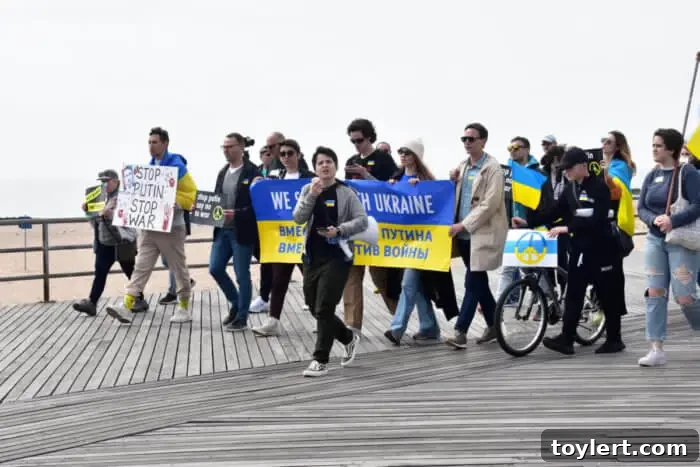
On a poignant Sunday afternoon, the iconic Riegelmann Boardwalk in Brighton Beach, Brooklyn, transformed into a vibrant tapestry of solidarity. Hundreds of individuals, hailing from diverse backgrounds including Russia, Ukraine, Georgia, and Kazakhstan, converged to express their unwavering support for the people of Ukraine. This powerful demonstration of unity unfolded just one day after a similar display of collective resolve in another of the Russian diaspora’s most significant communities outside of Eastern Europe, highlighting a growing global chorus against the conflict.
The March 20 protest was meticulously organized by “For Freedom in Russia,” a collective that has swiftly gained recognition through its active presence on social media, where it boldly proclaims its mission to “fight the Putin regime.” Their efforts represent a crucial voice of dissent from within the broader Russian-speaking community, challenging narratives and advocating for peace and freedom.
Alexander Korzun, a key organizer for the group, articulated to Brooklyn Paper the profound significance of the rally, emphasizing its importance for two fundamental reasons. While the original report briefly noted these reasons, it’s essential to delve deeper into the layers of meaning behind such a public gathering in a community deeply intertwined with the region’s complex history and present struggles. These demonstrations serve not only as a beacon of hope for those suffering but also as a clear signal to the world about the deep divisions within the diaspora regarding the conflict, and the strong desire for peace and justice that resonates across ethnic lines.
The Heart of ‘Little Odessa’: Brighton Beach as a Beacon of Dissent
Brighton Beach, affectionately known as “Little Odessa,” stands as a pivotal location for such a demonstration. For decades, it has served as a primary cultural and residential hub for a vast population of Russian-speaking immigrants and their descendants, including significant communities of Ukrainians, Russians, Georgians, Belarusians, and various Central Asian nationalities. This neighborhood, with its distinct character and deep roots in Eastern European culture, represents a microcosm of the very regions embroiled in conflict. The decision to gather on its boardwalk was therefore not merely coincidental but deeply symbolic.
The Riegelmann Boardwalk itself, stretching along the Atlantic Ocean, became a poignant stage. It’s a place where families gather, friends stroll, and the vibrant life of the community unfolds. On this day, however, its familiar hum was replaced by chants for peace, the rustle of flags, and the collective voice of people yearning for an end to suffering. The very air seemed charged with emotion, a mixture of anguish, defiance, and an enduring hope for a peaceful resolution. For many attendees, Brighton Beach is not just a neighborhood; it is home, a sanctuary where their diverse cultures intertwine. Yet, the ongoing conflict has created painful fissures even within this closely-knit fabric, making public expressions of solidarity all the more vital and, at times, fraught with personal complexity.
For the Russian diaspora in particular, participation in such protests carries a unique weight. It is a powerful rejection of the actions carried out in their name, a clear statement that the regime’s aggression does not represent the values or aspirations of all Russians. This public condemnation helps to counter stereotypes and highlights the global nature of opposition to the conflict, demonstrating that the desire for peace transcends national borders and political allegiances.
“For Freedom in Russia”: A Unified Voice Against Aggression
The organizing group, “For Freedom in Russia,” emerged as a crucial conduit for this collective expression. Born from a shared sense of urgency and moral obligation, their digital presence quickly galvanized support, transforming online activism into tangible real-world action. Their social media channels, far from being mere platforms for discussion, serve as vital tools for mobilization, information dissemination, and continuous advocacy. By explicitly stating their mission to “fight the Putin regime,” they position themselves not just as proponents of peace, but as active resistors against a specific political agenda, thereby giving a distinct focus to their efforts.
Alexander Korzun’s emphasis on the rally’s dual importance resonates deeply with the core objectives of such movements. Firstly, he underscored the critical need to showcase unwavering solidarity with Ukraine. This aspect involves not just verbal support but a visible, collective demonstration that the Ukrainian people are not alone in their struggle. Placards adorned with messages like “Stand with Ukraine,” “Stop the War,” and the colors of the Ukrainian flag dominated the visual landscape, sending a clear message of empathy and shared humanity across the miles. This solidarity is a lifeline for many, offering moral support and reminding them that the world is watching and cares.
Secondly, Korzun likely highlighted the importance of demonstrating to the world, and importantly, to the Russian-speaking diaspora itself, that there is significant internal opposition to the conflict. This is not merely a geopolitical dispute but a humanitarian crisis that has deeply affected individuals from all sides. By gathering on the boardwalk, Russian, Ukrainian, Georgian, and Kazakh participants collectively debunked any notion of monolithic support for the regime’s actions. Instead, they projected an image of a diverse community united by universal values of peace, freedom, and human dignity, actively advocating for a different future. This aspect is crucial for countering propaganda and ensuring that the voices of dissent are heard loudly and clearly.
Voices and Visions: Testimonies from the Boardwalk
The rally was a tapestry of personal stories and shared sentiments. Attendees carried signs reflecting a wide array of emotions and demands. Some simply read “NO WAR,” a universal plea transcending language barriers. Others featured more specific messages, such as “Russians Against War,” “Putin Out,” and “Save Ukraine.” The sight of these hand-crafted messages, held aloft by individuals from various backgrounds, underscored the profound personal impact of the conflict on ordinary people. Each sign was a testament to personal conviction, a fragment of a larger, collective outcry.
Conversations on the boardwalk revealed a spectrum of experiences. A woman who identified as Ukrainian-American spoke of her sleepless nights, constantly checking news from her relatives back home, her voice thick with worry. Next to her, a Russian immigrant, who had left Russia years ago seeking freedom, expressed profound shame and anger at the actions of his home country’s government, emphasizing that “this is not my Russia.” Georgian participants echoed similar sentiments, drawing parallels to their own nation’s past struggles with Russian aggression, emphasizing the need for global vigilance against territorial expansion.
Children, too, were present, some holding small flags or drawings of doves, their innocence a stark contrast to the gravity of the situation. Their presence was a powerful reminder of the future generations who will bear the consequences of today’s conflicts, and a silent plea for a world free from violence. The atmosphere, while charged with emotion, was also one of determined defiance. There was a palpable sense of community, a shared understanding that standing together, even thousands of miles away, offered a tangible form of resistance and support.
The Global Ripple: Diaspora Protests and Their Far-Reaching Impact
The Brighton Beach protest was not an isolated event but part of a much larger, global movement of diaspora communities mobilizing in response to the conflict. From London to Berlin, Toronto to Sydney, similar demonstrations have erupted, uniting people across continents in a shared stance against aggression. These global protests serve multiple vital functions. They keep the issue in the public consciousness, ensuring that the world does not become desensitized to the ongoing crisis. They pressure political leaders to maintain and strengthen sanctions, and to provide humanitarian and military aid to Ukraine. Moreover, they provide crucial moral support to those directly affected by the conflict, reminding them that they are not forgotten.
The role of diaspora communities in times of conflict is historically significant. They act as bridges between their adopted homes and their countries of origin, leveraging their unique perspectives to inform public opinion, lobby governments, and organize direct aid. In the context of the Russia-Ukraine conflict, these communities have been instrumental in fundraising for humanitarian efforts, coordinating refugee assistance, and raising awareness about the plight of civilians. Their collective voice amplifies the demands for peace and justice, creating a powerful international chorus that cannot be ignored.
For many members of the Russian diaspora, these protests represent a challenging but necessary moral imperative. It allows them to publicly disavow the actions of the Russian government and to express their solidarity with the victims, thereby drawing a clear distinction between the regime and the people. This act of public dissent is a testament to the power of individual conscience and the universal desire for human rights and self-determination.
Community Resilience and a Hope for the Future
Beyond the immediate impact of the protest, the gathering on the Riegelmann Boardwalk also highlighted the enduring resilience of the Brighton Beach community. Even as anxieties run high and internal discussions become more intense, the community demonstrates an ability to come together on fundamental issues of humanity and peace. Ongoing efforts extend beyond public rallies; local organizations and grassroots initiatives continue to provide support, gather aid, and create spaces for dialogue and healing within the community.
The long-term implications of the conflict on these communities are profound. It reshapes identities, challenges loyalties, and forces individuals to grapple with complex questions of heritage and belonging. Yet, amidst these challenges, there is also a powerful narrative of unity emerging, as people from diverse backgrounds find common ground in their shared humanity and their collective desire for an end to suffering. The Brighton Beach protest, therefore, is not just a snapshot of a moment in time; it is a testament to the ongoing strength of immigrant communities to stand for justice and advocate for a better world.
As the sun set over the Atlantic on that Sunday, casting long shadows across the boardwalk, the messages of solidarity and defiance lingered in the air. The Riegelmann Boardwalk, a place of everyday life, had momentarily become a global stage, a beacon of hope and a resounding declaration that the pursuit of freedom and peace is a universal endeavor. The powerful image of hundreds united against aggression on the shores of Brighton Beach serves as a potent reminder that even in the darkest of times, the light of human solidarity continues to shine brightly, inspiring courage and demanding accountability.