The End of an Era: Unpacking the Removal of Brooklyn’s Iconic Kentile Floors Sign
For decades, the colossal red letters spelling out “KENTILE FLOORS” have stood as an unwavering sentinel over the Gowanus Canal, a beacon of Brooklyn’s industrial past and a cherished landmark for residents and visitors alike. More than just a sign, it was a symbol of resilience, a visual anchor in a rapidly changing cityscape, and a constant reminder of the borough’s rich manufacturing heritage. However, the beloved sign is now slated for removal, a decision that has sparked widespread sentiment and initiated urgent conversations about preservation, urban development, and the cost of maintaining history. This comprehensive article delves into the sign’s profound significance, the reasons behind its impending disappearance, and the community’s passionate efforts to preserve its legacy.
A Glimpse into History: The Legacy of Kentile Floors
To truly understand the sign’s importance, one must first appreciate the company it represented. Kentile Floors, founded by Arthur Kennedy in 1898, grew from humble beginnings to become one of the nation’s leading manufacturers of resilient flooring. Operating out of its sprawling Gowanus facility, the company was a powerhouse in the American manufacturing landscape throughout the 20th century. Kentile was renowned for its asphalt and vinyl composition tiles, products that graced countless homes, offices, and public spaces across the country. It represented the ingenuity and industrious spirit that defined Brooklyn, providing thousands of jobs and contributing significantly to the local economy. The company’s success mirrored the rise of American industry, making its eventual decline in the late 20th century a poignant reflection of broader economic shifts.
The Gowanus plant, a bustling hub of production, was an integral part of the borough’s industrial identity. The sign itself, a monumental structure, was erected decades ago to proudly proclaim Kentile’s presence and its dominance in the flooring market. It stood as a testament to the company’s long-standing success and its deep roots in the Brooklyn community. The closure of Kentile Floors in 1992 marked the end of an era for industrial manufacturing in Gowanus, but the sign remained, a silent guardian overseeing the transformation of the neighborhood from a gritty industrial zone to an emerging residential and commercial district.
The Iconic Sign: More Than Just Advertising
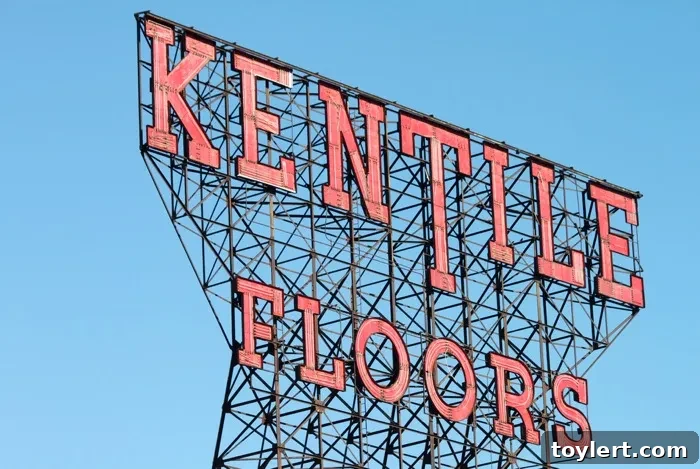
Perched atop the former Kentile factory building at 2nd Avenue and 9th Street, the massive red letters of the Kentile sign are an indelible part of the Brooklyn skyline. Its bold, unmissable presence made it a crucial navigational point and a distinct identifier for the Gowanus neighborhood. For many, catching sight of the sign meant coming home, or venturing into a part of Brooklyn rich with stories and character. It was an anachronism in the best sense, a vibrant relic from a bygone era that stubbornly resisted the march of time and gentrification. Its very existence served as a powerful reminder of what Gowanus once was, and for many, a hope for retaining some of that historical essence amidst rapid change.
Visually striking, the sign’s classic design and prominent placement allowed it to be seen from various vantage points across the borough, including parts of the Gowanus Expressway. Its distinctive red hue, often fading and repainted over the years, added to its charm and authenticity. This monumental piece of advertising transcended its commercial purpose, evolving into a cultural touchstone. It represented not just a brand, but a piece of collective memory, evoking nostalgia for a Brooklyn that was grittier, more industrial, and perhaps, more uniquely itself. Its impending removal leaves a significant void, not just architecturally, but emotionally, for those who cherished its familiar presence.
The Decision to Remove: A Costly Burden
The news of the Kentile sign’s removal, officially confirmed by the building’s owner, sent ripples of disappointment and concern through the community. The primary reasons cited for this difficult decision revolve around significant and prohibitive repair costs. According to statements made to The New York Times, both the roof beneath the sign and the sign structure itself are in dire need of extensive, costly repairs. Maintaining such a large, aging structure requires substantial financial investment, a burden the building owner ultimately found unsustainable.
The property owner expressed deep regret regarding the necessity of the sign’s removal, acknowledging its importance to the community. In a statement, the owner conveyed, “We love the sign, and we heard the voices of so many community members. We will work hard to preserve the letters during removal.” This sentiment highlights the difficult position many property owners face when balancing historical preservation with the practicalities of property maintenance and financial viability. The structural integrity of both the roof and the sign had deteriorated over decades, posing potential safety hazards and requiring an overhaul that would run into hundreds of thousands, if not millions, of dollars. This financial reality, coupled with the ongoing redevelopment of the area, made the decision seemingly inevitable from a business perspective.
Community Uproar and Preservation Efforts
Upon hearing the news, the Brooklyn community reacted swiftly and passionately. Protests erupted, petitions circulated, and local residents voiced their dismay over the potential loss of such a vital piece of their shared heritage. The Kentile sign was not merely an old advertisement; it was a character in the narrative of Brooklyn, an unyielding symbol against the tide of constant change. Its removal felt like an erasure of memory, an unwelcome sign of accelerating gentrification that threatened to strip Gowanus of its unique identity.
Local political figures quickly became involved, recognizing the deep emotional connection the sign held for their constituents. Councilman Brad Lander, a prominent advocate for Brooklyn’s unique character, met with the building owner to mediate and explore potential solutions. These discussions were crucial in brokering a deal that, while not saving the sign in its original location, aimed to preserve its individual letters. The outcome of these negotiations was a bittersweet compromise: the sign would come down, but efforts would be made to carefully dismantle and save its iconic components. This agreement offered a glimmer of hope that parts of the sign could eventually find a new home, perhaps in a public art installation or a local museum, allowing its legacy to endure in some form.
Gowanus in Transition: The Broader Context of Urban Development
The Kentile sign’s removal cannot be viewed in isolation; it is a powerful microcosm of the larger forces of urban development and gentrification sweeping across Gowanus and many other historical industrial zones in New York City. Once a gritty, working-class neighborhood defined by its canal, factories, and warehouses, Gowanus is undergoing a dramatic transformation. Rezoning efforts, new residential constructions, and an influx of creative businesses and residents are reshaping its landscape. This evolution brings new opportunities and economic growth but also raises questions about preserving historical identity and ensuring equitable development.
Landmarks like the Kentile sign serve as important reminders of a neighborhood’s past, providing a sense of continuity and rootedness amidst rapid change. Their disappearance can be perceived as a loss of character, a homogenization that erases the distinctiveness of a place. The debate surrounding the Kentile sign encapsulates the broader tension between progress and preservation, innovation and nostalgia. As Gowanus continues its metamorphosis, the absence of this iconic sign will undoubtedly mark a significant turning point, prompting further reflection on how communities navigate the delicate balance between embracing the future and honoring their past.
What Lies Ahead: The Future of the Preserved Letters and Enduring Legacy
With the decision made and the removal process underway, the focus now shifts to the careful preservation of the individual letters that spell out “KENTILE FLOORS.” The building owner’s commitment to “work hard to preserve the letters during removal” offers a potential pathway for the sign’s legacy to continue. The meticulous dismantling process is crucial, as each letter is a substantial, historic artifact in itself. The hope within the community is that these letters will not simply be stored away but will eventually find a new purpose, perhaps forming a public display that honors the sign’s history and its connection to Brooklyn.
Speculation abounds regarding the ultimate fate of these salvaged components. Could they be reassembled as a public art installation in a new location within Gowanus, perhaps along the revamped canal promenade? Could they become part of an exhibition at the Brooklyn Museum or a local historical society, serving as educational pieces about Brooklyn’s industrial past? Whatever their eventual destination, the efforts to save the letters are a testament to their enduring cultural value. Even in pieces, the Kentile sign will continue to tell a story – a story of American manufacturing, of a vibrant Brooklyn community, and of the bittersweet process of urban evolution. Its physical absence from the skyline will be felt, but its spirit, embodied in its carefully preserved letters and the collective memory of Brooklynites, is destined to live on.
Conclusion: A Fond Farewell to a Brooklyn Icon
The impending removal of the Kentile Floors sign marks the end of an era for Gowanus and for Brooklyn as a whole. While the reasons for its departure are rooted in practical necessities—the high cost of essential repairs—the emotional impact of its absence will be profound. For generations, the sign has stood as a silent witness to Brooklyn’s triumphs and transformations, a steadfast symbol of its industrial might and unique character. Its story is a microcosm of the larger narrative of urban change, highlighting the constant tension between preserving the past and forging ahead into the future.
As the iconic red letters are carefully taken down, Brooklyn will bid a bittersweet farewell to a beloved landmark. Yet, the commitment to preserve its components offers a glimmer of hope that the Kentile sign’s legacy will not be entirely erased. Its memory will undoubtedly persist in photographs, in local lore, and in the collective consciousness of those who cherished its presence. The Kentile sign may be leaving the Brooklyn skyline, but its spirit as an enduring icon of Brooklyn’s industrial heart and community identity will forever remain etched in the borough’s rich tapestry.