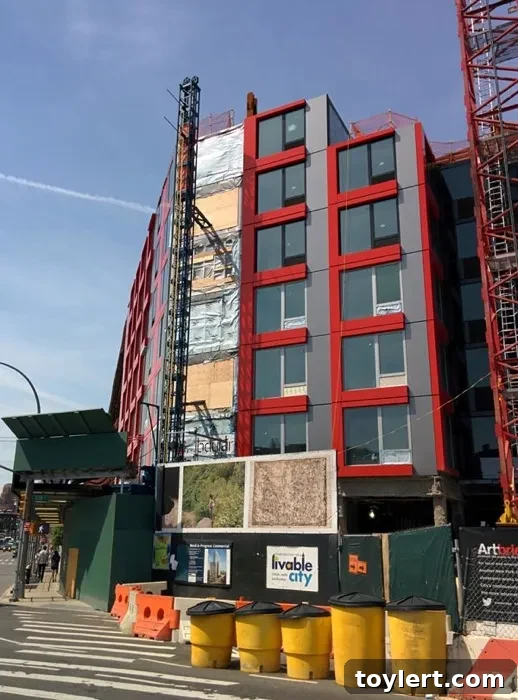
Construction Halted at Brooklyn’s Landmark B2 Modular Tower: A Deep Dive into the Atlantic Yards Dispute
The ambitious vision for Brooklyn’s Atlantic Yards, a sprawling urban development project now known as Pacific Park, has encountered a significant roadblock. Work on its pioneering first residential tower, the modular building once famously dubbed “B2,” has come to a grinding halt. This unexpected stoppage is the direct result of a bitter financial dispute escalating between the project’s developer, Forest City Ratner, and its contractor, Skanska, over unforeseen and escalating costs. As The Wall Street Journal first reported, both parties are vigorously pointing fingers, each asserting the other’s culpability for the significant financial setbacks.
The Vision Behind B2 and the Atlantic Yards Project
The Atlantic Yards project, conceived as a transformative multi-use development in the heart of Brooklyn, promised to reshape the urban landscape surrounding the Barclays Center. Encompassing residential towers, commercial spaces, and public areas, it was designed to be a vibrant new hub for the borough. Central to this vision was the B2 Tower, intended to be a flagship example of innovative construction: the tallest modular high-rise in the world at the time.
Modular construction, involving the factory assembly of pre-fabricated units that are then stacked and connected on-site, was championed for its potential to deliver projects faster, more cost-effectively, and with enhanced environmental benefits. For B2, this method was supposed to streamline the construction process, reduce waste, and bring much-needed affordable and market-rate housing units to Brooklyn efficiently. The B2 tower, with its promise of speed and efficiency, was not just a building; it was a symbol of progress and a test case for the future of urban development.
Unraveling the Dispute: Forest City Ratner vs. Skanska
The dream of seamless modular construction for B2 has been overshadowed by a contentious financial disagreement. Forest City Ratner, the driving force behind the broader Atlantic Yards development, alleges that Skanska, the contractor responsible for the modular construction, is directly accountable for the substantial cost overruns. Their claims center on what they describe as “faulty management” of the construction process. This includes accusations of inefficiencies on site, failure to adhere to agreed-upon schedules, and mismanagement of labor and resources, all contributing to ballooning expenses.
Conversely, Skanska has launched a robust defense, shifting the blame squarely onto the “faulty design” of the modules themselves. According to Skanska, the pre-fabricated units supplied for assembly were not engineered correctly, leading to significant challenges during installation. They contend that these inherent design flaws made the assembly process far more complex, time-consuming, and costly than initially anticipated. This fundamental disagreement over who bears responsibility—project management or product design—has created an impasse that has brought all construction activity to a halt. The details of this bitter dispute, including formal letters exchanged between the two sides, have been extensively published by the Atlantic Yards Report, offering a rare glimpse into the high-stakes world of major urban development conflicts.
The Perilous Path of Pioneering Modular Construction
The B2 dispute highlights the inherent risks and complexities associated with pioneering large-scale modular construction, especially in dense urban environments like New York City. While modular building offers undeniable advantages in theory, its practical application at such an unprecedented scale presents unique challenges:
- Quality Control and Precision: Ensuring uniform quality across thousands of factory-produced modules and their seamless integration on-site requires extraordinary precision and rigorous quality control protocols.
- Logistical Hurdles: Transporting oversized modules through congested city streets and lifting them into place on a tight construction site demands meticulous planning and execution.
- Design-Build Integration: A truly successful modular project necessitates an exceptionally close collaboration between design and construction teams from the outset. Any disconnect can lead to costly modifications and delays.
- “First-of-Its-Kind” Risks: As a trailblazer, B2 faced the inevitable challenges of being the first. There were no established blueprints or extensive prior experience at this scale to draw upon, magnifying potential missteps.
This contentious halt not only jeopardizes the completion of B2 but also casts a shadow over the future of modular construction as a viable, cost-effective solution for high-stakes urban projects. It forces developers and contractors worldwide to re-evaluate contract structures, risk allocation, and the need for comprehensive contingency planning when embarking on innovative building methods.
Wider Implications for Atlantic Yards and Brooklyn
The stoppage of work on the B2 Tower carries profound implications, extending far beyond the immediate financial concerns of Forest City Ratner and Skanska:
- Project Delays: The immediate consequence is a significant delay in the completion of B2, pushing back the delivery of much-needed housing units to Brooklyn residents. This directly impacts the overall timeline for the entire Pacific Park development.
- Financial Ramifications: Both companies face substantial financial losses from idled equipment, stalled progress, and potential legal battles. These disputes often lead to protracted and expensive litigation, further draining resources.
- Reputational Damage: The public nature of the disagreement can harm the reputations of both Forest City Ratner, as a developer of innovative projects, and Skanska, as a leading construction firm. It could also deter future investment in similar large-scale modular ventures.
- Impact on Brooklyn’s Housing Market: Delays in projects like B2 exacerbate the existing housing crunch in Brooklyn, particularly for the affordable housing component that was a key promise of the Atlantic Yards development.
- Investor Confidence: Such high-profile disputes can shake investor confidence in the feasibility and profitability of complex, innovative urban development projects, potentially impacting future phases of Pacific Park and other similar ventures.
Beyond B2: The Future of Pacific Park
While B2 remains at a standstill, the broader Pacific Park (formerly Atlantic Yards) project is a long-term endeavor with many other phases planned. The critical question now is how this dispute will influence the remaining stages of the development. Will Forest City Ratner (or its successors) continue to champion modular construction for subsequent towers, or will they revert to more traditional building methods to mitigate risk? The lessons learned from B2 will undoubtedly shape strategic decisions for the remaining 15 buildings planned for the site, impacting their design, construction methodologies, and ultimate delivery.
Lessons Learned and Moving Forward
The B2 Tower saga serves as a potent case study for the construction and real estate industries. It underscores several critical lessons:
- Clarity in Contracts: The need for meticulously detailed contracts that clearly define responsibilities, allocate risks, and outline procedures for managing cost overruns and design modifications.
- Robust Design Validation: Emphasizing thorough pre-construction design validation and prototyping, especially for innovative technologies like large-scale modular components.
- Integrated Project Management: The importance of a collaborative and integrated project management approach from concept to completion, ensuring all stakeholders are aligned.
- Contingency Planning: The necessity of robust contingency plans and financial buffers for projects pushing the boundaries of construction technology.
As the dispute between Forest City Ratner and Skanska unfolds, potential resolutions could include mediation, renegotiation of contracts, or even protracted litigation. Regardless of the outcome, the B2 Tower’s journey will forever be etched into the narrative of urban development, offering invaluable insights into the promises and pitfalls of pushing technological boundaries in high-stakes construction environments. The eventual resolution, and the lessons it imparts, will undoubtedly influence how future generations of developers and contractors approach innovative building methods in our rapidly evolving cities.