Brooklyn’s Dynamic Canvas: From Vandergaw’s Carriages to City Point’s Skyline
Brooklyn, New York, is a borough defined by its relentless evolution. Its streetscapes are a testament to layers of history, where the echoes of bygone eras merge seamlessly with the pulsating rhythm of contemporary urban life. To truly understand Brooklyn’s essence, one must delve into its past, examining how specific locations have transformed, mirroring the borough’s larger journey. This article embarks on such a historical voyage, tracing the remarkable metamorphosis of a pivotal site in Downtown Brooklyn, from the horse-drawn grandeur of John Vandergaw’s carriage works in the mid-19th century to the gleaming modern towers of City Point today.
John Vandergaw: Crafting Mobility in 1850s Brooklyn
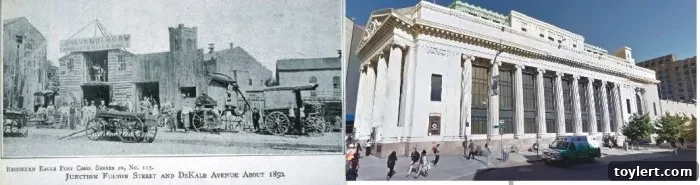
Long before the towering structures of City Point dominated the skyline, and even predating the cultural landmarks and commercial hubs that would later occupy this very ground, Brooklyn presented a vastly different tableau. In the 1850s, the area that is now a bustling commercial nexus felt more akin to a burgeoning town than the global metropolis it would become. Amidst this rapidly expanding yet still intimate urban landscape, a remarkable entrepreneur named John Vandergaw established a thriving business. His establishment was not just a workshop; it was a cornerstone of local commerce, dedicated to the meticulous craft of building carriages and coaches.
In an era preceding the widespread adoption of automobiles, carriages were the lifeblood of urban transportation. They served as essential conveyances for daily commutes, luxurious transports for the affluent, and robust wagons for commercial deliveries. Vandergaw’s enterprise flourished because it met a fundamental need for a growing city. As Brooklyn’s population expanded, so too did the demand for reliable, well-built modes of transport. His reputation for quality craftsmanship and durable vehicles made his establishment a trusted name among Brooklynites. Artisans like Vandergaw were integral to the urban fabric, their skills underpinning the functionality and mobility of the burgeoning borough, contributing significantly to its economic dynamism and the daily lives of its residents. The presence of such a skilled trade speaks volumes about the early industrial and commercial character of Brooklyn, a place where local businesses catered directly to the community’s burgeoning needs.
The Dawn of Entertainment: The Albee Theater Era
As the 19th century gave way to the 20th, Brooklyn continued its relentless march of progress, and with it, the landscape of its downtown core began to shift dramatically. The era of horse-drawn carriages, though vital for decades, gradually receded with the advent of new transportation technologies. Businesses like John Vandergaw’s, while historically significant, eventually made way for the demands of a modernizing city. On the very site where Vandergaw’s carriages were once meticulously crafted, a new kind of establishment rose, reflecting a profound shift in urban priorities and popular culture: the magnificent Albee Theater.
The Albee Theater, which opened its doors in 1925, quickly became a beloved cultural institution. It was a grand movie palace, an architectural marvel designed to transport audiences into worlds of fantasy and drama. With its opulent interiors, soaring ceilings, and state-of-the-art projection technology, the Albee Theater was a vibrant hub for entertainment. It hosted not only the latest cinematic features but also live vaudeville acts, making it a focal point for social gatherings and shared experiences in Downtown Brooklyn. For decades, the Albee was synonymous with glamour and escapism, drawing crowds from across the borough and beyond, cementing its place in the hearts of generations of Brooklyn residents. Its existence marked a crucial transition from an industrial and craft-focused urban center to one increasingly defined by leisure, culture, and mass entertainment.
The Rise of Retail: The Albee Square Mall
The mid-to-late 20th century brought another wave of transformation to Downtown Brooklyn, challenging the established order of grand movie palaces. As consumer habits evolved and suburbanization gained traction, many downtown theaters faced declining attendance. The Albee Theater, despite its storied past, eventually closed its doors in the 1970s, making way for a new commercial vision that reflected the changing retail landscape. In its place emerged the Albee Square Mall, an indoor shopping center designed to cater to a new generation of shoppers.
Opening in 1981, the Albee Square Mall represented a significant departure from its predecessor. It embodied the growing popularity of enclosed, multi-store shopping experiences, providing a climate-controlled environment where consumers could browse a variety of retailers under one roof. The mall quickly became a local landmark, particularly renowned for its vibrant atmosphere and diverse offerings, including small businesses, food vendors, and a range of popular chains. For many years, it served as a bustling retail and social hub for the community, a place where residents would meet, shop, and spend leisure time. Its transformation from a cultural entertainment venue to a consumer-driven retail complex underscored the ongoing evolution of urban centers, adapting to new economic models and societal preferences.
Brooklyn Today: City Point, Dime Savings Bank, and Modern Urban Renewal
The turn of the 21st century ushered in perhaps the most dramatic reinvention of this historical site. As downtown areas across the country experienced revitalization, Brooklyn led the charge. The Albee Square Mall, despite its prior popularity, eventually became seen as a relic of a bygone era, no longer fully aligning with the borough’s ambitious vision for a vibrant, mixed-use urban core. In the 2000s, the mall was demolished to clear the way for one of Brooklyn’s most significant contemporary developments: City Point.
City Point stands as a testament to modern urban planning, a sprawling mixed-use complex that redefines Downtown Brooklyn’s skyline and functionality. This massive development integrates residential towers, diverse retail spaces, a dynamic food hall (DeKalb Market Hall), and an Alamo Drafthouse Cinema, bringing entertainment back to the site in a contemporary form. It is designed to be a self-contained ecosystem, attracting residents, businesses, and visitors, contributing to Brooklyn’s reputation as a prime destination for living, working, and leisure. City Point embodies the borough’s upward trajectory, its commitment to density, sustainability, and a high quality of urban life.
Adjacent to this modern marvel stands another iconic structure that serves as a powerful anchor to Brooklyn’s past: the Dime Savings Bank Building. A magnificent example of Neoclassical architecture, this landmark building, completed in 1908, has long been a symbol of Brooklyn’s enduring financial and architectural heritage. While not directly on the original Vandergaw site, its close proximity to City Point and its historical significance highlight the layering of time in Brooklyn. It stands as a majestic counterpoint to the contemporary glass and steel towers, reminding us that even amidst rapid development, cherished historical elements can be preserved and integrated into new narratives, bridging the past with the present in a striking architectural dialogue.
The Enduring Spirit of Brooklyn: A Legacy of Transformation
The journey of this particular site—from John Vandergaw’s bustling carriage works to the entertainment grandeur of the Albee Theater, through the retail boom of the Albee Square Mall, and finally to the contemporary urban hub of City Point—offers a compelling microcosm of Brooklyn’s broader history. It illustrates the relentless dynamism of urban spaces, perpetually adapting to technological advancements, evolving social needs, and shifting economic landscapes. This narrative is not unique to a single plot of land; it is reflected across the entire borough, from its charming brownstone blocks to its vibrant industrial waterfronts.
Brooklyn has transformed from a collection of distinct towns into a powerhouse borough, a global symbol of diversity, culture, and innovation. The shift from horse-drawn carriages to a sophisticated public transit system and personal vehicles, from localized artisan economies to international retail and booming tech sectors, underscores this profound evolution. Yet, through all these changes, an unmistakable spirit of Brooklyn endures—a blend of resilience, community pride, and an unwavering capacity for reinvention. The story of this site is a vivid reminder that while the physical manifestations of the city may change dramatically over time, the underlying pulse of progress and adaptation remains a constant, shaping the vibrant, multi-layered identity of one of the world’s most fascinating urban centers. Each layer of its history adds depth and character to the Brooklyn we know today, making it a truly unique and continuously evolving place.
Next Page |
Page 3 |
Page 4 |
Last Page |
Single Page View