Editor’s note: An updated version of this insightful post about 1155 Manhattan Avenue can be viewed here, offering further details on this iconic Greenpoint landmark.
Brooklyn’s Enduring Legacy: The Story of 1155 Manhattan Avenue, from Chelsea Fiber Mills to Greenpoint Manufacturing and Design Center
Brooklyn, one building at a time, reveals stories of industry, innovation, and community resilience. Few structures embody this narrative as profoundly as 1155 Manhattan Avenue in Greenpoint. This formidable brick edifice, once humming with the machinery of the Chelsea Fiber Mills, now pulsates with the creative energy of the Greenpoint Manufacturing and Design Center (GMDC), serving as a vibrant testament to Brooklyn’s adaptive spirit.
The Industrial Heart of Greenpoint: A Glimpse into the Past
Greenpoint, nestled on the northernmost tip of Brooklyn, has a history deeply intertwined with its waterfront and burgeoning industries. From shipbuilding and petroleum refining to glassmaking and rope manufacturing, this neighborhood was a powerhouse of American production throughout the 19th and early 20th centuries. The very fabric of Greenpoint was woven from the threads of commerce and craftsmanship, transforming it into a dynamic industrial hub that attracted diverse communities seeking opportunity.
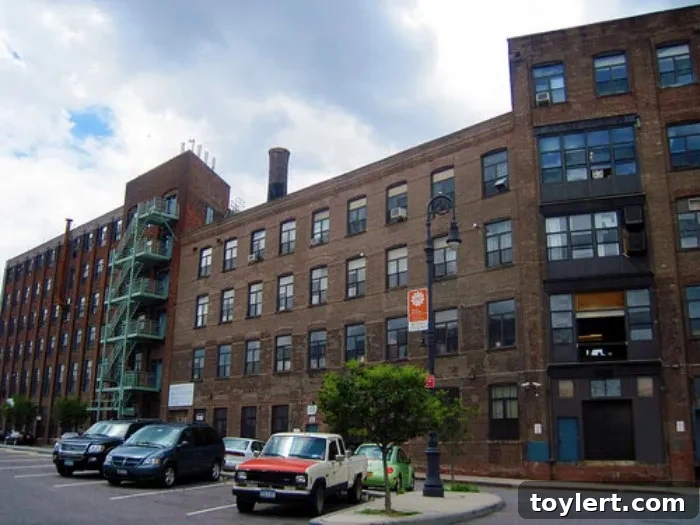
It was within this thriving landscape that the Chelsea Fiber Mills established its roots at 1155 Manhattan Avenue. While specific historical records detailing the exact founding date and precise operations of the Chelsea Fiber Mills might be extensive, the name itself suggests a focus on processing fibers, likely for textiles, ropes, or other industrial cordage. These mills were crucial players in an era when manufactured goods formed the backbone of the national economy. Buildings of this period, often characterized by their robust brick construction, large multi-paned windows, and utilitarian design, were built to last, engineered for both heavy machinery and the diligent workforce that operated them. The sheer scale and architectural integrity of 1155 Manhattan Avenue speak volumes about the ambition and output of its original occupant, the Chelsea Fiber Mills, and its significant contribution to Brooklyn’s industrial might.
The rhythmic clang and whir of machinery, the scent of fibers, and the bustling activity within these walls were once commonplace sounds and sensations that defined life and labor in industrial Greenpoint. This building wasn’t just a structure; it was an economic engine, providing livelihoods and contributing to the supply chains that powered a growing nation. Its location on Manhattan Avenue, a primary thoroughfare, would have ensured easy access for materials and distribution, further cementing its importance in the local industrial ecosystem.
The Dawn of a New Era: The Greenpoint Manufacturing and Design Center (GMDC)
As the 20th century progressed, economic shifts led to the decline of traditional heavy manufacturing in many American cities, including Brooklyn. Factories closed, jobs moved overseas, and once-vibrant industrial districts faced an uncertain future. Greenpoint was not immune to these changes, and many of its magnificent industrial buildings, including the former Chelsea Fiber Mills, risked falling into disrepair or being demolished for new developments. However, a forward-thinking vision emerged, one that recognized the intrinsic value of these historic structures and the enduring need for manufacturing and creative spaces within an evolving urban landscape.
This vision materialized in the form of the Greenpoint Manufacturing and Design Center (GMDC). The GMDC is a non-profit industrial developer whose mission is to provide affordable, flexible, and secure workspace for small and medium-sized manufacturing and design businesses in New York City. Their acquisition and adaptive reuse of 1155 Manhattan Avenue was a pivotal moment for both the building and the Greenpoint community. Rather than razing history, GMDC embarked on a transformative journey to breathe new life into the old mill, meticulously adapting its robust framework to suit the needs of contemporary artisans, fabricators, and creative entrepreneurs.
The transformation of 1155 Manhattan Avenue into a GMDC facility represents a shining example of adaptive reuse. This sustainable development practice involves repurposing existing buildings for new functions, thereby preserving architectural heritage, reducing waste, and often revitalizing neighborhoods. For the former Chelsea Fiber Mills, this meant carefully renovating the sprawling interior spaces to create individual units, while respecting the building’s historical character. High ceilings, large windows that flood spaces with natural light, and the durable structural elements of the original mill were all leveraged to create ideal environments for modern creative and industrial work.
GMDC at 1155 Manhattan Avenue: A Hub of Creativity and Craftsmanship Today
Today, 1155 Manhattan Avenue stands as a dynamic nexus of diverse businesses and artistic endeavors, a true microcosm of Brooklyn’s contemporary economy. The GMDC facility here houses an eclectic mix of tenants, ranging from traditional manufacturers and metal fabricators to furniture makers, fashion designers, tech startups, and a multitude of visual artists and artisans. This deliberate curation fosters a collaborative ecosystem where different crafts and industries can coexist, often inspiring cross-pollination of ideas and services.
The importance of GMDC, and specifically the 1155 Manhattan Avenue location, cannot be overstated for the local economy and community. By providing stable, affordable industrial space, GMDC enables small businesses to grow, innovate, and create local jobs that might otherwise be pushed out of a rapidly gentrifying urban environment. These businesses contribute to the unique character of Greenpoint, offering locally made goods and services that enrich the neighborhood’s cultural and economic tapestry.
Walking through the corridors of 1155 Manhattan Avenue today is an experience in itself. The building, while retaining its historic industrial charm, now buzzes with the hum of modern machinery, the scent of fresh wood or paint, and the focused energy of skilled creators. It’s a place where traditional craftsmanship meets cutting-edge design, where the legacy of the Chelsea Fiber Mills continues in a new, exciting form. Tenants benefit from shared resources, a supportive community, and the inherent character of a building designed for enduring work.
Architectural Splendor and Functional Design
The architectural presence of 1155 Manhattan Avenue is undeniable. Its imposing brick facade, a hallmark of 19th-century industrial architecture, commands attention. The building’s design prioritizes functionality, with its robust load-bearing walls, generous floor plates, and strategically placed windows. These large windows, once essential for natural light to illuminate detailed factory work, now serve the same purpose for artists and craftspeople, reducing the need for artificial lighting and contributing to a pleasant working environment.
The interior spaces are equally impressive. High ceilings provide ample vertical clearance, crucial for machinery, large-scale art installations, or multi-level studio setups. The open-plan layouts, typical of old mills, offer unparalleled flexibility, allowing tenants to customize their workspace according to their specific needs. Exposed brick, original timber beams (if present), and sturdy concrete floors often feature prominently, adding to the authentic industrial aesthetic that many tenants find inspiring and practical.
This fusion of architectural heritage with modern utility is what makes 1155 Manhattan Avenue so remarkable. It’s a living museum of Greenpoint’s past, meticulously adapted to facilitate its future. The building stands as a powerful symbol of how historical structures can be preserved not merely as static monuments, but as dynamic, productive spaces that continue to serve their communities in new and essential ways.
The Broader Impact: Adaptive Reuse and Urban Sustainability
The story of 1155 Manhattan Avenue extends beyond its immediate walls, serving as a powerful case study for sustainable urban development through adaptive reuse. In an age where rampant new construction often leads to homogenous cityscapes and significant environmental impact, projects like the GMDC’s re-imagining of the former Chelsea Fiber Mills offer a vital alternative. By reusing existing structures, developers minimize demolition waste, reduce the carbon footprint associated with new material production, and preserve the unique character and history of a neighborhood.
Moreover, adaptive reuse projects often contribute significantly to community revitalization. They can anchor economic activity in an area, attract new businesses and residents, and create a sense of continuity and place. For Greenpoint, the presence of the GMDC at 1155 Manhattan Avenue ensures that manufacturing and creative industries remain a part of its identity, preventing the neighborhood from becoming solely residential or purely commercial. It fosters a diverse urban economy, crucial for long-term resilience and vibrancy.
The success of GMDC’s initiatives, particularly at the 1155 Manhattan Avenue site, has inspired similar projects across Brooklyn and other urban centers. It demonstrates that with vision, strategic planning, and a commitment to preservation, industrial heritage can be transformed into thriving hubs for the 21st century, honoring the past while building a sustainable future.
A Testament to Brooklyn’s Enduring Spirit
From the industrial might of the Chelsea Fiber Mills to the creative dynamism of the Greenpoint Manufacturing and Design Center, 1155 Manhattan Avenue stands as a powerful symbol of Brooklyn’s enduring spirit of transformation and innovation. It is a building that has adapted through economic shifts, embracing new purposes while retaining the sturdy character of its origins. It encapsulates the very essence of Brooklyn: a borough that respects its roots, embraces its working-class heritage, and constantly reinvents itself for the future.
This magnificent structure is more than just bricks and mortar; it is a repository of history, a crucible of creativity, and a cornerstone of Greenpoint’s evolving identity. As visitors and residents traverse Manhattan Avenue, the former Chelsea Fiber Mills, now the GMDC, serves as a poignant reminder that Brooklyn’s past is not merely preserved in museums, but actively lives on, shaping and inspiring its vibrant present and promising future.
Name: Former Chelsea Fiber Mills, now Greenpoint Manufacturing and Design Center (GMDC) at 1155 Manhattan Avenue