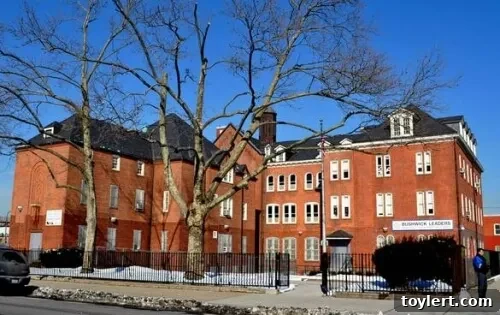
The Enduring Legacy of 797 Bushwick Avenue: From Sanctuary to School
Brooklyn, one building at a time. Few structures in New York City tell a story as compelling and transformative as 797 Bushwick Avenue. Nestled within the vibrant and ever-evolving neighborhood of Bushwick, this magnificent edifice has served diverse community needs for well over a century. Its walls have witnessed epochs of change, from providing compassionate care to the elderly poor to fostering academic excellence for the youth of today. This article delves into the rich history and architectural journey of this significant Brooklyn landmark, tracing its evolution from St. Augustine’s Home for the Aged, operated by the venerable Little Sisters of the Poor, to its current incarnation as the prestigious Bushwick Leader’s High School for Academic Excellence.
A Foundation of Compassion: St. Augustine’s Home for the Aged
The story of 797 Bushwick Avenue begins in an era defined by burgeoning urban populations and a growing need for social welfare institutions. In the late 19th and early 20th centuries, Brooklyn, much like the rest of New York City, experienced rapid expansion, attracting countless immigrants and residents seeking new opportunities. With this growth came an increased demand for charitable organizations to care for the vulnerable, particularly the elderly who often lacked family support or adequate resources.
It was against this backdrop that the Little Sisters of the Poor, a Catholic religious congregation founded in France in 1839 by Saint Jeanne Jugan, established their presence in Brooklyn. Their mission, deeply rooted in Christian charity, was to care for the destitute elderly of every race and religion, providing them with a safe, dignified home in their twilight years. The sisters relied entirely on providence, begging for food, clothing, and funds, embodying a spirit of humility and unwavering dedication to their charges.
Around the turn of the 20th century, the Little Sisters embarked on building St. Augustine’s Home for the Aged at 797 Bushwick Avenue. This wasn’t merely a building; it was envisioned as a true sanctuary, a place where the elderly poor could find solace, medical attention, and spiritual comfort. The location in Bushwick, then a rapidly developing residential area with strong community ties, was ideal for serving a population in need. The construction of such a grand and substantial building underscored the community’s commitment to social welfare and the significant role of religious orders in providing essential services.
Architectural Grandeur and Purposeful Design
The architecture of 797 Bushwick Avenue reflects the institutional grandeur and robust construction characteristic of its era. Likely designed in a Romanesque Revival or Collegiate Gothic style, typical for large civic or religious buildings of the late 19th or early 20th century, the structure commands attention with its imposing scale and durable materials. Red brick, often accented with limestone or terra cotta details, would have been the material of choice, chosen for its longevity, aesthetic appeal, and ability to convey a sense of permanence and dignity.
The building would have featured multiple stories, large windows designed to maximize natural light for its residents, and possibly a prominent central entrance adorned with arches or decorative stonework. Its layout would have been meticulously planned to accommodate numerous residents, communal dining halls, infirmaries, chapels, and living quarters for the sisters. Spacious grounds surrounding the building would have provided areas for recreation and quiet contemplation, offering a tranquil retreat from the bustling city streets. Every architectural detail, from the sturdy foundations to the intricate roofline, would have been imbued with the purpose of creating a safe, functional, and comforting environment for those in their care.
A New Dawn: Bushwick Leader’s High School for Academic Excellence
As decades passed, the urban landscape of Brooklyn, and indeed Bushwick, continued to evolve. Social structures shifted, healthcare provisions changed, and the needs of the community transformed. By the late 20th or early 21st century, the Little Sisters of the Poor, facing changing demographics, rising operational costs, and the consolidation of their services, made the difficult decision to transition out of St. Augustine’s Home. This marked the end of an era, but also paved the way for a new chapter in the building’s storied life.
Recognizing the immense potential of such a significant and well-built structure, the New York City Department of Education acquired the property, envisioning its transformation into a vital educational institution. In 2004, the building reopened its doors as Bushwick Leader’s High School for Academic Excellence. This marked a profound, yet remarkably harmonious, adaptive reuse of the historic space. The mission shifted from nurturing the elderly to cultivating the minds of young adults, preparing them for higher education and future leadership roles within their communities and beyond.
Adaptive Reuse: Preserving History, Fostering Education
The conversion of a home for the aged into a modern high school presented unique challenges and opportunities. The school’s design team meticulously worked to preserve the building’s historical integrity while updating it to meet contemporary educational standards. Dormitory rooms were creatively transformed into bright, functional classrooms equipped with the latest technology. Communal spaces, such as the former dining halls or recreational areas, found new life as libraries, science labs, art studios, and administrative offices. The former chapel, a space once dedicated to quiet reflection and worship, might have been repurposed into a grand auditorium or a spacious multi-purpose room, continuing its legacy as a gathering place for the community.
This adaptive reuse is a testament to the enduring quality of the original construction and a thoughtful approach to urban development. Instead of demolition and new construction, which often erases architectural heritage, the project embraced the building’s inherent strength and character. Students at Bushwick Leader’s High School now learn within walls that hold generations of history, offering a tangible connection to the past while shaping their future. The building itself becomes a living lesson in sustainability, preservation, and the power of reinvention.
797 Bushwick Avenue: A Beacon of Community Resilience
Today, 797 Bushwick Avenue stands not just as a school, but as a symbol of Brooklyn’s resilience and its commitment to caring for its citizens, whether through elder care or education. Its architectural presence continues to anchor a prominent corner of Bushwick Avenue, contributing significantly to the neighborhood’s distinctive character. It serves as a visual reminder of the area’s rich past, when charitable institutions played a crucial role in the social fabric, and its vibrant present, where educational opportunities are paramount.
The building’s journey encapsulates a powerful narrative of purpose and transformation. From the compassionate embrace of the Little Sisters of the Poor, who devoted their lives to serving the most vulnerable, to the dynamic environment of Bushwick Leader’s High School, which empowers the next generation, the core mission of service to the community remains unbroken. This continuity, albeit in different forms, speaks volumes about the enduring spirit of the institution and the community it serves.
As students walk through its impressive doorways each day, they are not merely entering a school; they are stepping into a living piece of Brooklyn history. They are part of an ongoing legacy that began with selfless devotion and now continues with academic aspiration. The adaptive reuse of 797 Bushwick Avenue is a shining example of how historical structures can be revitalized to meet contemporary needs, providing functional spaces while preserving the architectural and cultural heritage that defines our cities.
Conclusion: A Landmark Transformed, A Legacy Continued
The architectural grandeur and profound historical significance of 797 Bushwick Avenue make it a truly remarkable building. Its transformation from St. Augustine’s Home for the Aged, a beacon of charity managed by the Little Sisters of the Poor, to Bushwick Leader’s High School for Academic Excellence, a center for learning and growth, is a powerful narrative of adaptation and enduring community service. This Brooklyn landmark embodies the spirit of resilience that defines the borough itself, gracefully evolving to meet the changing needs of its residents while retaining its majestic presence.
By exploring the multifaceted history of buildings like 797 Bushwick Avenue, we gain a deeper appreciation for the layers of stories embedded in our urban environment. It is a testament to the fact that while functions may change and communities may transform, the inherent value of well-built structures, and the purposes they serve, can continue to enrich our lives for generations to come. Brooklyn’s architectural heritage is alive and thriving, one building at a time, with 797 Bushwick Avenue standing proudly as a testament to its enduring legacy.