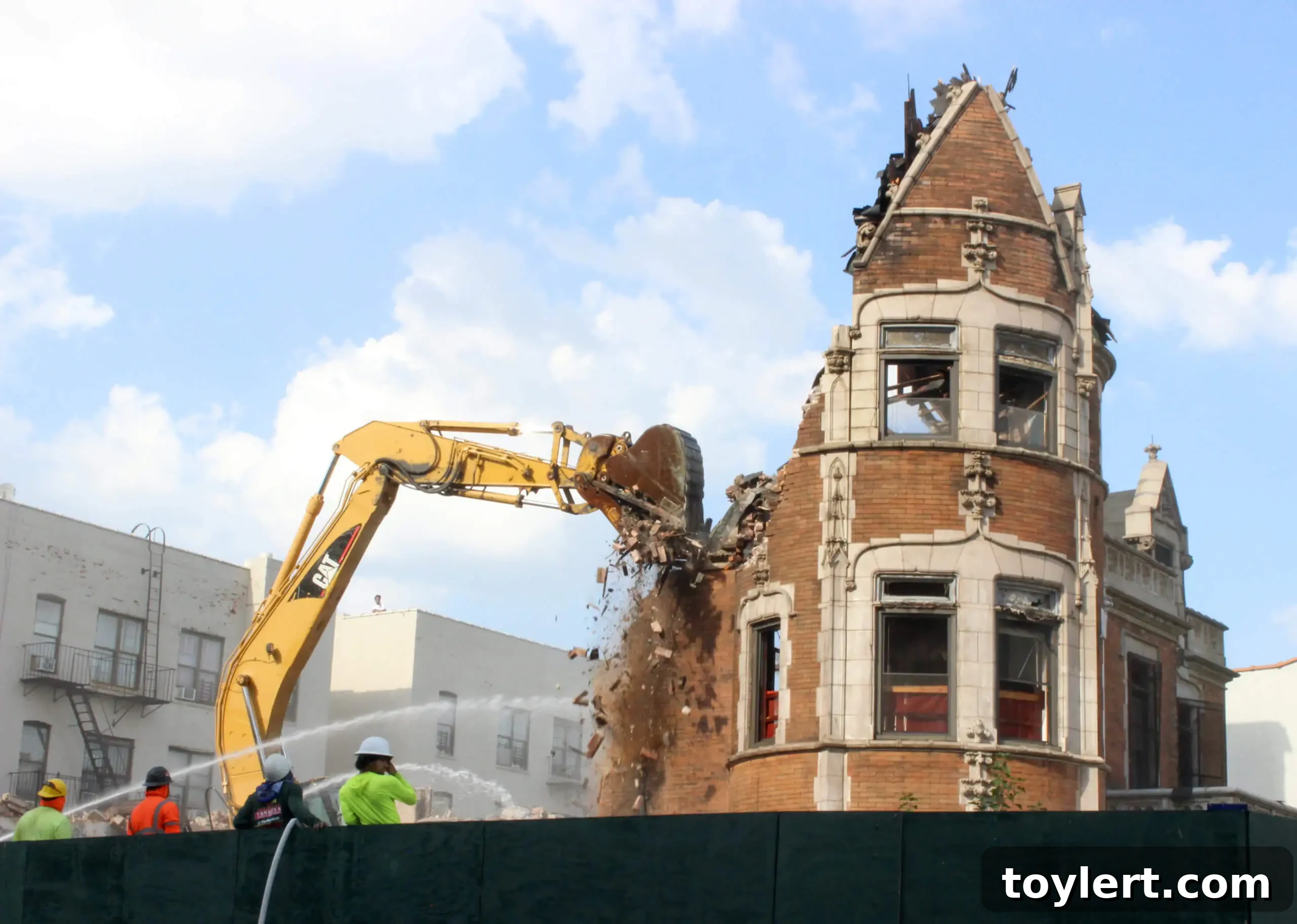
The air on Willoughby Avenue was heavy with a profound sense of loss Thursday night, as a sorrowful crowd bore witness to the irreversible demolition of Bed-Stuy’s cherished Jacob Dangler mansion. Tears flowed freely, echoing the community’s collective heartache as decades of history and architectural grandeur crumbled into dust. This was more than just the dismantling of a building; it was the tearing down of a local landmark, a vibrant piece of Brooklyn’s soul, and a symbol of a bygone era.
For many, the sight was unbearable. Michael Williams, a long-time resident of Willoughby Avenue, voiced the raw emotion shared by countless neighbors. “I’m sad, I’m hurt,” he told reporters, his voice tinged with the grief of witnessing a beloved fixture vanish before his eyes. His sentiments resonated deeply within the crowd, where others struggled to find words adequate enough to describe the devastating scene. Phrases like “gut-wrenching,” “demoralizing,” and “deflating” were heard, paintstakingly illustrating the depth of despair. Beneath the sadness, a palpable anger simmered – anger at the loss, at the swiftness of the destruction, and at the perceived disregard for the community’s heritage.
The emotional weight of the event extended even to those who passed by. One man, cycling past the site as the demolition machinery tore through the venerable structure, paused, his face a mask of disbelief. “I work for the city, so this is painful,” he remarked, his voice heavy with disappointment, having mistakenly believed the iconic building had been spared from such a fate. His reaction underscored a widespread hope that, despite the ongoing challenges, such an architectural treasure would ultimately be preserved.
The Grandeur and Legacy of the Jacob Dangler Mansion
For over 120 years, the magnificent French Gothic Revival building had served as a proud anchor at the corner of Willoughby and Nostrand Avenues. Its intricate stonework, towering gables, and elegant turrets were not merely architectural features; they were a testament to the craftsmanship and aesthetic values of the late 19th century. Built for Jacob Dangler, a successful German-American pork packer and businessman, the mansion was a reflection of the prosperity and refined tastes that characterized Brooklyn’s burgeoning elite at the turn of the century. It stood as one of the finest examples of its architectural style in the borough, its distinctive silhouette a familiar and comforting presence against the Bed-Stuy skyline.
Beyond its aesthetic appeal, the Dangler mansion held significant historical value. It represented a direct link to Brooklyn’s industrial past and the prominent figures who shaped its development. The building’s unique design, characterized by its ornate detailing and robust construction, commanded respect and admiration from both architectural enthusiasts and local residents alike. It wasn’t just a house; it was a living monument, a repository of stories, and a visual bookmark in the ongoing narrative of the neighborhood. Its presence profoundly contributed to the unique character and historic ambiance of Bed-Stuy, distinguishing it from the ever-changing urban landscape of New York City. The mansion wasn’t just observed; it was experienced, woven into the daily lives and memories of generations of Brooklynites.
A Community’s Heartbreak and the Battle for Preservation
The community’s deep emotional response to the demolition was not sudden but the culmination of years of advocacy and fervent hope for the mansion’s preservation. For many residents, the Jacob Dangler mansion was more than just an old building; it was an integral part of their neighborhood’s identity, a familiar backdrop to their lives, and a symbol of the rich history that defines Bed-Stuy. Efforts to landmark the property and secure its future had been ongoing, spearheaded by passionate local groups and preservationists who recognized its irreplaceable value. These campaigns often involved rallying public support, engaging with city officials, and meticulously documenting the mansion’s historical and architectural significance. The widespread belief that the building could, and should, be saved fueled a persistent optimism, even in the face of daunting challenges.
The sudden and brutal act of demolition, therefore, felt like a betrayal. It underscored the vulnerability of historic structures in New York City, particularly those that lack official landmark status. Despite the tireless efforts and the vocal outcry from the community, the machinery of development often moves with an unstoppable force. The scene on Willoughby Avenue was a stark reminder of this power imbalance, as countless onlookers could only watch helplessly as their shared heritage was systematically dismantled. The tears shed were not just for the building itself, but for the erosion of community power, the diminishing voice of residents in decisions that profoundly impact their neighborhoods, and the heartbreaking realization that sometimes, even the most cherished landmarks cannot withstand the relentless march of progress.
The Swift Fall: Developers’ Disregard for Heritage
In a matter of mere hours, what had stood majestically for over a century came crumbling down, transforming into a chaotic pile of rubble and twisted debris. The speed and efficiency of the demolition were jarring, a stark contrast to the slow, painstaking craftsmanship that had originally brought the mansion to life. More disheartening still was the apparent lack of effort by the developers to salvage any of the historic structure’s exquisite materials. Elements like the detailed terracotta, ornate woodwork, and intricate stained glass, which held immense historical and artistic value, appeared to be summarily discarded as mere construction waste. This deliberate oversight signaled a profound disregard for the architectural heritage and the embedded stories within the Dangler mansion.
Such actions often indicate a prioritization of expediency and profit over the meticulous preservation of historical artifacts. Developers, driven by tight schedules and the desire to maximize returns, frequently find it more economically viable to completely clear a site rather than to carefully deconstruct and salvage materials. This approach, while efficient for development, represents a significant loss to the cultural fabric of a city. Each salvaged piece could have told a part of the mansion’s story, perhaps finding new life in other restoration projects or becoming educational tools in museums. Instead, the rapid, unceremonious destruction of the Dangler mansion underscores a concerning trend where profit motives overshadow the irreplaceable value of historic preservation, leaving communities with little more than memories and a gaping void where a landmark once stood.
A Wider Lens: The Battle for Brooklyn’s Soul
The tragic end of the Jacob Dangler mansion serves as a poignant and urgent symbol in the ongoing struggle between urban development and historic preservation throughout Brooklyn and indeed, across New York City. Bed-Stuy, with its rich architectural tapestry and vibrant community history, is particularly susceptible to these pressures. As property values soar and the demand for new housing intensifies, older buildings – especially those without the robust protection of official landmark status – often become prime targets for developers eager to capitalize on lucrative real estate opportunities. This scenario often pits long-standing communities and dedicated preservationists against powerful development interests, creating a contentious environment where the very character of neighborhoods hangs in the balance.
The loss of the Dangler mansion is not an isolated incident; it’s a recurring narrative in a city constantly grappling with its past and future. It highlights critical vulnerabilities within the existing preservation framework, exposing how quickly a treasured piece of history can be erased when economic incentives outweigh cultural value. This event should serve as a wake-up call, prompting deeper reflection on how New York City balances growth with the imperative to protect its irreplaceable architectural heritage. It underscores the urgent need for more proactive measures, stronger protections, and greater community involvement in the decision-making processes that determine the fate of these invaluable structures. Without enhanced efforts, more of Brooklyn’s distinctive soul risks being paved over, replaced by generic modern constructions that lack the historical depth and unique charm that define the borough.
The legacy of the Jacob Dangler mansion, now irrevocably lost, must continue to fuel the fight for preservation. It is a stark reminder that once a building of such significance is gone, it is gone forever, taking with it a piece of our shared history and the unique spirit of the neighborhoods it once graced. Moving forward, the tears shed on Willoughby Avenue must transform into a renewed determination to safeguard the remaining architectural treasures of Bed-Stuy and beyond, ensuring that future generations can still connect with the rich, tangible history that shaped this extraordinary city.