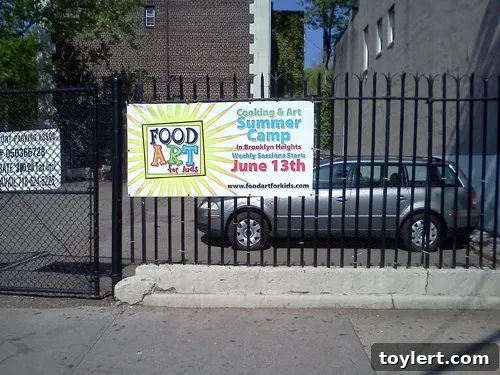
The Baffling Case of the Vanishing Summer Camp Banners in Brooklyn
In the bustling heart of Brooklyn, a curious and frustrating mystery has been unfolding, leaving local small business owner Michelle Thaler utterly bewildered. Her vibrant advertising banner for Food Art for Kids, a unique summer camp designed to inspire creativity and culinary exploration in children, has been stolen not once, but twice within a single month from its prominent location on the corner of Court and Bergen streets. This perplexing pattern of theft raises questions about community respect, the challenges faced by local entrepreneurs, and the very nature of low-level crime.
A Recurring Enigma: Two Banners Vanish
The ordeal began several weeks ago when Michelle’s initial banner, strategically placed to catch the eyes of parents and children in the neighborhood, mysteriously disappeared overnight. For a small business, such an act is more than just a minor inconvenience; it’s a direct blow to visibility and marketing efforts. After the initial theft, Michelle, an enterprising entrepreneur and former lawyer, took swift action. She invested in a new, slightly smaller banner, meticulously ensuring all permissions were in place with the property owners at Court and Bergen. Confident that her advertising was both legal and visually unobtrusive, she rehung it on a Saturday, hopeful that the first incident was an isolated, if bizarre, occurrence.
However, her optimism was short-lived. By Monday morning, less than 48 hours after its reinstallation, the replacement banner too had vanished. This second, rapid disappearance elevated the situation from an odd incident to a targeted campaign, leaving Michelle searching for answers. “To my surprise, within less than 2 days, that banner went missing as well!” she expressed in an email, clearly flummoxed by the persistent targeting of her camp’s advertisement.
Michelle Thaler’s Stand: Legality, Aesthetics, and the Local Landscape
Michelle Thaler brings a unique perspective to this situation, shaped by her background in law. She meticulously confirmed that her form of advertisement does not require a municipal permit or license, provided she secures the express permission of the lot owners – a step she diligently completed. This legal certainty only deepens her confusion regarding the thefts. “Being a lawyer, I know that this form of advertisement does not require a permit or a license, as long as I get the permission of the owners of the lot (which, of course, I did),” she affirmed.
Beyond legalities, Michelle also strongly refutes any notion that her banner might be an unwelcome addition to the streetscape. “The banner, as you can see in the pic, is not an eye sore, and did not ‘uglyfy’ the street scenery in any way!” she insists. Indeed, the banner for Food Art for Kids is designed to be appealing and informative, reflecting the creative spirit of the camp itself. She points out the widespread presence of similar banners throughout the neighborhood: “There are many banners similar to mine in the neighborhood… religious institutions put them up on their fences all the time and so are other businesses… it just makes me wonder why mine is causing so much opposition!” This observation underscores a crucial point: if other banners coexist peacefully, why is hers singled out for such repeated acts of vandalism?
The Rippling Impact on a Small Business
While the monetary value of a single banner, estimated at approximately $200, might seem minor to some, the true damage to Michelle’s small business, Food Art for Kids, is far more substantial and insidious. As the summer season approaches, effective advertising is paramount for summer camps looking to attract enrollments. Each day the banner is missing represents lost visibility and missed opportunities to reach potential families. The psychological toll on a dedicated entrepreneur cannot be overstated either. Michelle articulates this profound impact: “I can’t even begin to describe the damage to the business side being that summer is close and I want as many families to know about my camp.”
For a small, local business like Food Art for Kids, every advertising dollar counts, and traditional methods like banners on busy streets remain a cost-effective way to engage with the immediate community. The repeated thefts force Michelle to divert precious resources and time away from camp preparations and directly engaging with families, instead spending them on replacing banners and dealing with this frustrating predicament. It’s a classic example of how seemingly small acts of vandalism can create significant obstacles for the backbone of our local economy: small businesses.
Unraveling the Motive: Who and Why?
The sustained nature of these thefts suggests something more than a random prank. Michelle herself dismisses the idea of teenagers being responsible, noting, “I don’t suspect that it was teenagers since they usually get bored after pulling a stunt once and don’t do it again.” This points towards a more deliberate, perhaps even targeted, agenda. But what could be the motive behind such persistent harassment of a children’s summer camp?
Several theories might be considered, though none offer a clear explanation. Could it be a disgruntled individual with a personal vendetta against Michelle or her business? Is it an overly zealous competitor, though such an act is highly unprofessional and unethical? Or perhaps it’s someone with an extreme anti-advertising stance, mistakenly targeting a local business’s legitimate promotional efforts? The fact that the banners are stolen rather than simply defaced further complicates the puzzle, implying the perpetrators are actively removing the advertisement from public view, perhaps to prevent its message from spreading. The absence of any discernible pattern or specific message from the culprits only adds to the mystery, filing this bizarre string of events squarely under “news of the weird.”
Considering reporting the incidents to the police, Michelle recognizes the practical limitations. “I thought about going to the police but that actual damage is just the banner’s value ($200),” she observed. While the financial cost of the banner itself is relatively low, the broader impact on her business is immeasurable. Law enforcement resources are often stretched, and while such acts are technically theft and vandalism, they may not always receive immediate high priority, leaving small business owners like Michelle feeling vulnerable and without clear recourse.
Community Support and the Path Forward
This unusual case highlights the essential role of community support for local businesses. When entrepreneurs dedicate themselves to providing valuable services, like the creative and educational offerings of Food Art for Kids, they rely on a respectful and supportive environment. Incidents like these not only cause financial strain but also erode morale, making the already challenging journey of small business ownership even tougher.
Moving forward, Michelle Thaler faces a difficult choice. Should she invest in more secure, perhaps permanent, signage? Or is it time to explore alternative marketing strategies that are less susceptible to theft? Her resilience, like that of many Brooklyn small business owners, will undoubtedly guide her next steps. This puzzling situation serves as a stark reminder of the unexpected hurdles that can arise, even for legitimate and well-intentioned local ventures. It also prompts a collective community question: why would anyone repeatedly target a summer camp banner, and what can be done to foster a more respectful environment for all local businesses?
The story of Michelle Thaler and her vanishing banners is more than just a peculiar local news item; it’s a testament to the dedication required to run a small business and a call for greater awareness and protection of the local enterprises that enrich our neighborhoods.
For further context on these events, you can refer to the earlier report: Summer Camp Banner Stolen on Court Street Last Night.