Reimagining Atlantic Yards: Innovative Architectural Visions for Brooklyn’s Future
The Atlantic Yards project, initially proposed by Forest City Ratner (FCR), has long been a subject of intense debate and considerable controversy within New York City’s urban planning landscape. While the development ultimately brought significant transformations to downtown Brooklyn, its sheer scale, design philosophy, and profound impact on the existing community frequently drew sharp criticism. Now, a wave of fresh perspective is emerging as five visionary architecture teams have stepped forward to reimagine this pivotal site. They are presenting their creative and cutting-edge designs in an upcoming exhibit at a Prospect Heights gallery, promising to offer compelling alternatives.
These proposals are far from mere academic exercises; they aim to ignite a vital public discourse, seeking a more contextual, sustainable, and less problematic pathway for developing one of Brooklyn’s most strategically important urban parcels. Each of the five participating firms was tasked with an ambitious challenge: to incorporate the foundational numerical requirements derived from FCR’s original master plan, ensuring their designs addressed the same scope. This included a substantial 4,728,000 square feet of housing, 156,000 square feet of retail space, and the provision for 1,234 parking spaces. However, beyond these quantitative metrics, the architects were encouraged to push the boundaries of conventional urban design, focusing on qualitative improvements that could better integrate the development into its Brooklyn surroundings, foster genuine community, and introduce innovative solutions for modern urban living.
The Enduring Controversy of Atlantic Yards: A Brief Overview
To fully appreciate the significance and forward-thinking nature of these new architectural proposals, it’s essential to understand the contentious history surrounding the original Atlantic Yards project. First unveiled in the early 2000s, the plan called for a massive mixed-use development centered around a new arena for the Brooklyn Nets (the Barclays Center), alongside a cluster of high-rise residential towers, retail, and office spaces. The project quickly became a significant flashpoint for debate, largely due to its reliance on eminent domain to acquire existing properties, which led to concerns over the displacement of long-time residents and local businesses. Critics also highlighted a perceived lack of transparency and public input in its approval process, fueling community discontent.
Furthermore, many argued that the sheer scale of the proposed towers was profoundly out of character with the low-rise brownstone neighborhoods of Prospect Heights and Fort Greene. There were fears that these towering structures would cast long shadows, overwhelm the existing urban fabric, and fundamentally alter the neighborhood’s unique charm. Questions were also rigorously raised about the project’s promised affordable housing components, its potential environmental impact, and its overall ability to genuinely serve the diverse needs of the broader Brooklyn community. This backdrop of intense civic activism, architectural contention, and community resistance forms the fertile ground from which these new, alternative visions have powerfully sprung, seeking to address past criticisms with innovative solutions.
OperA Studio’s Vision: Twisting Forms and Elevated Green Spaces
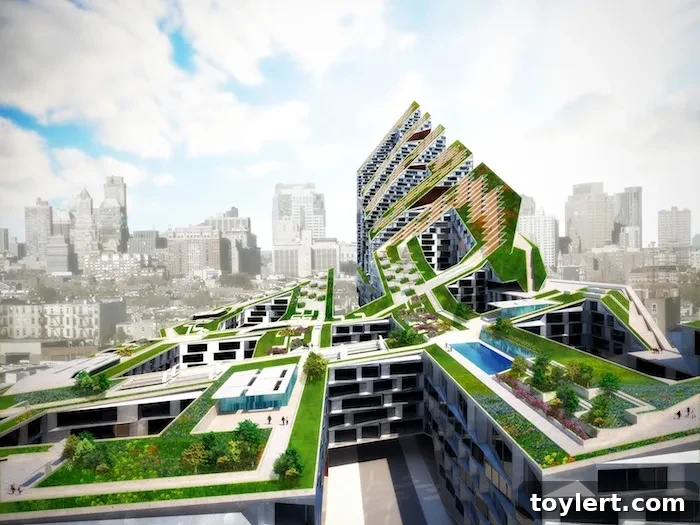
Among the first revealed designs, OperA Studio’s proposal immediately captures attention with its striking aesthetic and innovative utilization of space. They have conceptualized a futuristic, twisting structure that dramatically redefines the urban skyline with a sense of fluid movement. This design is characterized by a dynamic interplay of angled planes that meet to create not just visually engaging forms, but also an abundance of accessible public green space integrated directly atop the buildings. Imagine elevated parks, communal gardens, and landscaped terraces offering panoramic views of Brooklyn and the Manhattan skyline, transforming what would typically be unused rooftop areas into vibrant, accessible public amenities. This approach offers a stark and refreshing contrast to conventional urban planning, where green spaces are often confined to ground level and limited in scope.
OperA Studio’s design masterfully links the high-rise residential towers with vital ground-floor commercial spaces, ensuring a seamless and engaging pedestrian experience at street level. Furthermore, it intelligently connects with key existing infrastructure, specifically the iconic Barclays Center and the bustling Atlantic Terminal Mall, promising enhanced connectivity and synergy within the heart of the district. This vision emphasizes permeability and the creation of a ‘vertical public realm,’ inviting interaction, fostering a strong sense of community, and promoting pedestrian flow amidst the urban density. By re-imagining how public space can exist within a high-density development, OperA Studio offers a blueprint for more integrated and livable urban environments.
Amoia Cody Architecture: The Intimacy of Vertical Lots
Addressing a different yet equally crucial aspect of urban living – the often-overlooked need for private green space – Amoia Cody Architecture presents a design that offers a compelling and thoughtful solution. Their proposal introduces “vertical lots”, a concept that cleverly evokes the familiar spatial logic of Tetris pieces interlocking to form a cohesive whole. This ingenious design essentially carves out private outdoor areas within the residential towers, ensuring that each floor, or rather, each dwelling, benefits from its own dedicated terrace “yard.” In dense urban environments where private outdoor space is often considered an unaffordable luxury, Amoia Cody’s approach is truly revolutionary.
It offers residents the invaluable opportunity to connect with nature, cultivate personal gardens, or simply enjoy fresh air and private outdoor relaxation without having to leave their homes or compete for limited communal ground-level spaces. This strong focus on individual well-being and integrated living is a significant departure from traditional high-rise models, which frequently relegate residents to small, shared balconies or distant public parks. By prioritizing these intimate, private green zones, Amoia Cody Architecture crafts a profound vision for urban density that does not compromise on quality of life, individual amenity, or a personal connection to the natural world. It underscores a shift towards more humane and user-centric urban design principles.
Exploring Other Groundbreaking Concepts
While OperA Studio and Amoia Cody Architecture provide distinct yet complementary visions, the other three participating teams also contribute equally innovative and thought-provoking perspectives to the Atlantic Yards challenge. Each has taken the core requirements and infused them with unique architectural philosophies, pushing the boundaries of what integrated urban development can truly achieve in the 21st century.
Team 3: The Modular and Adaptive Community Hub
One of the undisclosed teams focused on a highly modular and adaptive design, envisioning Atlantic Yards as a dynamic community hub capable of evolving and reconfiguring over time. Their proposal emphasizes flexible mixed-use spaces that can seamlessly transform from residential to commercial, or even cultural, depending on future community needs and market demands. This modularity extends to the building’s facade and internal layouts, allowing for easy reconfigurations without the need for extensive and costly demolition. The design integrates public plazas and pedestrian pathways that flow directly into adjacent neighborhoods, actively breaking down the physical and psychological barriers often created by large-scale developments. This team champions a ‘living infrastructure’ approach, where the buildings are not static entities but rather responsive frameworks designed for long-term sustainability and adaptability, fostering a true sense of belonging and collective ownership among residents and local businesses.
Team 4: Blending History with Modernity
Another compelling design delves deeply into the rich historical context of brownstone Brooklyn. This team sought to expertly bridge the gap between the area’s cherished architectural heritage and the demands of modern high-density living. Their proposal features a series of thoughtfully articulated stepped facades and carefully selected material palettes that subtly echo the traditional aesthetics of the surrounding neighborhoods, creating a harmonious visual transition rather than an abrupt, jarring juxtaposition. Emphasis is placed heavily on the human scale at street level, with vibrant retail storefronts, intimate pocket parks, and wide, tree-lined boulevards all meticulously designed to enhance the pedestrian experience and encourage local engagement. The residential towers, while modern in their amenities and internal design, are carefully articulated to reduce their perceived mass and integrate seamlessly with the existing urban fabric. This approach seeks to demonstrate that large-scale development need not erase local history but can, in fact, enrich it by thoughtfully incorporating local character and community scale.
Team 5: Hyper-Sustainable and Resilient Urban Ecosystem
The fifth architectural team presented a bold and ambitious vision centered on hyper-sustainability and urban resilience. Their design imagines Atlantic Yards as a self-sufficient urban ecosystem, integrating advanced green technologies throughout the entire complex. This includes extensive rainwater harvesting and greywater recycling systems, building-integrated photovoltaics for on-site clean energy generation, and sophisticated climate-adaptive facades that intelligently respond to changing environmental conditions. The proposal features expansive urban farms on rooftops and striking vertical gardens on building exteriors, contributing significantly to local food production, enhancing biodiversity, and noticeably improving air quality. Furthermore, the design incorporates robust infrastructure specifically engineered to withstand future climate challenges, making it a pioneering model for resilient urban planning. This team’s innovative work underscores the critical need for new developments to not only be aesthetically pleasing and highly functional but also ecologically responsible, socially equitable, and comprehensively prepared for the complex challenges of the 21st century.
Common Threads: Innovation, Integration, and Sustainability
Despite their individual distinctiveness and unique design approaches, these five proposals share common underlying philosophies that represent a significant departure from conventional urban planning paradigms. A pervasive and powerful theme across all designs is the profound commitment to integrating green spaces – encompassing both public and private realms – into the very fabric of the development. This recognizes their crucial role in enhancing the quality of life, promoting biodiversity, and improving urban aesthetics. Furthermore, all designs demonstrate a thoughtful and deliberate approach to community integration, striving to create permeable and welcoming spaces that foster genuine connectivity with the surrounding neighborhoods rather than isolating the development behind imposing barriers.
Sustainability, in its broadest and most holistic sense, is another unifying principle, encompassing not just environmental responsibility but also social equity, long-term economic viability, and inherent adaptability. These architects are not merely designing buildings; they are meticulously envisioning vibrant, resilient communities that prioritize human experience, ecological health, and thoughtful, progressive urban growth. Their collective work signals a paradigm shift towards developments that are intrinsically connected to their environment and the people who inhabit them, focusing on long-term well-being over short-term gains.
Sparking Public Debate: The Exhibit’s Core Purpose
The upcoming exhibit at the Prospect Heights gallery serves as more than just a showcase of architectural talent and innovative design; it is, at its heart, a deliberate and urgent call to action. By presenting these diverse and compelling alternatives, the architects hope to reignite a robust public debate surrounding urban development, particularly concerning projects of the immense scale and profound impact of Atlantic Yards. The overarching goal is to move beyond the often-polarized and confrontational discussions that typically characterize large-scale developments and instead foster a constructive, inclusive dialogue about how cities can grow responsibly, beautifully, and equitably for all their inhabitants. It is an open invitation for residents, policymakers, urban planners, and developers alike to consider what truly constitutes a “contextual” and “less problematic” way to build and evolve our cities. These visionary proposals serve as tangible, inspiring proof that innovative, community-centric, and sustainable alternatives are not only possible but also absolutely essential for shaping a brighter future for our urban landscapes.
The Future of Urban Development in Brooklyn and Beyond
The comprehensive reimagining of Atlantic Yards by these five exceptional architectural teams offers a compelling and optimistic glimpse into the future of urban development, not just for Brooklyn but for metropolitan areas worldwide. Their collective work underscores a growing and vital recognition that successful urban projects must transcend mere functionality and economic viability; they must also wholeheartedly embrace ecological responsibility, social inclusivity, and unparalleled aesthetic excellence. As cities continue to grow at an unprecedented pace and face increasingly complex challenges like climate change, persistent housing shortages, and the imperative need for vibrant, accessible public spaces, the kind of forward-thinking, holistic design demonstrated in these proposals becomes critically important. The exhibit promises to be a powerful testament to the boundless creative potential of architecture to address complex urban problems, fostering a profound vision of cities that are not just dense but also wonderfully diverse, incredibly dynamic, and deeply connected to both their human inhabitants and their natural environments. This movement towards integrated, sustainable urbanism represents a beacon of hope for future generations.