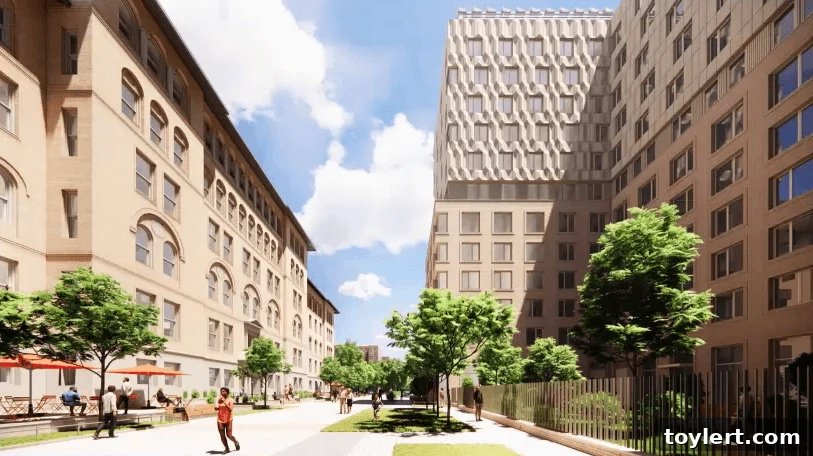
The recent public hearing hosted by the City Planning Commission marked a pivotal moment for East Williamsburg, as ambitious plans for a large-scale, completely affordable housing development at the former Greenpoint Hospital site were met with overwhelming praise. This significant proposal promises to deliver much-needed affordable homes to a community that has long championed the responsible redevelopment of this crucial urban parcel.
Greenpoint Hospital Site Poised for Transformation into East Williamsburg’s Beacon of Affordable Housing
East Williamsburg is on the cusp of a transformative change, with the proposed redevelopment of the former Greenpoint Hospital site into a sprawling, 100% affordable housing complex. This ambitious project, provisionally known as the Cooper Park Commons, has ignited a wave of enthusiasm, particularly from long-term residents and community advocates who have tirelessly campaigned for its fruition. The recent City Planning Commission hearing underscored the broad-based support and the urgent demand for such a development in one of Brooklyn’s rapidly evolving neighborhoods.
A Legacy of Advocacy: The Community’s Long Fight for Fair Development
For decades, the sprawling, disused grounds of the former Greenpoint Hospital have stood as a potent symbol of unrealized potential in East Williamsburg. Abandoned since the 1980s, the site has been a focal point for community organizing, with local residents consistently advocating for its redevelopment into something that truly serves the needs of existing populations, rather than contributing to further gentrification. Karen Leader, a resident of the nearby Cooper Park Houses for over 40 years, articulated the sentiment of many, stating, “Local residents like me have fought for proper development of this site, and have worked endless hours and years to see this community plan come to fruition.”
This statement encapsulates the deep-seated commitment and perseverance of the East Williamsburg community. Their vision for “proper development” has always centered on genuinely affordable housing, combined with essential community services and open spaces. The struggle has been arduous, involving numerous meetings, protests, and collaborative efforts with local elected officials and advocacy groups. The current proposal represents a significant victory for these grassroots efforts, validating years of dedication and demonstrating the power of collective action in shaping urban development.
Addressing Brooklyn’s Dire Need for Truly Affordable Housing
The enthusiastic community support for the Greenpoint Hospital site redevelopment is not merely a local phenomenon; it is a powerful reflection of a broader, critical need across Brooklyn for truly affordable housing. In a borough grappling with escalating rents, rampant gentrification, and an ever-widening gap between income levels and housing costs, developments that offer 100% affordability are exceptionally rare and immensely valuable.
Brooklyn has experienced an unprecedented surge in its real estate market over the past two decades, transforming many of its neighborhoods from working-class enclaves into highly desirable, often unaffordable, urban centers. This rapid change has displaced long-term residents, fractured communities, and exacerbated a housing crisis that affects tens of thousands of families. Many so-called “affordable” housing projects in New York City are still out of reach for low-income families, with eligibility requirements tied to Area Median Income (AMI) levels that are significantly higher than what many local residents earn.
Therefore, the commitment to a “completely affordable” development at the Greenpoint Hospital site is a groundbreaking distinction. It signals a dedication to serving the most vulnerable populations and ensuring that the benefits of urban renewal are shared equitably. This model stands in stark contrast to many other projects that blend market-rate units with a small percentage of affordable ones, often failing to address the deepest housing needs. The Greenpoint Hospital redevelopment, therefore, emerges as a potential paradigm shift, setting a new standard for inclusive urban planning in New York City.
The Vision for Cooper Park Commons: A Holistic Community Hub
While specific details continue to emerge through the planning process, the vision for the Cooper Park Commons at the Greenpoint Hospital site extends beyond mere housing units. The comprehensive plan envisions a vibrant, integrated community hub designed to enhance the quality of life for its residents and the surrounding East Williamsburg neighborhood. This typically includes a mix of housing types to accommodate diverse family sizes and needs, alongside a robust offering of community amenities.
Expected features for a development of this scale often encompass significant green spaces, playgrounds for children, and facilities for youth and senior programming. The inclusion of essential community resources, such as healthcare clinics, educational facilities, and spaces for local non-profits, is also a critical component that can foster a self-sufficient and thriving environment. Retail spaces that cater to local needs, rather than high-end boutiques, are also crucial for maintaining the neighborhood’s character and providing convenient services to residents.
The architecture and urban design will likely prioritize sustainability and integrate seamlessly with the existing fabric of East Williamsburg. Considerations for public transit accessibility, pedestrian-friendly pathways, and cyclist infrastructure will be integral to creating a well-connected and environmentally responsible development. This holistic approach ensures that the Cooper Park Commons will not only provide roofs over heads but also foster a strong sense of belonging, support economic stability, and contribute positively to the overall well-being of the community.
Navigating the City Planning Process and Gaining Momentum
The public hearing at the City Planning Commission represents a crucial stage in New York City’s Uniform Land Use Review Procedure (ULURP). This multi-stage process ensures transparency and provides opportunities for community input and rigorous review by various city agencies. The overwhelmingly positive reception at the hearing indicates that the project aligns well with the stated goals of the city and, crucially, the aspirations of the local population. Such strong support from residents, local leaders, and community boards often provides significant momentum as a project moves through subsequent approvals.
Following the City Planning Commission’s review, the proposal typically moves to the City Council for a final vote. The Council’s decision is often heavily influenced by the local council member, who acts as a key advocate for their district’s interests. Given the strong, organized backing from the East Williamsburg community, the project is well-positioned to garner favorable consideration during these later stages. The collaborative spirit demonstrated by all stakeholders – from grassroots activists to city planners – bodes well for the project’s successful navigation through the remaining bureaucratic hurdles.
A Blueprint for the Future: Impact and Precedent
The redevelopment of the Greenpoint Hospital site into Cooper Park Commons holds immense potential to serve as a powerful blueprint for future affordable housing initiatives across New York City and beyond. Its success would demonstrate that large-scale, 100% affordable developments are not only feasible but also deeply desired and critically important for maintaining the social and economic diversity of urban centers.
For the residents of East Williamsburg, the project promises more than just housing; it offers stability, dignity, and the opportunity to remain in a neighborhood they have called home for generations. It can alleviate the immense pressure of rising costs, allowing families to thrive, children to grow up in a stable environment, and seniors to age in place within their community. This kind of investment in existing communities strengthens social ties, fosters local economies, and prevents the displacement that so often accompanies urban growth.
Furthermore, this project reinforces the principle that community voices are paramount in urban planning. When city agencies genuinely listen to and collaborate with residents, the resulting developments are not only more successful but also more equitable and sustainable. The Greenpoint Hospital site redevelopment, with its strong emphasis on deep affordability and robust community input, has the potential to become a celebrated example of how to build inclusive, resilient cities in the face of widespread housing challenges.
As the Cooper Park Commons project moves forward, the optimism surrounding it is palpable. It represents a significant step towards addressing Brooklyn’s affordable housing crisis, showcasing the transformative power of dedicated community advocacy, and setting a high standard for future urban developments focused on genuine social equity.