Editor’s note: An updated version of this post can be viewed here.
Brooklyn Through Time: The Enduring Legacy of the Clarence Walker Seamans Mansion
The arc of human innovation often follows a similar, awe-inspiring path. Many of us remember the advent of the personal computer – a device that, upon its introduction, seemed to promise a future reimagined. Gathered around early models, we felt a palpable sense of wonder as we explored its features, convinced that this technology would redefine our daily lives. This transformative experience, replete with its initial sense of marvel and the subsequent widespread adoption, mirrors the journey of another groundbreaking invention that reshaped the world of communication: the typewriter. Just as the pioneers of computing foresaw a technological revolution, so too did the innovators behind the typewriter recognize its immense potential. Among these visionaries was a prominent New York State resident, Clarence Walker Seamans, whose acute business acumen and foresight in the burgeoning typewriter industry would catapult him to immense fortune and solidify his place in Brooklyn’s opulent history.
The late 19th century was a period of unprecedented industrial growth and social change in America, often referred to as the Gilded Age. This era saw the rise of new technologies that fundamentally altered how business was conducted, how information was disseminated, and even how people interacted. The typewriter, though seemingly mundane to our modern sensibilities, was a pivotal innovation of this period. Before its widespread adoption, all business correspondence and official documents were painstakingly handwritten, a laborious and time-consuming process. The typewriter promised efficiency, legibility, and standardization – qualities that businesses eagerly embraced. Its introduction sparked a quiet revolution in offices, transforming them from clerical bastions of male scribes into bustling hubs where efficiency reigned, and, notably, where women found a new and significant entry point into the professional workforce as typists and secretaries.
Clarence Walker Seamans was not merely a passive observer of this technological shift; he was an active architect of its expansion. Born in Syracuse, New York, Seamans’ journey began far from the grand mansions of Brooklyn. However, his sharp intellect and business savvy quickly propelled him into the vanguard of the burgeoning office equipment industry. He joined the Remington Typewriter Company, one of the most significant players in the early market. Remington, initially known for firearms, diversified into typewriters and became synonymous with the device. Seamans rose through the ranks, demonstrating exceptional leadership and an understanding of both product development and market strategy. His work was instrumental in refining the machine and, more importantly, in making it an indispensable tool for businesses across the nation and eventually the world. His contributions to the Union Typewriter Company, a formidable trust formed by consolidating several leading manufacturers, further cemented his status as a titan of industry, allowing him to amass a substantial personal fortune.
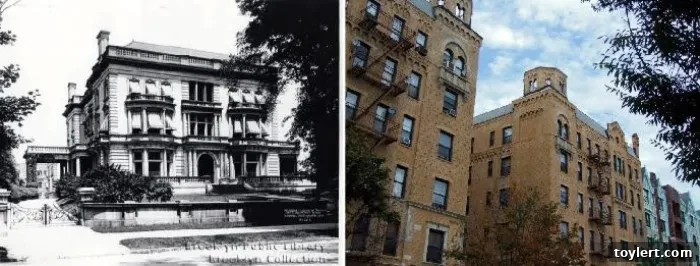
With his immense wealth, Seamans, like many successful industrialists of his time, sought to establish a residence that reflected his achievements and social standing. His gaze settled upon Brooklyn, a borough that was rapidly transforming from a collection of independent towns into a vibrant urban center, a magnet for the city’s elite. Specifically, the affluent and rapidly developing neighborhood of Crown Heights beckoned. Here, amidst tree-lined streets and nascent suburban grandeur, Seamans commissioned an extraordinary mansion at 789 St. Marks Avenue. This wasn’t just a house; it was a statement – a physical embodiment of his success and a testament to the Gilded Age’s architectural ambitions. Built during a period when design blended opulence with intricate craftsmanship, the mansion at 789 St. Marks Avenue stood as a jewel in Crown Heights’ “Mansion Row,” a prestigious stretch of homes that showcased the wealth and taste of Brooklyn’s leading citizens.
The architectural style of the Clarence W. Seamans Mansion, like many grand residences of its era, likely combined elements of popular late 19th-century movements such as the Queen Anne or Romanesque Revival, perhaps even hinting at the emerging Beaux-Arts influences. These styles were characterized by their asymmetrical facades, elaborate detailing, turrets, towers, varied textures, and rich ornamentation. Such homes often featured stained-glass windows, intricate wood carvings, mosaic tiled fireplaces, and grand staircases, all designed to impress and to provide a luxurious living environment for their wealthy occupants. The construction of such a residence involved a team of skilled architects, masons, carpenters, and artisans, all working to create a masterpiece that would endure for generations. The Seamans Mansion would have been a beacon of sophisticated living, offering ample space for entertaining, hosting lavish parties, and raising a family in an environment of unparalleled comfort and elegance.
Crown Heights itself has a fascinating history, serving as a microcosm of Brooklyn’s broader development. What began as a sparsely populated agricultural area in the early 19th century rapidly evolved into one of Brooklyn’s most desirable residential districts by the late 1800s. The extension of public transportation, particularly elevated trains and streetcars, made it feasible for the wealthy to commute to Manhattan while enjoying the relative tranquility and spaciousness of Brooklyn. Developers bought large tracts of land, carving out lots for grand estates and rows of elegant brownstones. St. Marks Avenue, in particular, became a symbol of prosperity, lined with the palatial homes of industrialists, merchants, and professionals. Life in these Brooklyn enclaves was characterized by a distinct social calendar, private clubs, carriage rides, and a strong sense of community among the affluent, all contributing to the unique charm and prestige of neighborhoods like Crown Heights.
Beyond the personal narrative of Clarence Walker Seamans and his magnificent dwelling, the typewriter’s legacy profoundly impacted society. It democratized communication to an extent previously unimaginable, speeding up commercial transactions and official correspondence. More significantly, it opened doors for women in the workplace. Before the typewriter, clerical work was predominantly a male domain. The skill required to operate a typewriter, coupled with the need for legions of efficient operators, led to a surge in demand for female typists. This shift was revolutionary, providing women with a pathway to economic independence and a professional identity outside the domestic sphere. From the buzzing offices of early 20th-century New York to global enterprises, the typewriter laid foundational groundwork for modern office environments and contributed significantly to the women’s suffrage movement by demonstrating female competence in the professional realm.
As the 20th century progressed, technology continued its relentless march forward. The mechanical typewriter eventually gave way to electric models, then to word processors, and ultimately, to the personal computers we know today – a full circle back to the initial analogy. Each transition brought increased efficiency, new capabilities, and further reshaped the way we work and communicate. Yet, the foundational principles of keyboard input and rapid document creation remain a direct lineage from Seamans’ era. The Seamans Mansion, meanwhile, continued its own journey. Many such Gilded Age homes in Brooklyn faced uncertain futures, some falling into disrepair, others being subdivided, and a fortunate few enduring as testaments to a bygone era. The preservation of these historic structures is crucial, as they offer tangible links to our past, providing insights into the lives of those who shaped our cities and the architectural grandeur that defined their aspirations.
The story of Clarence Walker Seamans and his magnificent mansion at 789 St. Marks Avenue is more than just a tale of personal wealth; it is a captivating chapter in the broader narrative of Brooklyn. It encapsulates the spirit of innovation that characterized the late 19th century, the transformation of a borough, and the enduring power of architecture to reflect human ambition. Today, as Brooklyn continues to evolve, embracing new technologies and diverse cultures, its historic neighborhoods like Crown Heights remain vital arteries connecting its dynamic present to its rich, storied past. The Seamans Mansion stands as a silent sentinel, whispering tales of a time when typewriters revolutionized offices, fortunes were made, and Brooklyn’s grand avenues were adorned with the splendid homes of those who dared to dream big, forever intertwining the borough’s architectural heritage with its economic and social history. It serves as a powerful reminder that “Brooklyn, then and now,” is a tapestry woven with threads of innovation, aspiration, and enduring beauty.