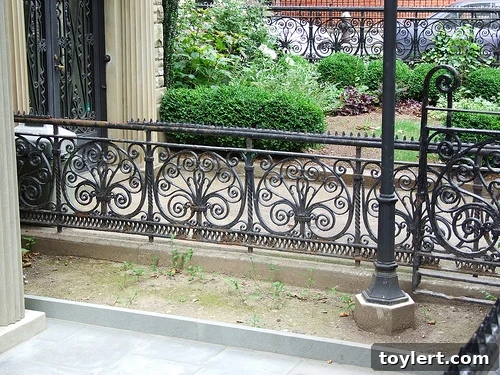
Welcome to a captivating journey through the timeless artistry of ironwork, a defining feature that profoundly shapes the character of New York City’s most historic and cherished neighborhoods. As we revisit this beloved topic, we invite you to immerse yourself in the intricate beauty and profound historical significance of the metallic lacework that adorns Brooklyn. From the elegant sweeps of garden fences to the majestic grandeur of gates and the delicate intricacies of balcony railings, these metallic masterpieces are more than mere decorations; they are storytellers, chronicling tales of unparalleled craftsmanship, innovative design, and an enduring legacy that continues to enchant residents and visitors alike. Join us as we explore the rich tapestry of ironwork, a silent yet eloquent testament to the borough’s architectural heritage.
The Enduring Legacy of Ironworking: A Global Historical Perspective
The ancient craft of shaping iron, universally known as ironworking, boasts a rich and expansive history that stretches back millennia, spanning across diverse cultures and continents. From the rudimentary tools painstakingly forged by ancient civilizations to the elaborate decorative pieces that graced later empires, iron has consistently served as a fundamental material in human development and artistic expression. Early evidence of iron manipulation can be traced to regions such as Anatolia and the Near East, where pioneering techniques for smelting and forging iron were first discovered and meticulously refined. The inherent strength, remarkable versatility, and abundant availability of iron quickly established its paramount importance, transcending mere utility to become a powerful medium for both practical application and profound artistic expression.
As societies progressively evolved, so too did the sophistication and artistry of ironworking techniques. During the medieval period in Europe, the figure of the blacksmith was utterly pivotal within every community, holding responsibility not only for crafting essential weapons and vital agricultural implements but also for creating the robust gates, intricate grilles, and sturdy hinges that secured formidable castles and majestic cathedrals. The Roman Empire, a testament to engineering prowess, utilized iron extensively in its monumental construction projects, while skilled Celtic artisans famously adorned their iron creations with intricate knotwork and captivating mythical beasts, imbuing them with deep symbolic meaning. The Renaissance period witnessed an extraordinary surge in decorative ironwork, as master artisans skillfully transformed raw metal into exquisite grilles, elegant balustrades, and elaborate architectural embellishments that magnificently graced palaces, grand estates, and public buildings across Italy and beyond. This transformative era marked a significant shift, placing an emphatic emphasis on aesthetic appeal and artistic flair alongside the material’s inherent structural integrity.
The dawn of global trade and exploration dramatically broadened the horizons for innovative iron design, ushering in an unprecedented era of artistic exchange. As diverse cultures intersected through burgeoning trade routes, new motifs, distinctive styles, and advanced techniques were continually introduced, profoundly influencing local traditions and inspiring fresh interpretations. The Victorian age, in particular, emerged as an unparalleled golden era for ornamental ironwork. This surge was powerfully driven by the transformative effects of the Industrial Revolution, which rendered iron production far more efficient and economical, alongside the rise of a burgeoning middle class eager to display their wealth, status, and refined taste. Designers of this era enthusiastically embraced an eclectic mix of historical and contemporary styles. From the romanticism of Gothic Revival to the classical elegance of Neoclassical, and from the playful flourishes of Rococo to the intricate beauty of naturalistic patterns, Victorian ironwork became a magnificent canvas for demonstrating both cutting-edge technological prowess and unparalleled artistic flair. This period saw the widespread and concurrent use of both wrought iron, meticulously hammered into shape by skilled hands, and the newly popularized cast iron, which ingeniously allowed for the mass production of highly detailed, often repeating, ornamental patterns.
Colonial American Roots and the Flourishing of Urban Ironwork
In the nascent stages of Colonial America, ironworking was far more than a mere craft; it represented a fundamental cornerstone of daily life, vital industry, and burgeoning self-sufficiency. The forge, an iconic symbol of American resilience, ingenuity, and a pioneering spirit, stood at the very heart of every fledgling settlement. Blacksmiths were utterly indispensable members of these communities, diligently producing everything from essential horse-shoes and crucial cooking utensils to vital agricultural tools and indispensable architectural hardware. While early American ironwork often prioritized robust functionality and utilitarian purpose, a distinctly elegant aesthetic gradually began to emerge, characterized by its inherent simplicity, clean lines, and remarkably sturdy construction. As the colonies matured and blossomed into a new, independent nation, the demand for both practical and exquisitely decorative iron elements escalated dramatically, particularly within the rapidly expanding urban centers that were beginning to define the American landscape.
The accelerated development of prominent cities such as New York, Boston, and Philadelphia fueled a highly specialized need for sophisticated architectural ironwork. As urban neighborhoods rapidly expanded and their populations grew increasingly affluent, decorative iron elements quickly evolved into a tangible marker of status, wealth, and sophisticated taste, becoming an indispensable and integral part of the urban streetscapes. In Brooklyn, a dynamic borough undergoing a profound transformation from expansive rural landscapes to a densely populated and thriving metropolis throughout the 19th century, ironwork became a ubiquitous and unmistakably defining feature. The unique combination of indigenous local craftsmanship, steeped in tradition, and a continuous influx of imported design influences from Europe and beyond, led to a remarkable synthesis of styles. This rich fusion elegantly reflected the diverse cultural heritage, evolving architectural trends, and ambitious aspirations of its rapidly growing residents. The robust yet exquisitely ornate railings, protective fences, and majestic gates served not only crucial practical purposes—meticulously defining property lines, providing essential security, and aiding convenient access to the elevated stoops—but also contributed immeasurably to the overarching architectural grandeur and cohesive visual identity that unmistakably characterize these venerable historic districts.
Brooklyn’s Iron Lace: A Neighborhood-Specific Tapestry of Design
Brooklyn proudly stands as a living, breathing museum of architectural ironwork, with specific neighborhoods earning widespread renown for their truly exceptional and remarkably preserved collections. The intricate ironwork adorning the esteemed districts of Brooklyn Heights, Cobble Hill, and Boerum Hill, among other pioneering neighborhoods, powerfully reflects the extraordinary talent, unwavering dedication, and innovative spirit of generations of master artisans. Each street, indeed almost every individual stoop, offers a tantalizing glimpse into this profoundly rich heritage, showcasing a breathtaking array of styles, techniques, and artistic expressions that eloquently speak to distinct eras of design, varying levels of affluence, and the evolving nature of craftsmanship.
Brooklyn Heights: An Emblem of Elegance and Grandeur
As one of America’s very first designated historic districts, Brooklyn Heights serves as a quintessential example of meticulously preserved architectural splendor. Its ironwork is frequently characterized by an unparalleled sophisticated elegance, powerfully reflecting the refined tastes and considerable affluence of its 19th-century residents. Here, discerning observers can discover exquisite examples of Federal and Greek Revival ironwork, often featuring delicate, gracefully curving scrolls, timeless neoclassical motifs such as the iconic Greek key, and meticulously crafted rosettes that add a touch of refined beauty. Stoop railings are particularly prominent throughout this neighborhood, serving as inviting guides up to magnificent doorways, often culminating in impressive newel posts that are themselves adorned with remarkably intricate patterns. The protective fences gracefully surrounding private gardens add yet another layer of charm and historical authenticity, frequently displaying patterns of elegant spears, classical lyres, or precisely geometric designs that perfectly echo the overarching architectural style of the adjacent brownstones, creating a harmonious visual symphony.
Cobble Hill: Residential Charm Infused with Artistic Flair
Nestled adjacent to the stately Brooklyn Heights, Cobble Hill presents a subtly different, yet equally captivating, narrative through its distinctive ironwork. This enchanting neighborhood, celebrated for its quaint tree-lined streets, charming historic brick and brownstone homes, features ironwork that beautifully complements its inherent residential character and welcoming ambiance. While still undeniably elegant, the ironwork found here often incorporates more whimsical, organic, or personalized touches, reflecting a slightly less formal aesthetic. Victorian-era influences are remarkably strong throughout Cobble Hill, bringing forth an abundance of intricate floral motifs, naturalistic vine patterns, and more elaborate, curvilinear designs that evoke a sense of romanticism. Wrought iron, with its unique hand-forged nuances and visible artisan marks, is particularly prevalent on charming garden gates and decorative window grilles, proudly showcasing the individual artistry and unique techniques of the blacksmiths who crafted them. Cast iron elements, frequently featuring repeating patterns of delicate leaves, luscious grapes, or abstract geometric forms, provide a striking contrast and are commonly observed on building facades and elegant balconies, adding considerable depth, intricate texture, and visual interest to the vibrant streetscape.
Boerum Hill: A Dynamic Blend of Styles and Enduring Craftsmanship
Boerum Hill, with its distinctive and eclectic mix of charming row houses and bustling commercial storefronts, offers a fascinating and comprehensive cross-section of Brooklyn’s diverse ironworking heritage. The ironwork in this dynamic neighborhood frequently reflects a captivating blend of various styles, ranging from the more restrained, understated designs characteristic of the early 19th century to the richly ornate and expressive elaborations of the late Victorian period. Here, one might encounter simpler, more utilitarian wrought iron railings that speak to an earlier, more functional aesthetic, standing in elegant juxtaposition alongside elaborate cast iron fences that boast intricate patterns and decorative finials, showcasing a range of artistic expressions. The sheer diversity of ironwork in Boerum Hill tells a compelling story of evolving architectural tastes, shifting economic landscapes, and the dynamic growth and transformation of the neighborhood itself. The stoop railings, often meticulously maintained and carefully restored, are a defining and continuous feature, providing an unbroken line of exquisite craftsmanship along the blocks, each subtly unique yet contributing seamlessly to a cohesive and richly historical urban fabric.
Techniques and Materials: The Profound Art of the Master Blacksmith
The enduring and captivating beauty of Brooklyn’s architectural ironwork stands as an eloquent testament to the specialized skills, profound knowledge, and meticulous techniques employed by generations of master artisans. Primarily, two distinct types of iron largely dominate the historical architectural landscape of the borough: wrought iron and cast iron, each possessing its own unique characteristics, specific methods of fabrication, and individual aesthetic appeal.
Wrought Iron: The Hand-Forged Masterpiece
Wrought iron, whose very name means “worked iron,” is traditionally produced through an arduous and painstaking process involving repeatedly heating and skillfully hammering raw iron. This time-honored process effectively removes impurities and creates a remarkably malleable, fibrous material that can be expertly twisted, intricately bent, and elegantly sculpted into incredibly intricate and uniquely personalized forms. Wrought iron pieces are typically bespoke creations, lovingly crafted by individual blacksmiths, and their distinct character is often evident in the subtle, visible hammer marks and the organic, fluid flow of the metal itself. This ancient method allows for the creation of delicate scrollwork, sharply defined points, and complex, three-dimensional patterns that are exceptionally challenging, if not impossible, to achieve with other materials or techniques. The inherent resilience, remarkable durability, and relative ease of repair of wrought iron also significantly contribute to its exceptional longevity, making it a highly valued and sought-after material for both decorative and structural architectural elements.
Cast Iron: Precision, Pattern Repetition, and Industrial Elegance
Cast iron, in stark contrast to wrought iron, is produced by melting iron until it becomes a liquid and then carefully pouring it into precisely engineered molds. This innovative process allows for the efficient creation of intricate, often highly repetitive, patterns with remarkable precision and at a significantly lower cost, particularly after the profound impact of the Industrial Revolution. Cast iron became immensely popular in the mid-19th century due to its unparalleled ability to replicate elaborate designs efficiently and consistently. Fences, elegant balcony fronts, and decorative panels could be mass-produced, making ornate architectural elements accessible to a much broader range of property owners and urban developers. While cast iron is inherently more brittle than wrought iron and can be susceptible to cracking under severe impact, its exceptional ability to capture exquisitely fine details—such as delicate leaves, clusters of grapes, or even mythological figures—made it a favored choice for adding grandeur, sophistication, and elaborate decoration to building facades and bustling streetscapes. The distinct lines, precise symmetry, and inherent uniformity of cast iron pieces offer a different yet equally compelling aesthetic compared to the more organic, hand-forged feel of wrought iron, showcasing the dawn of industrial design.
The Cultural and Architectural Significance of Brooklyn’s Ironwork
Beyond their undeniable aesthetic appeal and decorative charm, the intricate ironworks of Brooklyn hold profound cultural and architectural significance. They are not merely superficial decorative elements but rather integral components that fundamentally define the unique identity, inherent charm, and enduring character of the borough’s illustrious historic neighborhoods.
Defining Architectural Character and Urban Rhythm
Ironwork plays an absolutely critical role in meticulously establishing and preserving the distinctive architectural character of Brooklyn’s iconic brownstone districts. The visual uniformity of the elegant stoop railings, the intricate and varied patterns of the charming garden fences, and the graceful curves of the decorative balconies all contribute to a cohesive and instantly recognizable visual language that makes these areas profoundly unique. They expertly enhance the rhythmic flow of the street, provide compelling visual interest at every turn, and beautifully complement the rich textures of the brick and brownstone facades. Without these metallic embellishments, the historic buildings would undoubtedly lose much of their distinctive allure, appearing considerably plainer, less integrated into their surroundings, and lacking the depth of character that residents and visitors have come to cherish.
A Tangible Testament to Unwavering Craftsmanship and Rich History
Each individual piece of ironwork stands as a powerful and tangible testament to the extraordinary skill, unwavering patience, and profound artistic vision of the generations of artisans who painstakingly created them. They represent a direct, physical link to the past, offering invaluable insights into the prevailing styles, technological capabilities, and socio-economic conditions of different historical eras. Walking leisurely through Brooklyn’s historic streets is akin to strolling through an expansive open-air museum, where every fence post, every meticulously crafted railing, and every decorative element silently tells a compelling story of the borough’s remarkable development, its evolving architectural tastes, and the enduring human desire for both beauty and permanence in the built environment.
Fostering Community Identity and Inspiring Preservation Efforts
The distinctive and widely recognized ironwork also fosters a remarkably strong sense of community identity and collective pride. Residents and visitors alike instinctively associate these intricate details with the unique charm, historical authenticity, and vibrant character of Brooklyn. Recognizing their immense value, many of these cherished neighborhoods are diligently protected by stringent historic district designations, which include comprehensive guidelines for the careful preservation, meticulous restoration, and respectful maintenance of original ironwork. Preservation efforts, often passionately led by dedicated local community groups, tireless architectural preservation societies, and individual homeowners, are absolutely crucial in ensuring that this invaluable heritage is maintained, celebrated, and passed down for the enlightenment and enjoyment of future generations. This vital work involves the careful restoration of damaged pieces, the skilled replication of missing components using traditional methods and materials, and continuous public education about the profound importance of these irreplaceable historical assets.
Embracing the Details: A Call to Observant Appreciation
The next time you find yourself leisurely wandering through the captivating and charming streets of Brooklyn Heights, Cobble Hill, or Boerum Hill, take a deliberate moment to look beyond the grand facades and imposing structures. Allow your gaze to linger on the delicate scrolls, the sturdy uprights, and the intricate, often mesmerizing, patterns of the ironwork that so gracefully adorns these historic homes. Each piece is a miniature sculpture, a functional work of art that has bravely withstood the relentless tests of time, harsh weather, and changing fashions, silently yet powerfully contributing to the unparalleled beauty, enduring character, and distinct identity of our fair city. These timeless creations serve as a profound and poignant reminder of the artistry, dedication, and human spirit embedded within everyday architecture, inviting us all to deeply appreciate the enduring legacy of iron and the skilled hands that transformed raw metal into these magnificent, lasting works of art.