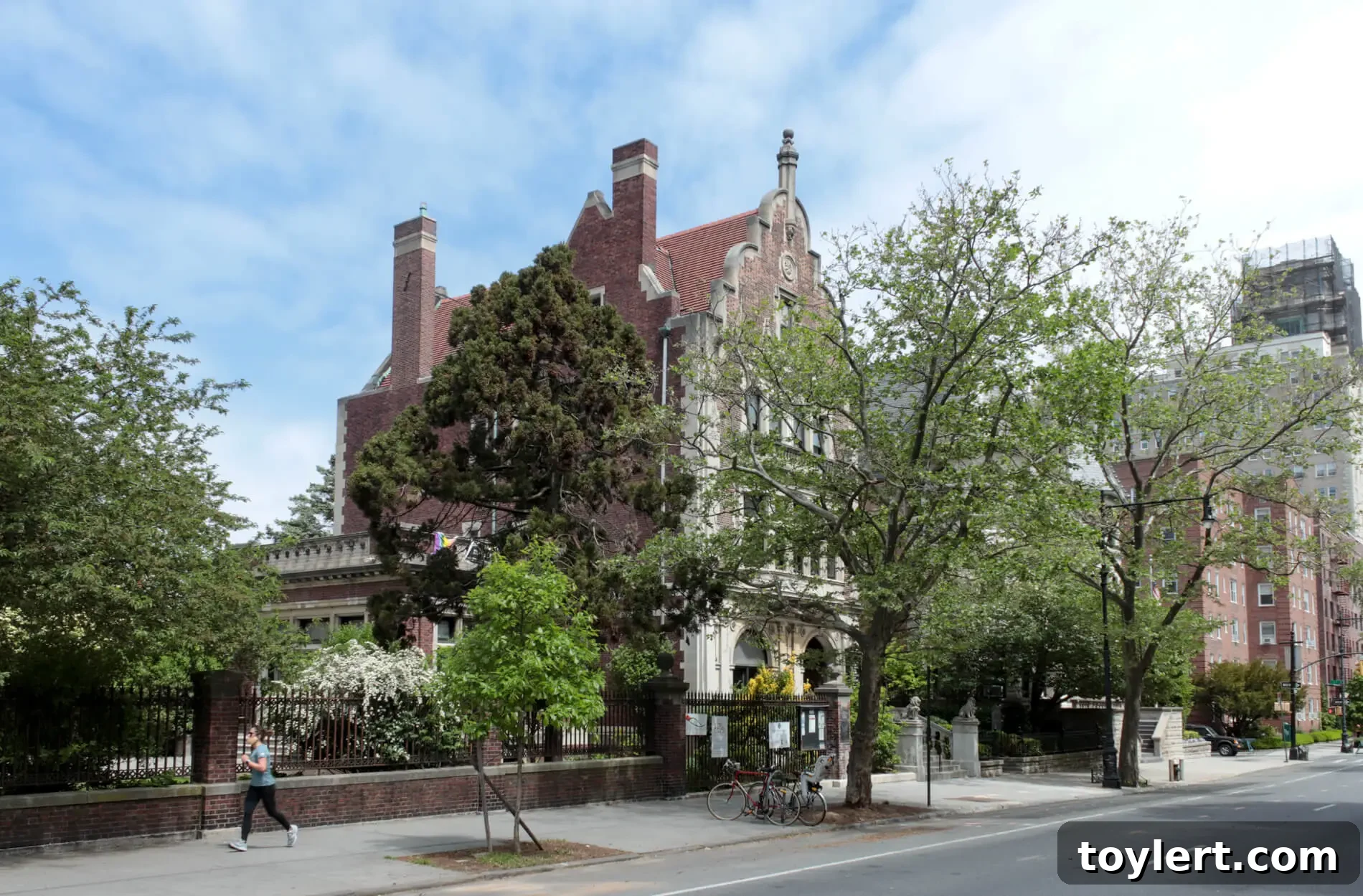
Historic Park Slope Landmark at 53 Prospect Park West Sells for $13.5 Million in Notable Off-Market Deal
A striking architectural masterpiece, the William Tubby-designed manse situated prominently at the corner of Prospect Park West and 2nd Street in Brooklyn’s coveted Park Slope neighborhood, has recently changed hands for $13.5 million. This significant transaction, an off-market deal, concluded with an undisclosed buyer, as first reported by The Real Deal, though the sale has yet to appear in public records. The property, a cornerstone of Brooklyn’s rich architectural heritage, offers a unique blend of historical grandeur and prime location, making its sale a subject of considerable interest within the real estate and preservation communities.
The final sale price represents a substantial reduction from its initial listing. Back in 2021, the property at 53 Prospect Park West was put on the market with a hefty asking price of $30.5 million. This recent deal, closing at less than half that figure, highlights the complex dynamics of the ultra-luxury real estate market, especially for unique, historically significant properties that often come with their own set of considerations and challenges. We previously covered the listing, recognizing its immense historical and architectural value.
An Architectural Icon: The Legacy of William Tubby and Neo-Jacobean Grandeur
The mansion at 53 Prospect Park West is not merely a residence; it is a designated Brooklyn landmark, a testament to the enduring vision of its architect, William Tubby. Tubby, a prominent American architect active in the late 19th and early 20th centuries, left an indelible mark on Brooklyn’s streetscape with his distinctive designs. His portfolio includes several notable structures, ranging from grand residential homes to institutional buildings, all characterized by a robust elegance and meticulous craftsmanship. Among his other renowned works are buildings for the Pratt Institute in Clinton Hill, showcasing his versatility and mastery of various architectural styles.
The chosen architectural style for 53 Prospect Park West is Neo-Jacobean, a revivalist interpretation of the Jacobean era of English architecture (early 17th century). This style is celebrated for its stately and academic appearance, often incorporating intricate brickwork, elaborate stone detailing, prominent gables, bay windows, and tall, decorative chimneys. At 53 Prospect Park West, these elements converge to create a formidable and aesthetically rich exterior that commands attention. The prominent corner location further amplifies its street presence, allowing its intricate details and imposing stature to be admired from multiple vantage points along Prospect Park West, a boulevard renowned for its architectural gems.
The building’s construction in this particular style speaks to the era’s appreciation for historical revivalism and the desire to imbue new structures with the gravitas and prestige of older European designs. Tubby’s application of Neo-Jacobean principles here is particularly masterful, balancing decorative flourishes with a sense of enduring strength and dignity. The use of high-quality materials and superior construction techniques has ensured the building’s preservation, allowing it to stand as a living monument to an architectural era of unparalleled craftsmanship.
A Rich History: From Private Residence to Community Hub
Before its recent sale, 53 Prospect Park West served for many years as the home of the Brooklyn Society for Ethical Culture, functioning as a vibrant community center. This transition from a grand private residence to a semi-public institution added another layer to the building’s rich narrative. The Society for Ethical Culture, a humanist movement founded in the late 19th century, emphasizes ethical living, social justice, and humanitarian action without recourse to theological dogma. Their occupancy of such a significant landmark underscores their commitment to fostering community and intellectual engagement.
For decades, the building welcomed countless individuals through its doors for meetings, lectures, cultural events, and community gatherings. Its well-preserved interior, which complements the grandeur of its exterior, provided a fitting backdrop for these activities. Features such as grand staircases, spacious meeting halls, and possibly intricate woodwork or stained glass windows, typical of homes of this era and scale, would have contributed to an inspiring and welcoming atmosphere for members and visitors alike. The building’s dual role as an architectural marvel and a center for civic life made it a truly unique asset to the Park Slope community.
This semi-public function also inadvertently shielded the property from some of the intense real estate pressures that have transformed many other historic Brooklyn structures into purely private residences or commercial spaces. Its status as a community center helped maintain its integrity, preserving its architectural details and ensuring its accessibility, at least in part, to the public eye. The sale now prompts contemplation about the future use of such a historically significant and large-scale property.
The Prospect Park West Appeal: Location and Landmark Status
The allure of 53 Prospect Park West is inextricably linked to its prestigious location. Prospect Park West is one of Brooklyn’s most iconic avenues, directly bordering the magnificent Prospect Park, designed by Frederick Law Olmsted and Calvert Vaux. This “park-like setting” mentioned in the initial description is no exaggeration; residents of this stretch enjoy direct access to one of New York City’s most cherished green spaces, offering endless opportunities for recreation, relaxation, and cultural engagement.
Beyond the park, the surrounding Park Slope neighborhood is renowned for its tree-lined streets, impeccably maintained brownstones, and vibrant community atmosphere. It is a neighborhood that consistently ranks among the most desirable in New York City, celebrated for its historic charm, excellent schools, diverse dining scene, and boutique shopping. The combination of an architectural masterpiece by a revered architect, its landmark status, and its unparalleled location makes 53 Prospect Park West a truly trophy property, regardless of its final sale price.
The decision to grant the property landmark status by the New York City Landmarks Preservation Commission was a clear recognition of its exceptional architectural and historical significance. Landmark designation protects the exterior features of the building, ensuring that its unique Neo-Jacobean character is preserved for future generations. While this designation offers invaluable protection, it also imposes certain restrictions on alterations, which can sometimes influence a property’s market value or the scope of potential renovations, particularly for a private buyer.
Understanding the Market: A $17 Million Price Adjustment
The significant disparity between the initial $30.5 million asking price in 2021 and the eventual $13.5 million sale price is a compelling aspect of this transaction. Several factors could contribute to such a substantial adjustment in the high-end real estate market, especially for unique properties like 53 Prospect Park West. Firstly, the luxury market can be highly sensitive to economic shifts, interest rate fluctuations, and general market sentiment. A property listed in 2021 might have faced different market conditions by the time it closed in 2023 or 2024.
Secondly, historical properties, while highly desirable, often come with unique challenges. The sheer scale of 53 Prospect Park West, coupled with its landmark status, means that any renovation or modernization project would be extensive, costly, and require careful navigation of preservation guidelines. A potential buyer would need to consider the significant investment beyond the purchase price to restore, update, and maintain such a grand estate, particularly if converting it back from a community center to a private residence.
Furthermore, the unique layout and previous function as a community center might present specific conversion challenges for a private buyer seeking a conventional single-family home. Customization would likely be extensive, potentially narrowing the pool of prospective buyers willing to undertake such a project. An off-market deal, while sometimes indicating a quick sale or a specific buyer target, can also reflect a need for discretion and flexibility in pricing given the property’s unique attributes and the nuances of the luxury market for heritage properties.
The Future of a Landmark: Preservation and Private Ownership
The sale of 53 Prospect Park West marks a new chapter for this magnificent Brooklyn landmark. While the specifics of the undisclosed buyer’s plans remain private, the transition from a long-standing community center to private ownership will undoubtedly bring changes. The hope remains that the new owners will appreciate and uphold the architectural integrity and historical significance of the property. The building’s landmark status will play a crucial role in safeguarding its exterior, ensuring that its distinctive Neo-Jacobean facade continues to grace Prospect Park West for decades to come.
This transaction underscores the ongoing conversation surrounding the preservation of historic buildings in rapidly developing urban environments. Properties like 53 Prospect Park West are more than just real estate; they are irreplaceable components of a city’s identity and cultural heritage. Their successful preservation, whether through public or private stewardship, is vital for maintaining the unique character and story of neighborhoods like Park Slope. The sale of this particular manse, with its rich history and architectural splendor, will be watched closely as it embarks on its next incarnation.