Escalating Tensions: Forest City Ratner and Skanska’s Modular Factory Dispute Heats Up
The protracted and increasingly acrimonious conflict between real estate developer Forest City Ratner (FCR) and construction giant Skanska has reached a new boiling point. Late Friday, Forest City Ratner issued a stark announcement, detailing how representatives from FCRC Modular were barred by Skanska from entering their jointly operated, and now controversially shuttered, modular construction factory. This dramatic turn of events has predictably led to yet another legal salvo, with FCR Modular, Forest City’s half of the partnership, initiating fresh legal proceedings against Skanska. The ongoing “war,” as it’s been dubbed by industry insiders, not only highlights a significant breakdown in a once-promising venture but also casts a long shadow over the future of modular construction in major urban development projects.
A Vision for Innovation: The FC+Skanska Modular Venture
The partnership between Forest City Ratner and Skanska, known as FC+Skanska, was initially hailed as a groundbreaking endeavor designed to revolutionize urban construction. At its core was the ambitious plan for a state-of-the-art modular factory, intended to produce prefabricated building components for large-scale developments. The vision was compelling: by manufacturing entire apartment units or sections of buildings off-site in a controlled factory environment, the venture promised unprecedented efficiency, cost savings, accelerated construction timelines, and superior quality control. This innovative approach sought to mitigate common construction challenges such as weather delays, on-site labor disputes, and logistical complexities, offering a streamlined path to delivering affordable and high-quality housing faster than traditional methods.
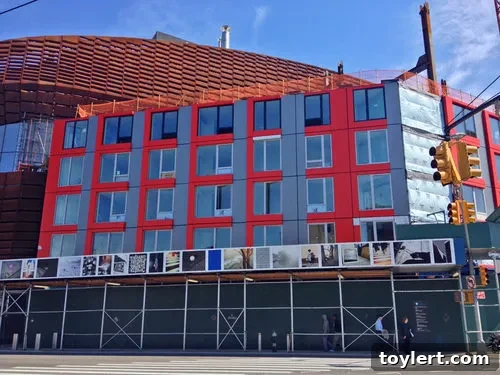
Forest City Ratner, a prominent developer with a history of tackling complex urban projects, including the ambitious Pacific Park (formerly Atlantic Yards) development in Brooklyn, saw modular construction as a vital component for its future projects. Skanska, a global leader in construction and development, brought its extensive expertise in large-scale building and project management to the table. Together, they aimed to transform the way high-rise residential buildings, particularly the B2 tower at Pacific Park, were constructed, setting a new standard for urban development. The initial excitement was palpable, with many viewing the factory as a beacon of progress and a potential game-changer for the industry.
The Factory at the Heart of the Dispute: Industry Hopes and Hurdles
The modular factory itself, a substantial facility located in the Brooklyn Navy Yard, was designed to be a bustling hub of precision manufacturing. Equipped with advanced machinery and employing hundreds of skilled workers, it was conceived as the engine driving the modular construction revolution in New York City. The factory’s operations were meticulously planned to ensure that each module met stringent quality standards before being transported to the construction site and assembled like giant LEGO blocks. This approach was particularly promising for projects like the B2 residential tower, which aimed to be the world’s tallest modular building upon completion. The factory was not just a manufacturing plant; it was a symbol of innovation, a tangible commitment to modernizing the traditionally slow-moving construction sector.
However, the journey of modular construction, especially at this scale, has always been fraught with challenges. Despite its numerous benefits, the industry grapples with issues such as initial capital investment, complex logistics for transporting large modules, and the need for seamless integration between factory production and on-site assembly. The FC+Skanska venture, while ambitious, also faced these inherent hurdles. Misunderstandings, technical difficulties, and differing operational philosophies can quickly turn a symbiotic partnership into a contentious battleground when high stakes and significant investments are involved. The dream of seamless modular delivery began to face the harsh realities of execution, ultimately leading to the closure of the very factory that embodied so much promise.
A Partnership Unravels: Allegations and Counter-Allegations
The seeds of discord in the FC+Skanska partnership were sown long before the factory’s eventual closure. Reports of cost overruns, production delays, and disagreements over operational control began to surface, hinting at deep-seated issues. Both parties, once united by a common vision, found themselves increasingly at odds regarding the factory’s management, output, and financial performance. These internal struggles culminated in the dramatic decision to shutter the modular factory, effectively halting production and leaving the ambitious B2 tower in limbo, along with other potential projects that relied on the factory’s output.
The recent incident, where FCRC Modular representatives were physically barred from entering the factory by Skanska, underscores the severe deterioration of trust and cooperation between the former partners. This act is not merely a symbolic gesture but a tangible sign of a complete operational impasse. Forest City Ratner views Skanska’s actions as a direct impediment to their legitimate access and an escalation of an already bitter dispute. Skanska, on the other hand, likely cites reasons pertaining to control, safety, or intellectual property rights as justification for their actions. This latest confrontation serves as a microcosm of the larger battle for control, responsibility, and financial accountability that has plagued the joint venture.
The Legal Battlefield: New Lawsuits and Enduring Claims
With the physical lockout, the dispute has fully transitioned into an intense legal battleground. The new lawsuit filed by FCR Modular represents a significant escalation, seeking to address a wide array of grievances. While specific details of the complaint are still emerging, it is anticipated to include claims related to breach of contract, improper lockout, interference with business operations, and potentially intellectual property disputes over the modular designs and processes developed within the factory. Forest City Ratner asserts that Skanska’s actions are detrimental to their interests and prevent them from assessing the factory’s assets and determining a path forward.
This is not the first legal entanglement between the two entities. The history of the FC+Skanska venture has been marked by a series of legal filings and counter-filings, each revealing deeper fissures in their relationship. Earlier disputes often centered on financial disagreements, project delays, and the allocation of responsibilities and liabilities. These legal skirmishes have accumulated significant legal costs for both parties and have created a cloud of uncertainty over the future of the factory and the modular components it was meant to produce. The outcome of these complex lawsuits will likely hinge on detailed contractual interpretations, forensic accounting, and expert testimony regarding the operational efficacy and financial performance of the modular factory.
Broader Implications: The Future of Modular Construction and Urban Development
The unraveling of the FC+Skanska partnership and the subsequent closure of their modular factory have far-reaching implications that extend beyond the two companies themselves. For projects like the B2 tower at Pacific Park, which heavily relied on the modular approach, the dispute has caused significant delays and cost overruns, complicating an already challenging development. The controversy also impacts the hundreds of workers who were employed at the factory, many of whom were trained in specialized modular construction techniques, leading to job insecurity and economic disruption in the local community.
More broadly, this highly publicized “war” could cast a chilling effect on the nascent modular construction industry. While modular building offers undeniable advantages for speed, sustainability, and quality, high-profile failures can deter potential investors and developers from embracing the technology. The dispute serves as a cautionary tale, highlighting the critical importance of robust partnership agreements, clear operational protocols, and effective dispute resolution mechanisms in complex joint ventures. It underscores that while the technology itself may be innovative, the success of such ventures ultimately depends on sound business practices and collaborative relationships. The industry must learn from these challenges to ensure that future modular projects can truly fulfill their promise of transforming urban development.
Seeking Resolution: A Path Forward?
The path to resolving the Forest City Ratner and Skanska dispute appears to be a long and arduous one, likely to unfold through protracted legal battles. Both parties are major players in their respective fields, with significant resources to defend their positions and pursue their claims. The lawsuits will likely involve intense discovery processes, expert witness testimonies, and potentially appeals, stretching over months, if not years. A mutually agreeable settlement, while always a possibility, seems distant given the level of animosity and the gravity of the financial and reputational stakes involved. However, continued litigation carries its own costs, both in terms of direct expenses and the diversion of executive attention from core business operations.
Ultimately, the resolution of this conflict will not only determine the fate of the modular factory and associated projects but also set a significant precedent for future modular construction ventures. It will clarify legal responsibilities in innovative construction partnerships and provide valuable lessons on managing complex, multi-stakeholder projects. The construction industry, urban developers, and policymakers will be closely watching the outcome, hoping to glean insights that can help pave a smoother, more predictable path for embracing advanced construction methodologies in the future. Until then, the dispute between Forest City Ratner and Skanska remains a stark reminder of the challenges inherent in pushing the boundaries of construction innovation.