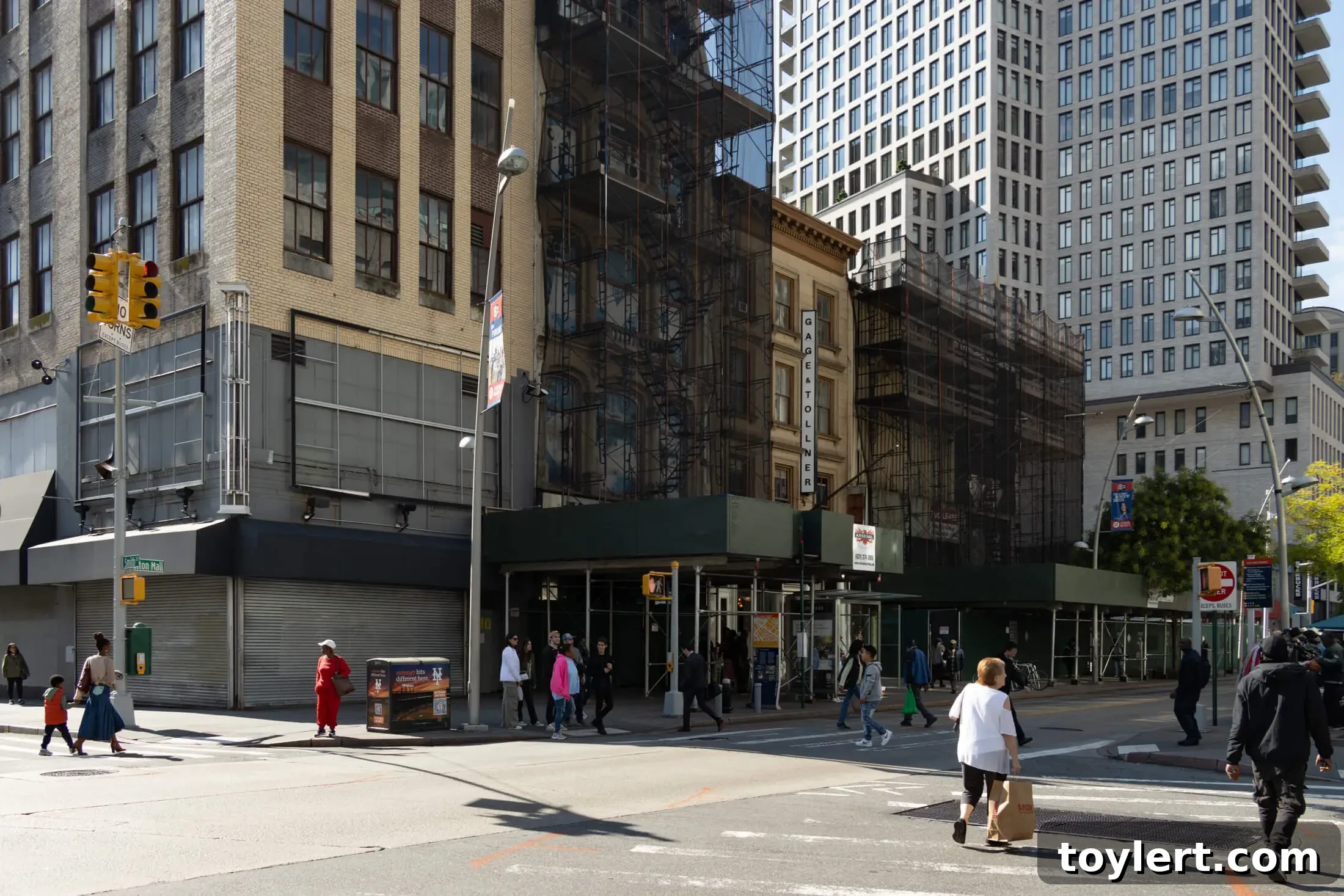
Gage & Tollner: A Historic Beacon Amidst Downtown Brooklyn’s Soaring Skyscrapers
In the rapidly transforming landscape of Downtown Brooklyn, where historic structures frequently yield to modern high-rises, the venerable Gage & Tollner restaurant on Fulton Street stands as a remarkable exception. This iconic establishment, renowned for its architectural grandeur and rich history, appears destined to be the sole survivor of its block’s past. Recent applications for demolition permits have been filed for the entire southern stretch of Fulton Street, specifically between Red Hook Lane and Smith Street, with the building housing Gage & Tollner being the only property excluded from these plans. Already, the adjacent corner buildings on Red Hook Lane have succumbed to the wrecking ball, setting a clear precedent for the future of this vibrant commercial corridor.
Currently, the four-story landmarked building at 372-374 Fulton Street finds itself nestled precariously between its scaffolding-clad neighbors, a stark visual representation of the dramatic changes unfolding around it. It requires little imagination to envision this architectural gem soon being dwarfed and surrounded by towering skyscrapers. This scenario is not merely speculative; it is a direct consequence of Downtown Brooklyn’s aggressive “super-tall development trend.” Further solidifying this future is the recent filing of a new-building permit application for a colossal 43-story mixed-use tower slated to rise directly next door to Gage & Tollner. This impending development underscores the extraordinary pressure on historic properties in an area undergoing an unprecedented urban metamorphosis.
The Enduring Legacy and Resurgence of Gage & Tollner
Gage & Tollner is far more than just a building; it is a living piece of Brooklyn’s history and a testament to enduring elegance. Established in 1879 and relocating to its current address in 1892, the restaurant quickly became a local institution, celebrated for its gaslight fixtures, mahogany paneling, and the exquisite craftsmanship that defined its interiors. After decades of operation, it sadly closed its doors in 1995, leaving a void in the borough’s culinary and cultural fabric. However, to the delight of preservationists and food enthusiasts alike, Gage & Tollner experienced a magnificent rebirth in 2020, meticulously restored to its former glory. The re-opening breathed new life into the landmarked space, re-establishing it as a premier dining destination while honoring its storied past.
The building’s landmark status, designated by the New York City Landmarks Preservation Commission, is crucial to its survival. This designation recognizes its significant architectural and historical value, affording it protections against arbitrary demolition or unsympathetic alterations. The meticulously preserved Victorian-era interior, with its ornate brass chandeliers, original cherrywood bar, and unique bentwood chairs, offers diners a rare glimpse into a bygone era. This commitment to preserving architectural integrity, even as the exterior facades of its neighbors vanish, highlights a unique tension between urban development and historical reverence. Its continued existence serves as a powerful symbol of resilience and the enduring appeal of authentic heritage in a city constantly reinventing itself.
Downtown Brooklyn’s Accelerated Urban Transformation
Downtown Brooklyn has, over the last two decades, undergone one of the most significant urban transformations in New York City. Once primarily a commercial and civic hub with a mix of older office buildings and retail spaces, it has rapidly evolved into a dense, vertical residential and business district. This dramatic shift is largely attributed to strategic rezoning initiatives, particularly the 2004 Downtown Brooklyn Plan, which encouraged high-density development and attracted major investment. Developers seized the opportunity to construct residential skyscrapers, luxury condominiums, and large-scale mixed-use projects, fundamentally reshaping the borough’s skyline.
The “super-tall development trend” mentioned in the context of Gage & Tollner is a defining characteristic of this transformation. These towering structures, often exceeding 50 or 60 stories, bring thousands of new residents and businesses to the area, contributing to its vibrant, yet sometimes overwhelming, urban energy. While these developments inject economic vitality and provide much-needed housing stock (though often at luxury prices), they also raise questions about community character, infrastructure strain, and the displacement of long-standing businesses and residents. The drive for vertical growth often places immense pressure on existing low-rise and historic buildings, making Gage & Tollner’s isolated survival all the more remarkable against this backdrop of pervasive change.
The Feil Organization’s Extensive Footprint on Fulton Street
The developer at the heart of this dramatic restructuring of Fulton Street is the Feil Organization, a prominent real estate firm with extensive holdings across New York City. With the sole exception of the landmarked Gage & Tollner building, the Feil Organization has acquired the entire block on Fulton Street, encompassing properties at 366, 370, 376, and 380 Fulton Street. This consolidated ownership provides the developer with a broad canvas for large-scale redevelopment. Applications for demolition permits have already been filed for these still-standing structures, signaling an imminent transformation of the entire block. Although these permits have not yet been formally issued, their application indicates a clear and comprehensive strategy to clear the path for new construction.
The centerpiece of this redevelopment vision, as previously noted, is the proposed 43-story mixed-use tower. This ambitious project aims to integrate residential, commercial, and possibly retail spaces, aligning with the modern paradigm of urban living that characterizes much of new Downtown Brooklyn. The architectural design, likely by a firm specializing in contemporary high-rise construction, will undoubtedly present a striking contrast to the ornate, turn-of-the-century facade of Gage & Tollner. This juxtaposition will create a unique visual dynamic, where a solitary historic building is flanked by towering symbols of modern urbanism, making it a powerful visual metaphor for Brooklyn’s ongoing evolution.
Navigating Preservation Amidst Progressive Development
The scenario unfolding on Fulton Street encapsulates a broader, ongoing challenge in rapidly developing cities: how to balance the imperative of progress and growth with the critical need for historical preservation. Gage & Tollner’s landmark status offers it a layer of protection that its former neighbors lacked, securing its physical presence even as its surroundings are entirely remade. However, preservation is not merely about saving buildings; it is about retaining the cultural narrative and unique character of a neighborhood. When an entire block is demolished save for one building, the context that made that building special can be irrevocably altered.
The broader implications of such extensive development extend beyond aesthetics. The rapid influx of luxury residential units and high-end retail often contributes to gentrification, a phenomenon where established residents and businesses are priced out of their neighborhoods. This issue, explored in articles detailing Brooklyn’s evolving real estate market, including those referencing affordable housing challenges and luxury condo development, underscores the complex socio-economic impacts of urban renewal. While Gage & Tollner may survive physically, the character of its immediate environment, and indeed Downtown Brooklyn at large, will be fundamentally reshaped, presenting new challenges and opportunities for this historic establishment.
The Future of Fulton Street and Brooklyn’s Evolving Urban Fabric
As the dust settles from the impending demolitions and construction cranes begin their ascent, Fulton Street between Red Hook Lane and Smith Street will emerge as a dramatic tableau of architectural contrasts. Gage & Tollner, with its timeless facade and glowing interiors, will stand as a resilient landmark, a whisper of the past amidst the roar of the future. Its survival is a testament not only to its landmark designation but also to the recognition of its intrinsic value by a community that cherishes its heritage.
The integration of this historic restaurant within a forest of new skyscrapers will present unique challenges and opportunities. It could become an even more prominent and cherished destination, a cultural anchor in a sea of modernity, drawing both locals and tourists seeking an authentic Brooklyn experience. The evolving identity of Downtown Brooklyn will be defined by how successfully it integrates its rich past with its ambitious future. Gage & Tollner’s singular presence on Fulton Street will serve as a constant reminder of the city’s layered history and the ongoing dialogue between preservation and progress, offering a poignant focal point for understanding Brooklyn’s dynamic urban story. The block, once a collection of varied commercial structures, will soon tell a new narrative, centered around one steadfast historic edifice and the colossal modernity surrounding it.
Resources:
- Understanding Brooklyn’s Development Trends and Affordability Challenges
- More on Downtown Brooklyn Development and the Fulton Street Skyscraper Proposal
- Visit Gage & Tollner’s Official Website