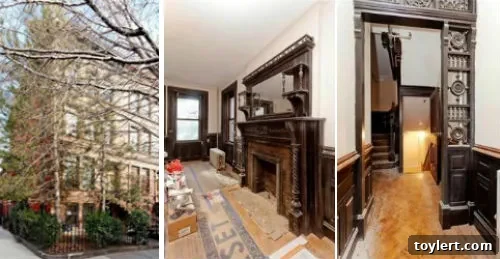
The Remarkable Revival of 271 Jefferson Avenue: A Bed Stuy Gem Transformed
Nestled on a prominent corner in the vibrant Bedford-Stuyvesant neighborhood, 271 Jefferson Avenue stands as a testament to resilience and tasteful renovation. This distinctive brownstone, rich with history and elaborate architectural details, has not only weathered periods of neglect but has also emerged from a recent transformation, much to the relief of preservation enthusiasts and residents alike. Its journey from a historically significant but struggling property to a prized asset in Brooklyn’s competitive real estate market offers a compelling narrative of urban revival.
The story of this particular property took a significant turn in September of the previous year when an LLC acquired it for $600,000 from the Concord Baptist Church. This transaction marked a new chapter for a building with a storied past, one that included periods of bankruptcy and previous ownership by the venerable Bedford Stuyvesant Restoration Corporation, an organization instrumental in the area’s community development and preservation efforts. The acquisition immediately sparked conversations about the fate of the house, particularly given its intricate design elements and ornate fireplaces – hallmarks of its original grandeur. Would these precious details survive the inevitable changes that come with a new owner and a potential “flipper” operation?
A Legacy Etched in Stone: The Architecture of George P. Chappell
The architectural significance of 271 Jefferson Avenue cannot be overstated. Designed by the esteemed architect George P. Chappell in 1887, this residence is a prime example of the late 19th-century aesthetic that defines much of Bed Stuy’s charming streetscape. Chappell, a prolific architect of his time, left an indelible mark on Brooklyn, particularly within its historic brownstone districts. His designs often featured a distinctive blend of Romanesque Revival and Queen Anne styles, characterized by rich textures, varied materials, and an emphasis on craftsmanship.
At 271 Jefferson Avenue, Chappell’s vision is evident in the elaborate details that adorn the exterior and interior. The intricate brickwork, decorative cornices, and perhaps most notably, the ornate fireplaces, speak to an era where attention to detail and artistic expression were paramount in residential architecture. These features are not merely decorative; they are historical artifacts, telling the story of the artisans who built them and the families who called this house home for over a century. For many, the prospect of a modern renovation, especially one driven by profit, often carries the risk of erasing such irreplaceable historical character in favor of contemporary trends. The community, therefore, watched with bated breath, hoping that any new development would honor its heritage.
Navigating Renovation Challenges: A Test of Patience and Preservation
The renovation of 271 Jefferson Avenue indeed commenced, but it was not without its hurdles. The process faced a significant pause due to a stop-work order issued between February and May concerning plumbing permits. Such orders are not uncommon in large-scale renovations, serving as crucial regulatory mechanisms to ensure construction adheres to safety standards and municipal codes. While temporarily frustrating for developers, these checks are vital for maintaining the structural integrity of historic buildings and protecting future occupants. This interlude, though unforeseen, arguably allowed for a period of reflection on the scope and sensitivity of the ongoing work.
Despite the interruption, the market’s anticipation for this property was palpable. Mid-renovation, the house was listed for sale at an ambitious $1,295,000, quickly earning it the distinction of “House of the Day” in February by local real estate observers like Brownstoner. This pre-completion market buzz underscored the property’s inherent value and the robust demand for meticulously restored homes in Bed Stuy. The confidence in the property’s potential was ultimately validated when, on July 24, it successfully sold for an impressive $1.2 million. This rapid appreciation from its $600,000 purchase price just months prior highlights the dynamic and often lucrative nature of real estate investment in this desirable Brooklyn neighborhood.
From Flipping to Flourishing: A Preservation Success Story
The sale of 271 Jefferson Avenue marked the beginning of its next phase: its return to active use, now as a multi-family residence. Shortly after the sale was finalized, rental listings appeared for units 2 and 3, priced at $1,750 and $1,800 a month, respectively. These rental figures are indicative of a strong market for quality housing in Bed Stuy, appealing to professionals and families drawn to the neighborhood’s charm and connectivity.
Crucially, a thorough inspection of the post-renovation photographs reveals a commendable outcome. Despite the common fears associated with “flippers” – a term often implying superficial upgrades that strip away historical character – the developers of 271 Jefferson Avenue appear to have struck a harmonious balance between modernization and preservation. While new flooring was installed, a necessary upgrade for functionality and aesthetics, the historic details that remained intact were carefully preserved. The ornate fireplaces, intricate moldings, and unique architectural quirks, which are the very soul of a Chappell design, were not only saved but appear to have been thoughtfully integrated into the refreshed interiors. The owner’s bathroom and the rental kitchens, too, seem to have received high-quality, tasteful upgrades, ensuring modern comfort without sacrificing the property’s inherent elegance. This approach ensures that the house continues to tell its story while providing contemporary living standards, making it a truly exceptional dwelling.
A Spacious Canvas in a Coveted Location
The property’s specifications further enhance its appeal. Boasting an expansive 3,300 square feet, this three-family residence offers significant living space, a rare commodity in urban settings. With seven bedrooms and five bathrooms, it provides ample accommodation for multiple households or a large family seeking flexibility and privacy. The inclusion of two parking spaces is another highly sought-after amenity in Brooklyn, adding substantial value in an area where parking is often at a premium.
Location plays a pivotal role in the narrative of 271 Jefferson Avenue. Situated in the proposed Bedford Corners historic district, the property benefits from the inherent protections and prestige that come with such a designation. Historic districts are designed to safeguard the architectural integrity and cultural heritage of an area, often leading to increased property values and a stable, desirable living environment. Its proximity to the Clinton Hill border further elevates its desirability. Clinton Hill is renowned for its grand mansions, tree-lined streets, and vibrant cultural scene, and properties bordering it often command higher prices due to spillover demand and shared amenities. This strategic location places 271 Jefferson Avenue at the nexus of two of Brooklyn’s most cherished neighborhoods, offering residents the best of both worlds.
Bed Stuy’s Real Estate Market: A Beacon of Growth
The successful sale and subsequent rental performance of 271 Jefferson Avenue raise a pertinent question for observers of the Brooklyn real estate market: Do prices seem to be rapidly rising in this particular area of Bed Stuy near the Clinton Hill border, or is this impressive valuation simply to be expected for such a large and finely appointed property?
The answer likely lies in a combination of both factors, illustrating the robust health and continued appreciation of Brooklyn real estate. Bed Stuy has, for many years, been on an upward trajectory, transforming from a historically underserved community into one of New York City’s most sought-after neighborhoods. Its rich architectural heritage, strong community ties, diverse cultural scene, and increasingly popular dining and retail establishments have drawn a steady influx of residents and investors. The “near Clinton Hill border” descriptor is especially significant, as it positions the property in an area that often benefits from the prestige and higher price points associated with its upscale neighbor.
Moreover, properties like 271 Jefferson Avenue – spacious, multi-family, historically significant, and meticulously renovated – are increasingly rare. The scarcity of such unique assets naturally drives up their value. Investors are keen to acquire properties that not only offer significant rental income potential but also promise substantial capital appreciation over time, particularly within proposed or established historic districts where future development is often restricted, thereby preserving the neighborhood’s character and exclusivity. The $1.2 million sale price, while a significant leap from its previous acquisition cost, is a reflection of this market reality: a perfect storm of prime location, historical appeal, a successful renovation, and sustained demand for high-quality Brooklyn homes. This transaction firmly entrenches 271 Jefferson Avenue as a flagship property, symbolizing the vibrant and lucrative future of Bed Stuy’s real estate market.
Further Reading and Resources:
- Architecture of George Pool Chappell [Save Bedford Stuyvesant]
- Walkabout: George P. Chappell, Architect [Brownstoner]
- HOTD: 271 Jefferson Avenue [Brownstoner]
- View on Google Maps
- For the recent listing details, visit the Douglas Elliman site.
- Information on the stop-work order can be found on the NYC BISWeb portal.
- Rental listings for Unit 2 on StreetEasy.
- Rental listings for Unit 3 on StreetEasy.