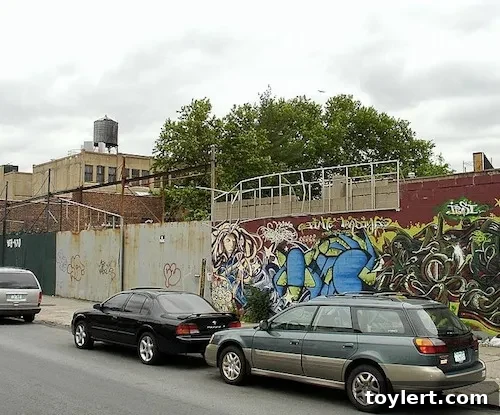
462 Baltic Street: A Parking Lot Today, A Glimpse into Brooklyn’s Development Tomorrow
In the bustling landscape of Brooklyn’s ever-evolving neighborhoods, the transformation of an empty plot of land often sparks curiosity and fuels speculation about the area’s future. While some developments grab headlines with soaring skyscrapers or innovative community spaces, others quietly signal deeper trends in urban planning and investment. Such is the case with the modest 2,500-square-foot lot at 462 Baltic Street, nestled between the vibrant Bond and Nevins Streets. On the surface, recent
Department of Buildings (DOB) permits
suggest a rather unassuming fate for this prime piece of real estate: it is slated to become a parking lot. However, this seemingly “boring” development tells a much richer story about zoning, land banking, and the intricate dance of real estate speculation in one of New York City’s hottest markets.
The Immediate Future: A Parking Solution in a Dynamic Neighborhood
The decision to convert 462 Baltic Street into a parking lot, as indicated by public permits, might strike some as an anticlimax given Brooklyn’s insatiable demand for new housing and commercial spaces. For residents and visitors in the Gowanus and Boerum Hill areas, parking can be a persistent challenge. Therefore, adding even a small parking facility, however temporary it may seem, offers a practical solution to an everyday urban problem. This immediate utility, while functional, contrasts sharply with the long-term potential often associated with vacant lots in rapidly developing districts.
The lot’s location is particularly noteworthy. Situated between Bond and Nevins Streets, it lies in a transitional zone that has witnessed a dramatic shift from its industrial roots to a vibrant mixed-use environment. This area, part of the larger Gowanus neighborhood, is currently undergoing significant changes, driven by rezoning initiatives and a surge of new residential and commercial projects. A parking lot in such a dynamic locale invites questions about the underlying strategy of its owners.
Unpacking the Investment: A Developer’s Long Game
Public records provide crucial insights into the history of this property. The 462 Baltic Street lot last changed hands in May 2011, selling for a significant $1.2 million to a Manhattan development company. For a mere 2,500-square-foot parcel, this price point underscores the inherent value and perceived potential of land in this strategic Brooklyn corridor. This acquisition wasn’t merely for immediate use; it was a calculated investment.
Adding another layer of intrigue, the original
listing
for the property boasted a total of 5,000 buildable square feet. This figure is critical to understanding the developer’s perspective. “Buildable square feet” refers to the maximum amount of floor area that can be constructed on a lot, typically determined by the Floor Area Ratio (FAR) dictated by zoning regulations. A 2,500-square-foot lot with 5,000 buildable square feet implies an FAR of 2.0, suggesting a potential for a structure twice the footprint of the lot itself, likely a two-story building or a taller structure with a smaller footprint.
The Zoning Dilemma: Why Not Residential Development?
The core of the mystery surrounding 462 Baltic Street lies in its zoning classification. The property is currently
not zoned for residential development. This is a crucial detail that explains the seemingly temporary nature of the parking lot plan. New York City’s zoning resolutions are complex, categorizing land into various districts such as residential (R), commercial (C), and manufacturing (M). The Baltic Street lot likely falls under a manufacturing or industrial zoning designation, which prohibits or severely restricts new residential construction.
This zoning constraint immediately limits the type of structures that can be built on the site. While the area around Baltic Street has seen a significant influx of residential buildings, particularly in neighboring Boerum Hill and closer to the newly developing Gowanus Canal corridor, specific parcels may retain older industrial zoning. For a developer who invested $1.2 million, building a mere industrial or commercial structure that doesn’t fully capitalize on the land’s potential, especially in a desirable location, might not be the most profitable immediate venture.
The Art of Land Banking: “Warehousing” for Future Gains
Given the substantial investment and the impressive buildable square footage, the most compelling hypothesis is that the developer is “warehousing” the space. Land banking, or land warehousing, is a common strategy in urban real estate. It involves purchasing land with the intention of holding onto it for an extended period, awaiting more favorable market conditions or, more critically in this context, awaiting a change in zoning regulations that would unlock higher development potential.
Why would a developer engage in such a strategy?
- Future Re-zoning: The Gowanus neighborhood, which encompasses 462 Baltic Street, has been a hotbed of re-zoning discussions for years. The city has actively pursued plans to transform parts of this traditionally industrial area into a vibrant mixed-use district, allowing for new residential and commercial construction while preserving some industrial character. Developers often anticipate these re-zonings and position themselves to benefit when they occur.
- Increased Property Value: Re-zoning land from industrial to residential or mixed-use can dramatically increase its market value. A lot that might be worth X under manufacturing zoning could be worth 2X or 3X under residential zoning, especially in a desirable Brooklyn location.
- Market Timing: Even without a re-zoning, developers might hold land if they believe the broader real estate market is poised for an upswing, or if the costs of construction or financing are currently unfavorable.
- Interim Income: While waiting, converting the lot into a parking space offers a low-cost, low-maintenance way to generate some income to offset carrying costs (taxes, etc.) until the “right” development opportunity arises. It’s a pragmatic placeholder.
The Broader Context: Gowanus and Brooklyn’s Urban Evolution
The story of 462 Baltic Street is a microcosm of the larger narrative of urban development in Brooklyn. Areas like Gowanus, once dominated by industrial facilities and characterized by their gritty aesthetic, are undergoing profound transformations. Driven by population growth, demand for housing, and shifts in economic activity, these neighborhoods are evolving into dynamic hubs.
The process of re-zoning is complex and often contentious, involving extensive community input, environmental reviews, and approvals from the City Planning Commission and the City Council. The Gowanus Canal re-zoning, for instance, has been years in the making, aimed at fostering thousands of new housing units, including affordable housing, alongside new public spaces and commercial opportunities, all while addressing environmental concerns related to the canal itself. A property like 462 Baltic Street sits squarely within this transformative wave.
Community Impact and Future Vision
For the immediate community, the short-term impact of a parking lot is minimal, possibly even beneficial from a convenience standpoint. However, the long-term potential for a residential or mixed-use building, complete with ground-floor retail, could significantly enhance the streetscape and contribute to the area’s vibrancy. Imagine a boutique apartment building or a unique commercial space in place of what is currently an asphalt patch. This potential future is what excites urban planners and community members alike.
The tension between preserving existing industrial uses and encouraging new residential and commercial growth is a constant theme in New York City’s development discourse. The saga of 462 Baltic Street serves as a tangible example of how these macro-level policies play out at the individual property level, influencing investment decisions and shaping the physical fabric of our neighborhoods.
What Lies Beyond the Asphalt?
While the current designation of 462 Baltic Street as a parking lot may seem unremarkable, it represents a calculated maneuver in the high-stakes game of Brooklyn real estate. It’s a temporary pause, a strategic hold, by a developer anticipating a future where the land’s full potential can be realized. The $1.2 million investment in 2011, combined with 5,000 buildable square feet, strongly suggests a vision far grander than mere vehicle storage.
As Brooklyn continues its relentless march of development, parcels like 462 Baltic Street are key indicators of where the city is headed. This lot, while currently offering pragmatic parking, is truly a placeholder for what could be a significant residential or mixed-use contribution to the evolving tapestry of Gowanus. Keep an eye on this space – its “boring” present may very well prelude an exciting future.
GMAP
|
Photo via PropertyShark