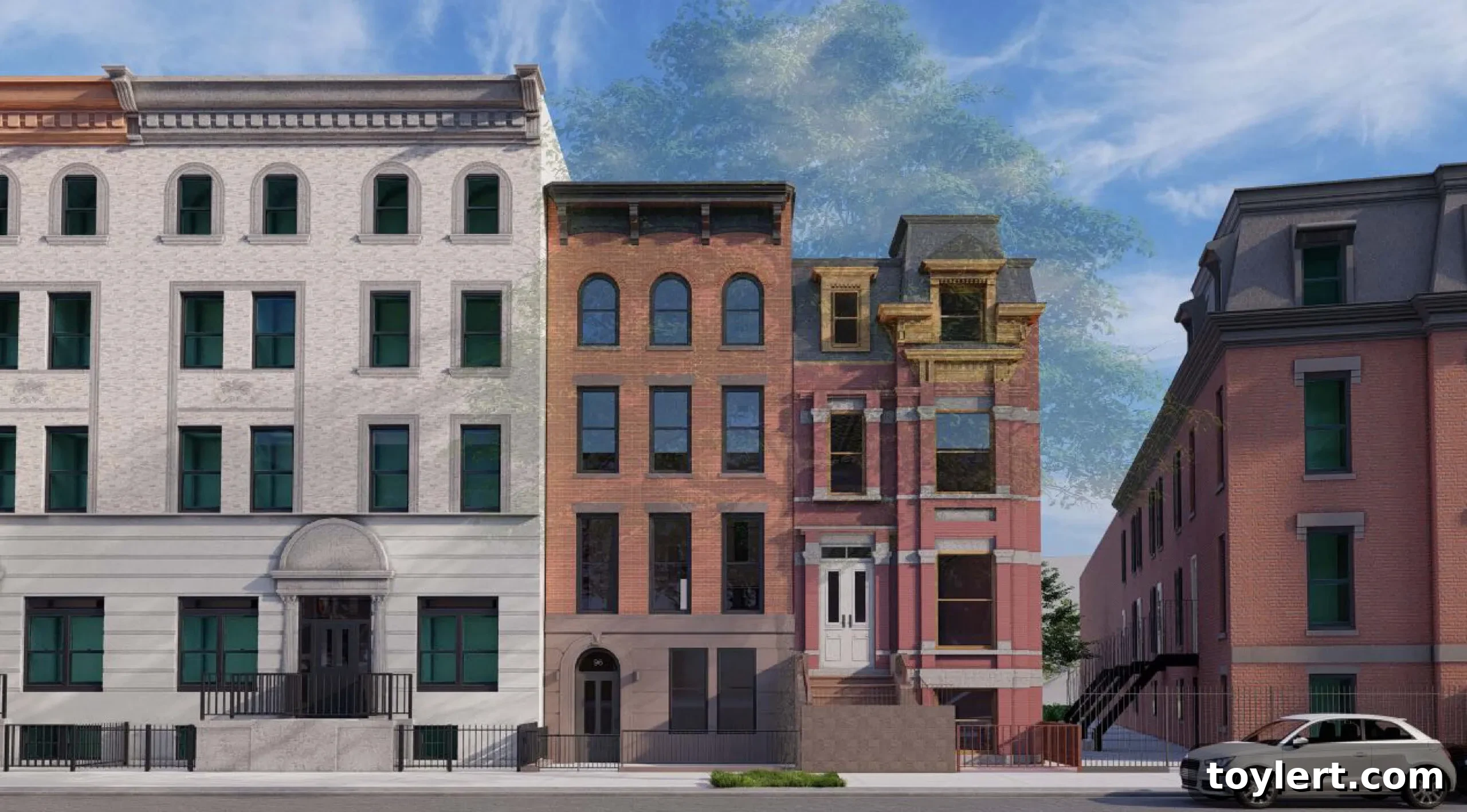
Landmarks Preservation Commission Greenlights “Almost Invisible” Row House for Bed Stuy’s Historic Macon Street
A significant stride in urban revitalization and architectural innovation has been made in Brooklyn’s storied Bedford-Stuyvesant neighborhood, as the city’s esteemed Landmarks Preservation Commission (LPC) unanimously approved plans for a distinctive new multi-family row house at 96 Macon Street. Dubbed “almost invisible” by its creators, the proposed four-story dwelling promises to seamlessly integrate into the block’s rich historical tapestry, a crucial factor that resonated deeply with commissioners during their deliberations last week. This approval marks a pivotal moment for a parcel of land that has lain vacant for decades, poised now to reclaim its place within one of Bed Stuy’s most cherished architectural streetscapes.
The visionary design for 96 Macon Street was meticulously presented to the LPC by a collaborative team comprising preservation consultant Jacqueline Peu-Duvallon and architect Brendan Coburn, a principal from the renowned The Brooklyn Studio. Their proposal addressed the unique challenges and opportunities presented by the site, which has been an empty canvas for at least 40 years. This prolonged vacancy followed the demolition of one of a pair of exquisite 19th-century Queen Anne-style row houses, leaving an unsightly gap in an otherwise continuous and historically significant row.
A Thoughtful Approach to Infill Development in Historic Brooklyn
The concept of “almost invisible” is not merely a catchy phrase; it encapsulates a profound architectural philosophy centered on contextual sensitivity and respectful integration. In historic districts like Bed Stuy, where the character of a street is defined by its architectural ensemble, any new construction faces stringent scrutiny. The challenge is to design a building that meets contemporary living standards while deferring to the aesthetic and material palette of its elder neighbors. The team from The Brooklyn Studio meticulously studied the existing buildings on Macon Street, analyzing their proportions, fenestration patterns, material usages, and decorative elements. The resulting design for 96 Macon Street is a contemporary interpretation that echoes the rhythm and scale of its surroundings without resorting to direct mimicry. This subtle approach ensures that the new structure enhances, rather than disrupts, the street’s historical harmony.
Bedford-Stuyvesant is celebrated for its stunning collection of 19th and early 20th-century brownstones and limestone row houses, representing various architectural styles from Italianate and Neo-Grec to Queen Anne and Romanesque Revival. Macon Street, in particular, is a quintessential example of this architectural grandeur, lined with meticulously preserved homes that tell tales of Brooklyn’s past. The LPC’s role is paramount in safeguarding this heritage, ensuring that any new development or alteration aligns with the community’s preservation goals. The unanimous approval for 96 Macon Street underscores the commissioners’ confidence that the proposed design not only respects but actively contributes to the block’s historic character, setting a precedent for thoughtful infill development in equally sensitive urban environments.
Reclaiming a Missing Tooth: The History of 96 Macon Street’s Vacant Lot
For over four decades, 96 Macon Street has been a noticeable void on an otherwise picturesque block. Its status as an empty lot stems from the unfortunate demolition of one half of a twin pair of Queen Anne-style row houses built in the 19th century. These twin houses, once standing proudly side-by-side, embodied a common architectural practice of the era, creating symmetrical and harmonious facades. The loss of one of these twins left a literal “missing tooth” in the streetscape, disrupting the visual continuity and diminishing the block’s aesthetic coherence. Vacant lots in historic districts often present unique challenges: they can attract blight, deter investment, and interrupt the pedestrian experience. Filling such gaps with appropriate, well-designed structures is crucial for restoring the urban fabric and fostering a sense of completeness and vibrancy.
The Brooklyn Studio, with its deep expertise in historic preservation and contextual architecture, approached this challenge with a clear understanding of the site’s history and its potential. Their proposal for a multi-family row house reflects the evolving needs of urban living while honoring the scale and typology of the traditional Brooklyn row house. The “almost invisible” design intends to recede, allowing the existing historic architecture to remain the dominant visual narrative. This involves careful consideration of setbacks, facade articulation, material choices such as brick and perhaps subtle metalwork, and window proportions that align with the historic rhythm of the street. The goal is not to create a statement piece that competes with its neighbors, but rather to craft a quiet, elegant background structure that allows the existing grandeur of Macon Street to shine even brighter.
The Phoenix Rises: Restoration Efforts at 94 Macon Street
Adding another layer of optimism to Macon Street’s revitalization narrative is the promising future of 94 Macon Street, the surviving twin house. For many years, this once-grand Queen Anne residence had fallen into a severe state of disrepair. Following the death of its homeowner, the property languished, becoming an unfortunate symbol of neglect within the vibrant community. The structural integrity deteriorated to such an extent that the Department of Buildings (DOB) ultimately issued a full vacate order, even contemplating demolition at one point. This grim prospect highlighted the fragility of historic structures when left unmaintained and the constant battle preservationists face against decay and neglect.
However, the tide has turned for 94 Macon Street. A new owner, recognizing the inherent value and potential of the historic property, purchased it in February of last year. This acquisition marked the beginning of a new chapter, one filled with hope for restoration and rebirth. The new owner has since secured the necessary permits from the DOB to undertake a comprehensive renovation, transforming the derelict structure back into a functional and beautiful two-family home. This parallel effort at 94 Macon Street, coinciding with the approval for new construction at 96 Macon Street, creates a powerful synergy. Together, these projects signify a complete revitalization of this segment of the block, transforming two neglected parcels—one vacant, one dilapidated—into vibrant, contributing elements of Bed Stuy’s architectural heritage once more.
A Collaborative Vision for Bed Stuy’s Architectural Future
The unanimous approval by the Landmarks Preservation Commission is a testament to the meticulous work and collaborative spirit of the entire project team. Jacqueline Peu-Duvallon, a seasoned preservation consultant, played a crucial role in navigating the complex regulatory landscape of historic districts, ensuring that the design not only met aesthetic criteria but also adhered to the stringent preservation guidelines set forth by the LPC. Her expertise in the nuances of landmark review processes was invaluable in presenting a compelling case for the project’s contextual appropriateness and its long-term benefits to the community.
Brendan Coburn and The Brooklyn Studio, known for their thoughtful and sensitive approach to architecture within historic contexts, demonstrated their mastery in translating preservation principles into a buildable, beautiful, and functional design. Their ability to conceive an “almost invisible” building speaks volumes about their commitment to an architecture that respects its surroundings, prioritizing continuity and subtlety over overt individual expression. This type of design requires not just technical skill but also a deep historical understanding and an empathetic appreciation for the existing built environment.
This project at 96 Macon Street, alongside the concurrent restoration of 94 Macon Street, represents a significant victory for historic preservation in Brooklyn. It illustrates how infill development can be approached thoughtfully and respectfully, demonstrating that modern architectural interventions can indeed enhance, rather than detract from, the character of historic neighborhoods. The revitalization of these two parcels will not only restore the aesthetic integrity of this beautiful block but also contribute to the overall vibrancy and desirability of Bed Stuy, ensuring that its rich architectural legacy continues to thrive for generations to come. Such endeavors are crucial in balancing urban growth with the imperative of safeguarding the unique identities of our cherished historic districts, fostering a future where the past and present coexist in elegant harmony.