This is Part 3 of our comprehensive look at Harmony Mills. Catch up on the fascinating journey by reading Part 1, Part 2, and continue the narrative with Part 4.
Harmony Mills and the Ascendancy of Mill No. 3: A Glimpse into America’s Industrial Grandeur
Nestled in Cohoes, New York, just across the majestic Hudson River from Troy, Harmony Mills stands as a monumental testament to 19th-century American industrial prowess. In 1866, this textile giant embarked on its most ambitious expansion to date: the construction of Mill No. 3. This wasn’t merely another addition; it was a declaration, a colossal undertaking that would solidify Harmony Mills’ reputation as the largest cotton mill in the United States, overshadowing even the renowned textile powerhouses of Lowell, Massachusetts, and Nashua, New Hampshire.
As we’ve explored in the preceding chapters of our story, Harmony Mills was not just a factory; it was a fully integrated textile operation. From raw cotton bales arriving at its docks, the mill meticulously transformed the fibers into fine threads, and then skillfully wove those threads into high-quality cotton fabric. This intricate process and the sheer volume of its output earned Cohoes the enduring nickname, “The Spindle City,” a moniker that perfectly encapsulates its identity as a bustling hub of textile manufacturing. The mills were the engine of regional prosperity, driving population growth and urban development in an era defined by industrial expansion.
The Genesis of a Giant: Planning Mill No. 3
The decision to construct Mill No. 3 in 1866 was a bold strategic move, born out of immense success and a burgeoning demand for cotton textiles in post-Civil War America. The previous mills had proven incredibly efficient, but market forces and the company’s ambitious vision necessitated an even grander scale of production. The planning for Mill No. 3 was meticulous, involving the era’s leading architects and engineers. It was conceived as an architectural marvel, designed not only for maximum operational efficiency but also to convey the immense power and wealth of Harmony Mills.
The chosen site for this expansion was strategically significant, leveraging the abundant hydropower from the Mohawk River, which flows into the Hudson River at Cohoes. This natural advantage was crucial, as water power was the lifeblood of early industrial machinery. Engineers developed sophisticated systems of dams, canals, and turbine houses to harness this energy, providing a clean and powerful source to drive thousands of spindles and looms within the new mill complex.
Architectural Grandeur and Engineering Innovation
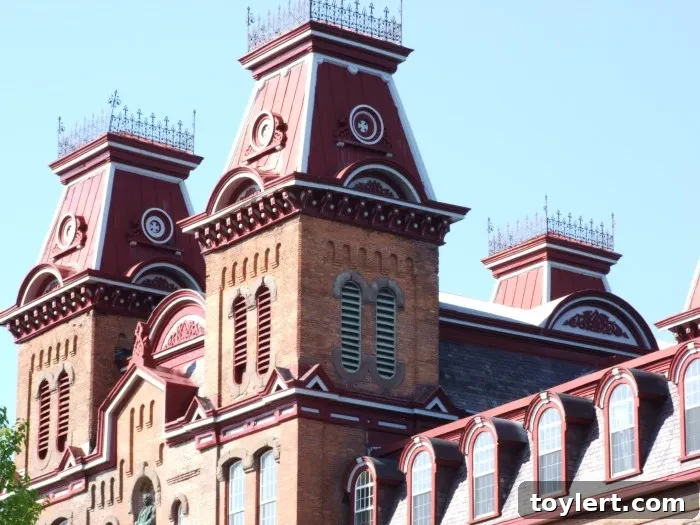
Mill No. 3, upon its completion, was nothing short of an architectural triumph and an engineering marvel. Stretching an astonishing 1,180 feet in length and five stories high, it was an imposing structure built predominantly from locally sourced red brick, adorned with intricate Romanesque Revival architectural elements. Its sheer scale was designed to impress, featuring thousands of windows that allowed natural light to flood the vast interior spaces, crucial for the precise work of textile manufacturing.
Beyond its impressive facade, the internal design of Mill No. 3 was a testament to industrial innovation. The building was robustly constructed to withstand the vibrations of heavy machinery, and its layout was carefully planned to optimize the flow of materials – from raw cotton entry to finished fabric exit. Wide, open floors facilitated the arrangement of hundreds of looms and spinning frames, while high ceilings ensured adequate ventilation. This integrated design philosophy was critical in maximizing productivity and ensuring the efficiency that made Harmony Mills so competitive.
The “Spindle City” Flourishes: Harmony Mills’ Societal Impact
The expansion represented by Mill No. 3 had a profound and transformative impact on Cohoes. The city’s population swelled dramatically, attracting waves of immigrants from Ireland, French Canada, and later Eastern and Southern Europe, all seeking opportunities in the burgeoning textile industry. Harmony Mills became the heart of this vibrant, multi-ethnic community, shaping not only its economy but also its social fabric.
The mill provided not just jobs, but also housing, stores, and community services, creating a self-contained ecosystem around its operations. While working conditions in 19th-century mills were often arduous, Harmony Mills offered a relatively stable source of employment, drawing thousands of workers to Cohoes. The rhythmic hum of its thousands of spindles and looms became the city’s soundtrack, a constant reminder of its industrial identity and the reason for its “Spindle City” nickname. This immense workforce, comprised of men, women, and often children, powered the looms that spun the prosperity of Cohoes.
Outpacing the Giants: A National Leader
What truly set Harmony Mills apart was its unprecedented scale. While cities like Lowell and Nashua in New England had established themselves as pioneers in American textile manufacturing, Harmony Mills, with the addition of Mill No. 3, surpassed them all in terms of sheer size and production capacity. This was a point of immense pride for Cohoes and New York State. The mill housed an astounding number of spindles and looms, capable of producing millions of yards of cotton fabric annually, catering to a national market hungry for textiles.
Its strategic location near major transportation routes, coupled with its ability to harness immense water power, gave Harmony Mills a distinct advantage. The managerial acumen of its leaders, who continually invested in the latest machinery and expanded operations, also played a crucial role in its dominance. Harmony Mills was a symbol of America’s burgeoning industrial might, demonstrating that the future of manufacturing was not solely confined to New England but was also thriving in the dynamic landscape of New York.
A Legacy Endures: From Production to Preservation
For decades, Mill No. 3 and the broader Harmony Mills complex remained a cornerstone of American industry. However, like many other large-scale manufacturing operations in the Northeast, the mills eventually faced the challenges of global competition, changing economic landscapes, and technological shifts in the 20th century. Production gradually declined, and the once-thriving complex eventually ceased its textile operations.
Yet, the story of Harmony Mills did not end there. In a remarkable testament to its architectural significance and historical importance, the complex underwent extensive revitalization in recent decades. Mill No. 3, along with its companion buildings, has been adaptively reused, transformed into modern residential lofts, commercial spaces, and offices. This adaptive reuse has breathed new life into the historic structures, preserving their grandeur while integrating them into the contemporary fabric of Cohoes. Today, visitors and residents can marvel at the robust brickwork, soaring windows, and industrial aesthetic that once housed thousands of workers and machines, now repurposed for 21st-century living.
Harmony Mills: A Timeless Industrial Icon
The construction of Mill No. 3 in 1866 was more than just an expansion; it was a pivotal moment in the history of Harmony Mills and American industry. It represented the peak of textile manufacturing in the United States, an era where innovation, scale, and sheer human endeavor converged to create economic powerhouses. Harmony Mills, and particularly its monumental Mill No. 3, stands as an enduring symbol of Cohoes’ “Spindle City” heritage and the relentless spirit of American industrial development. Its legacy continues to inspire, reminding us of a time when colossal brick structures hummed with the energy of progress, forever shaping the landscape and identity of a nation.