Vanishing Heritage: The Demolition of Bed-Stuy’s Historic Carpenter Gothic Church at 809 Jefferson Avenue
Bedford-Stuyvesant, a vibrant and historically rich neighborhood in Brooklyn, is renowned for its stunning architecture and deep-rooted heritage. However, the relentless march of modern development often brings with it the bittersweet reality of change, sometimes at the expense of irreplaceable landmarks. Such is the poignant tale unfolding at 809 Jefferson Avenue, where one of Bed-Stuy’s oldest and most distinctive structures, a Carpenter Gothic church, has been reduced to a mere shell, signaling the end of an era and the beginning of a new chapter.
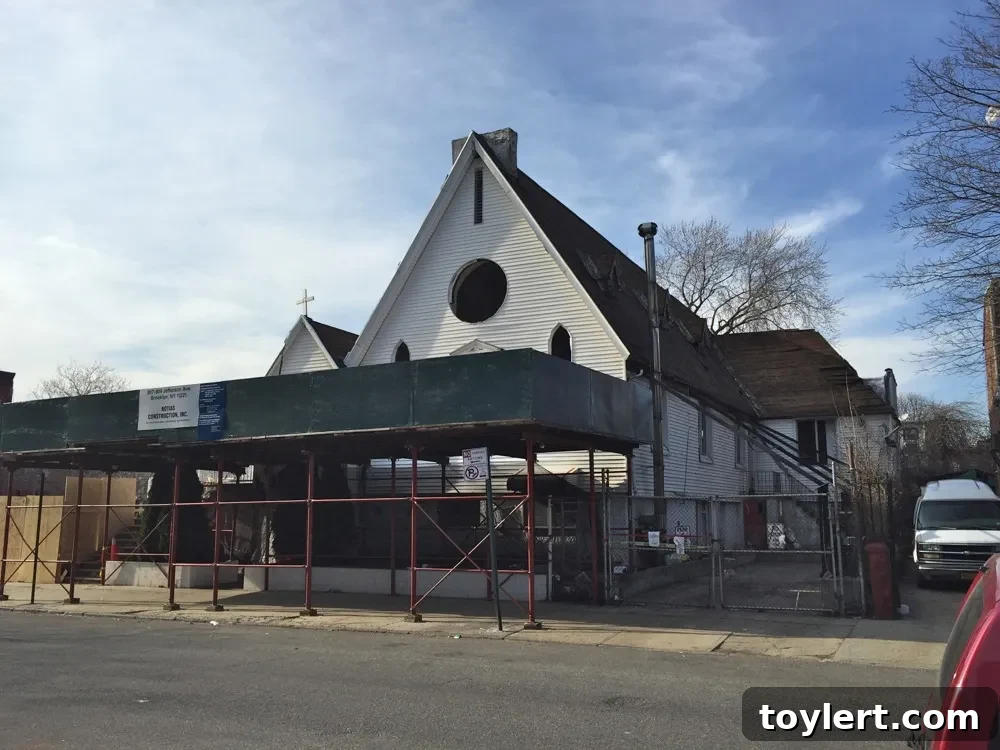
This remarkable pre-Civil War edifice, an exquisite example of Carpenter Gothic architecture, began its demolition in January. The site is slated for redevelopment, making way for a modern apartment complex and a new, contemporary church. From the street, the profound transformation is immediately apparent: the building’s interior has been entirely hollowed out, its once-proud framework now standing as a skeletal testament to its past grandeur. The historic stained glass windows, intricate carvings, and other unique features that defined its character have been carefully, or perhaps hastily, removed, leaving behind a void that echoes with centuries of untold stories.
A Glimpse into the Past: Bed-Stuy’s Pre-Civil War Architectural Gem
The church at 809 Jefferson Avenue was more than just a building; it was a cornerstone of the community, a tangible link to Bed-Stuy’s nascent days. Historical maps confirm its existence as early as 1854, firmly placing it among the most venerable structures in the neighborhood. Intriguingly, some historians suggest its origins might stretch back even further, potentially to the 1840s. This places the church’s construction firmly in an era when Brooklyn was rapidly transforming from a collection of towns into a bustling city, long before the consolidation with New York City.
During this period, Bed-Stuy was evolving, attracting diverse communities and witnessing the construction of many of its iconic brownstones and public buildings. A structure dating back to the 1840s or 1850s would have witnessed the significant societal changes leading up to the Civil War, the industrial boom of the late 19th century, and the subsequent ebb and flow of urban life. Its very presence offered a silent narrative of the borough’s historical trajectory, making its current state of demolition particularly heartbreaking for those who value Brooklyn’s architectural legacy and the unique history embedded within its oldest structures.
Decoding Carpenter Gothic: An Architectural Style Defined by Craftsmanship
The Carpenter Gothic style, a charming American interpretation of the broader Gothic Revival movement, emerged in the mid-19th century. Unlike its grander European counterparts built from stone, Carpenter Gothic utilized readily available timber, allowing for more affordable and widespread construction. Yet, it did not compromise on aesthetic appeal, bringing the romantic and picturesque qualities of Gothic architecture to more modest structures, often found in rural or burgeoning suburban settings like Bed-Stuy once was.
Key characteristics of the Carpenter Gothic church at 809 Jefferson Avenue would have included its distinctive steeply pitched roofs, pointed arch windows, decorative vergeboards (or bargeboards) along the gables, and intricate wooden tracery that mimicked the stone tracery of medieval cathedrals. The removal of the historic stained glass windows is a particularly significant loss, as these elements were integral to the style, bathing the interiors in colorful, ethereal light and often depicting religious scenes or intricate patterns. These windows were not merely functional; they were works of art, handcrafted expressions of faith and artistic skill that added immeasurable beauty and spiritual depth to the sanctuary.
Such churches were often characterized by their verticality, slender spires, and sometimes board-and-batten siding, all contributing to an upward-reaching, heavenly aesthetic. The Bed-Stuy church stood as a testament to the ingenuity and craftsmanship of its builders, a unique example of how timber could be manipulated to evoke the grandeur of Gothic design, creating structures that were both visually striking and deeply rooted in their communities. Its design would have offered a stark contrast to the more common Georgian or Federal styles prevalent in older parts of the city, truly showcasing a distinct architectural moment.
The Echoes of Demolition: What’s Lost and What’s Next for Jefferson Avenue
The sight of the Carpenter Gothic church at 809 Jefferson Avenue reduced to a hollow shell is a stark reminder of the irreversible consequences of demolition. When a historic building is torn down, it’s not merely bricks and mortar that are lost; it’s the craftsmanship of generations past, the layers of history embedded in its very fabric, and the collective memory of a community. The building’s intrinsic value lay in its unique architectural style, its venerable age, and its role as a silent witness to Bed-Stuy’s evolution.
The ongoing demolition, which commenced in January, has systematically stripped the church of its defining characteristics. The removal of the stained glass windows, a process that might have been undertaken for salvage or simply as part of the demolition, represents the loss of irreplaceable artistic and historical elements. Other architectural features, such as ornate wooden details, unique fenestration, and the overall structural integrity that spoke of its original design, have been dismantled. What remains is a skeletal frame, awaiting its final collapse to make way for the new development.
The planned redevelopment signals a significant shift for this particular block of Jefferson Avenue. The construction of new apartments, alongside a new church, reflects the intense demand for housing in Brooklyn and the ongoing transformation of neighborhoods like Bed-Stuy. While new development can bring much-needed housing and economic vitality, it also raises critical questions about how communities balance progress with the imperative of preserving their unique historical character. The design of the new church and residential units will undoubtedly shape the aesthetic and functional landscape of the area for decades to come, hopefully harmonizing with the surrounding brownstones and streetscape rather than clashing starkly with the established architectural rhythm and historical context.
Preservation in Peril: The Broader Context in Bedford-Stuyvesant
The demolition of the 809 Jefferson Avenue church highlights the continuous challenges faced by historic preservation efforts across Brooklyn. Bed-Stuy, in particular, has seen an explosion of real estate development in recent years, driven by its attractive housing stock, convenient location, and vibrant cultural scene. This boom often puts pressure on older, unprotected buildings that stand on valuable parcels of land.
A crucial question arises: why wasn’t this pre-Civil War Carpenter Gothic church designated a landmark? Landmark status, bestowed by the New York City Landmarks Preservation Commission (LPC), provides crucial protection against demolition and insensitive alteration. While many areas of Bed-Stuy, such as parts of its historic districts, enjoy landmark protection, individual buildings outside these zones can remain vulnerable. The process for landmark designation is often lengthy and requires concerted advocacy from community groups and preservationists. Without such protection, a building’s fate often rests solely with its owner and developers, whose motivations may prioritize economic gain over historical preservation.
The loss of structures like the Jefferson Avenue church serves as a powerful reminder of the urgency of proactive preservation. Community organizations, local historians, and urban planners continually advocate for the expansion of historic districts and the individual landmarking of significant properties. Their efforts aim to ensure that Bed-Stuy’s architectural diversity, its rich social history, and the tangible reminders of its past are not completely erased in the pursuit of modernization. The struggle to balance development with preservation is an ongoing dialogue, with each demolition like this church serving as a poignant chapter in that larger narrative. It underscores the need for robust zoning laws and community engagement to safeguard precious historical assets.
A Call to Action and Reflection for Brooklyn’s Future
The dismantling of the historic Carpenter Gothic church at 809 Jefferson Avenue represents more than just the physical removal of a structure; it’s a symbolic moment that calls for reflection on Brooklyn’s identity and future. It compels us to consider the value we place on our shared heritage and the legacies we choose to leave for future generations. While progress and development are essential for urban vitality, they should ideally proceed with a deep respect for the architectural and cultural fabric that defines a place.
As the new apartments and church rise on this historic site, it is imperative for residents, developers, and city officials to learn from such losses. The preservation of Bed-Stuy’s remaining historic architecture, whether it be its iconic brownstones, grand institutional buildings, or more modest yet historically significant structures, should be a collective priority. Documenting these vanishing landmarks through photography, historical research, and oral histories becomes even more critical when physical structures are lost.
The legacy of the Carpenter Gothic church at 809 Jefferson Avenue, though now a hollow echo, should serve as an enduring reminder of what once stood—a testament to Bed-Stuy’s foundational history and the distinctive architectural styles that once graced its streets. May its memory inspire greater vigilance and more robust efforts in preserving the irreplaceable treasures that still stand, ensuring that the soul of Bedford-Stuyvesant continues to thrive not just in its present and future, but also in its profound and visible past. Protecting these architectural narratives is crucial for maintaining the unique character and appeal of one of Brooklyn’s most cherished neighborhoods.