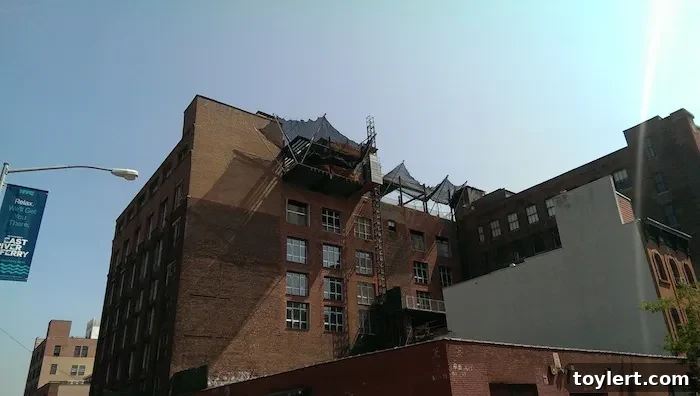
The End of an Era: Illegal Addition at 53 Bridge Street in Dumbo Finally Comes Down
For four long years, the skyline of Dumbo, Brooklyn, has been marred by an unauthorized five-story addition atop the historic warehouse conversion project at 53 Bridge Street. This architectural anomaly, a stark defiance of urban planning regulations, has been a source of contention and regulatory action by the New York City Department of Buildings (DOB). After persistent efforts and legal battles, it appears the long-standing saga is finally reaching its resolution, as the illicit structure is now in the process of being dismantled.
Recent observations confirm visible progress in the demolition, with the building at 53 Bridge Street appearing strikingly shorter – an estimated three stories less than its previous, illegally inflated height. This pivotal development signals a significant victory for regulatory oversight and a return to legal compliance in one of Brooklyn’s most coveted neighborhoods. The gradual reduction of the structure is a testament to the DOB’s unwavering commitment to upholding building codes and preserving the architectural integrity of New York City.
A Deep Dive into the Dumbo Development Landscape
The neighborhood of Dumbo, an acronym for “Down Under the Manhattan Bridge Overpass,” has undergone a phenomenal transformation over the past few decades. Once a gritty industrial waterfront district characterized by cobblestone streets and cavernous warehouses, Dumbo has evolved into a highly desirable residential, commercial, and artistic hub. Its stunning views of the Manhattan skyline and iconic bridges, combined with its unique industrial charm, have made it a magnet for residents, businesses, and developers alike.
This rapid gentrification has naturally led to intense real estate interest, driving up property values and fostering a climate of ambitious development projects. Warehouse conversions, in particular, are a hallmark of Dumbo’s architectural narrative, repurposing historical industrial structures into modern lofts, offices, and retail spaces. However, with intense development pressure comes the critical need for strict adherence to zoning laws and building regulations, designed to ensure public safety, maintain neighborhood character, and prevent unchecked expansion. The case of 53 Bridge Street serves as a potent reminder of the challenges and complexities inherent in navigating such a dynamic urban development landscape.
The Four-Year Saga of Non-Compliance
The controversy surrounding 53 Bridge Street dates back to March 2010, when the DOB first issued an order to landlord Joshua Guttman, requiring the removal of the then-newly constructed, unapproved addition. Despite this initial order, the illegal five-story structure remained perched atop the building, becoming a glaring symbol of non-compliance and a source of frustration for local residents and authorities. The ensuing years saw a protracted series of administrative actions and legal skirmishes, with the DOB repeatedly attempting to enforce its mandate.
An “illegal addition” in the context of NYC real estate refers to any structural expansion that has been constructed without the necessary permits, failing to comply with zoning regulations regarding height, setback, floor-area ratio, or other critical building codes. Such violations not only pose potential safety risks but also disrupt urban planning, cast a shadow on property values, and undermine the city’s meticulous efforts to manage its built environment responsibly. The persistence of the addition at 53 Bridge Street for so long highlighted the often-lengthy and arduous process involved in enforcing building codes against determined property owners.
Recent Breakthroughs: Stop-Work Orders and Demolition Progress
While conversion work at 53 Bridge Street reportedly restarted just a few months prior, these efforts were swiftly met with renewed and decisive action from the DOB. In March of this year, the property was slapped with not one, but three distinct partial stop-work orders. These orders were unequivocal in their demands, specifically mandating the immediate demolition of the illegal addition. The issuance of multiple, stringent stop-work orders underscored the DOB’s escalated commitment to resolve the long-standing violation.
The visible progress in the demolition suggests that these recent orders have finally prompted substantive action. The process of dismantling such a large-scale, illegally constructed section of a building is complex, requiring careful planning to ensure the structural integrity of the remaining legal structure and the safety of workers and the public. It involves methodical deconstruction, often floor by floor, removing materials in a controlled manner to prevent collapse or damage to adjacent properties. The sight of the building gradually shrinking back to its permitted height is a significant milestone, indicating a turning point in this long-running dispute.
Implications for Dumbo and the Broader NYC Real Estate Market
The successful enforcement action at 53 Bridge Street carries significant implications, extending far beyond the immediate confines of the property itself. For the residents of Dumbo, the removal of the illegal addition brings a sense of relief and reinforces confidence in the city’s regulatory framework. It helps to preserve the unique character and scale of the neighborhood, ensuring that development proceeds in a manner consistent with approved plans and community expectations. This outcome establishes a clear precedent, signaling that violations of building codes, no matter how entrenched, will eventually face resolute enforcement.
For developers operating in New York City, this case serves as a stern warning regarding the absolute necessity of obtaining all required permits and strictly adhering to approved plans and zoning regulations. Cutting corners or attempting to bypass the regulatory process ultimately leads to costly delays, financial penalties, and, as demonstrated here, the complete dismantling of unauthorized construction. It underscores the principle that long-term success in the competitive NYC real estate market is intrinsically linked to legal compliance and responsible development practices. Furthermore, for the DOB, this outcome validates its enforcement mechanisms, demonstrating that even complex and protracted cases can ultimately be brought to a satisfactory resolution, reaffirming the agency’s role as a vital guardian of the city’s built environment.
Looking Ahead: The Future of 53 Bridge Street
With the illegal addition now being systematically removed, the focus will undoubtedly shift to the future of the 53 Bridge Street property. Once the demolition is complete and the building is brought into full compliance with its original, approved plans, the stalled warehouse conversion can finally proceed as intended. This will likely involve a re-evaluation of permits, careful inspections to ensure structural soundness, and a renewed construction effort to complete the project according to legal specifications.
The completion of the project, albeit delayed by years of non-compliance, will eventually contribute to Dumbo’s vibrant landscape, offering new residential or commercial spaces that are both safe and legally constructed. This incident, while protracted, ultimately reinforces the importance of a robust regulatory system in New York City – a system designed to balance ambitious development with the critical imperatives of public safety, urban planning, and the preservation of neighborhood character. The journey of 53 Bridge Street serves as a powerful case study in the complexities of urban development, the challenges of enforcement, and the ultimate triumph of regulatory oversight.