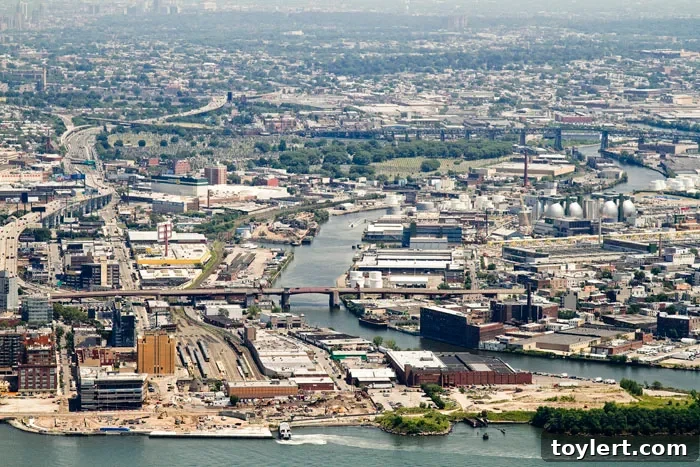
Unveiling the Legacy: Newtown Creek, Brooklyn’s Industrial Artery and Environmental Battleground
Nestled between the vibrant boroughs of Brooklyn and Queens, Newtown Creek stands as a powerful symbol of New York City’s industrial past and the complex environmental challenges that ripple into its present. Once a bustling, indispensable waterway that fueled the backbone of Brooklyn’s mighty industrial economy, this unassuming creek now carries the weight of a century-long legacy of pollution, struggle, and determined efforts toward revitalization. From its crucial role in shaping urban development to its controversial designation as a federal Superfund site, Newtown Creek offers a compelling narrative of human ambition, environmental consequence, and the enduring spirit of community advocacy. For those eager to delve deeper into this captivating history, an enlightening event at Brooklyn Brainery promises a unique photographic journey and an insightful lecture.
The Heart of Brooklyn’s Industrial Might: A Glimpse into Newtown Creek’s Storied Past
To truly understand Newtown Creek today, one must journey back in time to its heyday as an economic powerhouse. For generations, this serpentine estuary served as the lifeblood of Brooklyn and Queens, a critical conduit for industry that transformed the surrounding landscape. From the mid-19th century through much of the 20th, its banks teemed with activity: oil refineries, chemical plants, metal foundries, fertilizer factories, and gasworks all relied on the creek for transportation, water, and waste disposal. Large barges navigated its waters, carrying raw materials in and finished products out, connecting local industries to a broader global market. The sheer volume of industrial operations along Newtown Creek was staggering, positioning it as one of the busiest and most productive industrial waterways in the entire United States. It was an era of unprecedented growth and innovation, a period when Brooklyn earned its reputation as a manufacturing giant, with Newtown Creek at its very heart.
This intense industrialization, while undoubtedly driving economic prosperity and urban expansion, came at a tremendous cost to the creek itself. What was once a vibrant natural ecosystem, home to diverse aquatic life and supporting a rich marshland environment, gradually succumbed to the relentless pressures of unchecked industrial discharge. The very industries that brought prosperity also contributed to its gradual degradation, transforming the waterway from a natural resource into an open sewer. The story of Newtown Creek is, in many ways, a microcosm of industrialization’s dual nature: fostering progress while inadvertently sowing the seeds of environmental crisis.
A Legacy of Pollution: From Industrial Hub to Federal Superfund Site
The legacy of Newtown Creek’s industrial past is undeniably intertwined with its profound environmental contamination. For over 150 years, factories, refineries, and other businesses discharged massive quantities of waste directly into its waters, creating one of the nation’s most severely polluted waterways. This continuous dumping included a toxic cocktail of heavy metals, volatile organic compounds, polycyclic aromatic hydrocarbons (PAHs), and perhaps most notoriously, millions of gallons of petroleum products. The notorious “black mayonnaise,” a tar-like sludge of oil and industrial waste, still blankets much of the creek bed, a grim testament to decades of spills and neglect.
The scale of this environmental disaster was so immense that, in 2010, the federal government officially designated Newtown Creek as a Superfund site under the Comprehensive Environmental Response, Compensation, and Liability Act (CERCLA). This critical designation acknowledged the creek’s severe contamination, signaling that it posed a significant threat to human health and the environment, thereby qualifying it for long-term cleanup strategies and federal oversight. The Superfund status was a turning point, bringing national attention and resources to a problem that had plagued local communities, particularly Greenpoint and Long Island City, for generations.
One of the most significant milestones in the creek’s journey toward remediation occurred shortly after its Superfund designation. In 2010, Exxon Mobil agreed to a substantial $25 million settlement. This historic agreement aimed to address decades of extensive oil spills and leaks originating from the company’s former facilities along the creek. While this settlement represented a crucial step in holding polluters accountable, much of the funds were directed not just into direct cleanup operations, but also into a vital community fund. This fund was established to benefit the residents of Greenpoint and its surrounding environment, empowering local initiatives focused on environmental justice, community health, and ecological restoration efforts within the affected areas. The settlement underscored the devastating impact of industrial pollution on both the natural world and the human communities that depend on it.
The Road to Recovery: Cleanup Efforts and Community Engagement
The journey to restore Newtown Creek is a monumental undertaking, fraught with technical complexities and long-term challenges. As a Superfund site, the creek is now subject to a rigorous and multi-faceted remediation process overseen by the Environmental Protection Agency (EPA). This process involves extensive studies to fully characterize the contamination, evaluate various cleanup technologies, and ultimately implement a comprehensive plan to remove or neutralize pollutants. The cleanup is not a quick fix; it involves dredging contaminated sediments, treating groundwater plumes, and mitigating ongoing sources of pollution, a task expected to span many decades.
Crucially, the revitalization of Newtown Creek is not solely a government-led endeavor; it is deeply intertwined with the tireless efforts of local community groups and environmental advocates. Organizations like the Newtown Creek Alliance have played an indispensable role, advocating for more stringent cleanup standards, raising public awareness, and working to reconnect residents with this historically neglected waterway. Through educational programs, community cleanups, and policy advocacy, these groups ensure that the creek’s future remains a priority, pushing for a future where the creek can once again support thriving ecosystems and be a safe, accessible resource for all New Yorkers. Their work highlights the power of sustained community engagement in driving environmental justice and restoration.
Experience the Story: “The Newtown Creek Magic Lantern Show” at Brooklyn Brainery
For an unparalleled opportunity to explore the intricate history and ongoing transformation of Newtown Creek, mark your calendars for “The Newtown Creek Magic Lantern Show” at Brooklyn Brainery. This unique event, featuring a captivating photographic journey and an insightful lecture, offers a vivid portal into the past, present, and future of this iconic waterway. The presentation promises to transport viewers on a visual expedition, chronicling the creek’s evolution from its majestic junction with the East River, through its winding industrial segments, all the way to what its presenter evocatively describes as the “heart of darkness” found at its end in East Williamsburg.
The lecture will take place on Thursday, February 27, from 8 to 10 pm, at Brooklyn Brainery’s inviting Prospect Heights storefront, located at 190 Underhill Avenue. Attendees will gain a deeper appreciation for the creek’s ecological significance, its industrial heritage, and the monumental task of its ongoing environmental restoration. Tickets for this illuminating event are affordably priced at $12, making it an accessible opportunity for anyone interested in urban history, environmental science, or the hidden stories of New York City. Secure your spot and join this journey into the depths of Newtown Creek’s compelling narrative by signing up on the official Brooklyn Brainery signup page.
Mitch Waxman: A Voice for the Creek’s Past and Future
Leading this fascinating exploration will be Mitch Waxman, a renowned local historian, prolific blogger for Brownstoner Queens, and a dedicated historian with the Newtown Creek Alliance. Waxman is not merely a commentator; he is a passionate observer and chronicler of the creek, possessing an encyclopedic knowledge of its nuanced history and the intricate details of its environmental struggles. His unique perspective, combining academic rigor with grassroots activism, makes him an exceptionally engaging and authoritative guide to the creek’s complex narrative. Through his extensive research, compelling photography, and articulate presentations, Waxman has become a leading voice in bringing the story of Newtown Creek to a broader audience, fostering understanding and inspiring action. His “Magic Lantern Show” is more than just a lecture; it’s a profound act of storytelling that connects the past to the present, urging us to consider our collective responsibility towards this vital urban ecosystem.
A Call to Action for Environmental Awareness
Newtown Creek serves as a potent reminder that our urban landscapes hold layers of history, both triumphant and challenging. Its transformation from a natural wetland to an industrial hub and now to a focal point of environmental remediation reflects the dynamic relationship between human development and the natural world. Events like Mitch Waxman’s “Magic Lantern Show” are crucial in fostering public awareness, educating communities about the importance of environmental stewardship, and inspiring continued efforts toward ecological recovery. By understanding the creek’s past, we are better equipped to advocate for its future—a future where Newtown Creek can once again thrive, clean and accessible, serving as a testament to the power of collective action and environmental resilience.
Don’t miss this extraordinary opportunity to connect with a crucial piece of New York City’s environmental and industrial heritage. The story of Newtown Creek is not just about pollution and cleanup; it’s about the resilience of nature, the strength of community, and the ongoing quest for a more sustainable urban future.