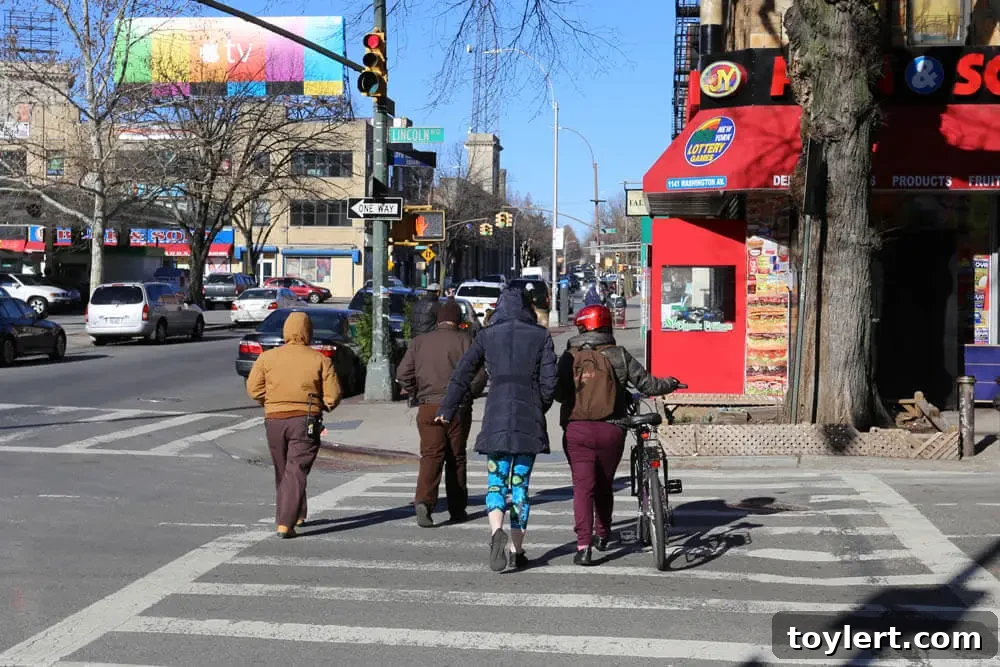
Celebrating Jane Jacobs: Her Enduring Legacy and the Global Phenomenon of Jane’s Walks
On May 4th, the remarkable urbanist, activist, and author Jane Jacobs would have celebrated her 100th birthday. A formidable opponent of the era’s powerful city planner Robert Moses, Jacobs penned the groundbreaking 1961 critique, The Death and Life of Great American Cities, forever altering the discourse around urban planning. To honor her centennial and underscore her profound legacy in advocating for vibrant, human-centric cities, communities worldwide, including numerous neighborhoods across Brooklyn, come alive with a series of free, locally-led walking tours known as Jane’s Walks.
These unique walks, organized by volunteers and held globally, transcend mere sightseeing. They are designed as “walking conversations,” fostering a deeper engagement with the urban environment. Participants explore diverse topics ranging from a neighborhood’s distinctive architecture and rich historical narratives to current development challenges and community aspirations. In New York City, the Jane’s Walks are proudly coordinated by the Municipal Art Society of New York (MAS), a prominent nonprofit organization dedicated to urban planning and preservation advocacy, ensuring that Jacobs’ principles continue to inspire local engagement.
The Visionary Behind the Movement: Who Was Jane Jacobs?
Jane Jacobs (1916-2006) was not a trained urban planner, but her insightful observations and compelling arguments revolutionized how we understand and approach city life. Born Jane Butzner in Scranton, Pennsylvania, she moved to New York City in 1934 and began her career as a freelance writer. It was her keen eye for detail and an intuitive understanding of how cities actually functioned at a street level, rather than how planners imagined they should, that set her apart. She became an associate editor for Architectural Forum magazine, a position that provided her a platform to voice her increasingly critical views on mid-20th-century urban renewal policies.
Jacobs championed the idea of dense, diverse, and mixed-use neighborhoods where residents felt a strong sense of ownership and responsibility. Her most famous concept, “eyes on the street,” argued that the continuous presence of people going about their daily lives provides natural surveillance, making streets safer and more vibrant. She believed in the organic evolution of communities, where old and new structures coexist, and where small businesses thrive alongside residences. This organic, bottom-up approach stood in stark contrast to the prevailing top-down, large-scale urban planning initiatives of her time, which often involved mass demolition and the imposition of sterile, segregated zones.
The Death and Life of Great American Cities: A Paradigm Shift
Published in 1961, The Death and Life of Great American Cities became an instant classic and remains a foundational text in urban studies. In this seminal work, Jacobs meticulously deconstructed the prevalent urban planning theories of the 1950s, which she argued were destroying American cities rather than improving them. She criticized the fashion for “blight removal,” which often meant razing vibrant, albeit older, neighborhoods to make way for monolithic housing projects, expansive highways, and isolated commercial districts.
Jacobs contended that these modernist planning principles, often driven by engineers and architects disconnected from the lived experience of city dwellers, fostered sterile environments, eroded community ties, and ultimately made cities unsafe and uninviting. She passionately argued for the inherent intelligence and self-organizing capacity of complex urban systems, emphasizing the importance of diversity, density, short blocks, and the preservation of historic buildings to create truly thriving neighborhoods. Her book was not just a critique; it was a powerful articulation of an alternative vision, celebrating the messy, intricate beauty and functional logic of successful urban life.
The Battle with Robert Moses: A Clash of Ideologies
No discussion of Jane Jacobs is complete without acknowledging her legendary clashes with Robert Moses, New York City’s unparalleled “master builder.” Moses, an urban planner of immense power and influence, envisioned a city shaped by grand, monumental infrastructure projects: expressways cutting through existing neighborhoods, towering public housing, and vast parks. His approach was one of top-down efficiency and engineering prowess, often prioritizing automobile traffic and large-scale development over the concerns of local communities.
Jacobs became a vocal and effective leader of grassroots movements opposing Moses’s most destructive plans. Her most famous victories include the successful efforts to halt the Lower Manhattan Expressway (LoMEX), which would have carved a destructive path through Greenwich Village and SoHo, and the fight to prevent a highway from bisecting Washington Square Park. These battles were not just about saving physical spaces; they were ideological wars between two diametrically opposed visions of urbanism: Moses’s belief in the power of the planner and the automobile, versus Jacobs’s conviction in the wisdom of the street, the pedestrian, and the community. Her activism demonstrated the power of organized citizens to challenge entrenched power and shaped a new era of urban preservation and community advocacy.
Jane’s Enduring Legacy: Shaping Modern Urbanism
Jacobs’ ideas, once considered radical, are now fundamental to contemporary urban planning and design. Her emphasis on mixed-use development, walkability, public transportation, and community participation has profoundly influenced concepts like “new urbanism,” “smart growth,” and “placemaking.” Cities around the world are increasingly adopting policies that encourage human-scale development, prioritize pedestrian and bicycle infrastructure, and celebrate local character—all tenets championed by Jacobs decades ago.
Her work continues to inspire planners, architects, policymakers, and activists to look beyond blueprints and consider the social fabric of neighborhoods. The importance of local economies, diverse populations, and the organic evolution of urban spaces are now recognized as critical for sustainable and resilient cities. Jane Jacobs taught us that cities are not just collections of buildings and roads, but complex, living organisms that thrive on human interaction, diversity, and continuous adaptation.
Jane’s Walks: A Global Celebration of Local Wisdom
The annual Jane’s Walks are a vibrant, living testament to Jacobs’s philosophy. Originating in Toronto, where Jacobs spent the latter part of her life, these walks have grown into a global movement, typically held on the first weekend of May. They are a decentralized, community-driven initiative, coordinated internationally by a charitable organization in Toronto, but locally organized by passionate volunteers. This structure perfectly embodies Jacobs’s belief in local expertise and bottom-up engagement.
Unlike traditional guided tours, Jane’s Walks are not lectures. They are interactive “walking conversations” where participants are encouraged to share their observations, memories, and insights about the places they inhabit. These walks are free, accessible, and open to everyone, creating inclusive spaces for dialogue and discovery. They empower residents to become experts in their own neighborhoods, fostering a deeper connection to their surroundings and often inspiring further civic engagement.
Exploring Brooklyn Through Jane’s Lens: History, Architecture, and Community
Brooklyn, a borough celebrated for its distinct neighborhoods, rich history, and vibrant communities, offers an ideal canvas for Jane’s Walks. This weekend, volunteers across Brooklyn are leading tours that delve into the unique character of various areas. Participants might explore the historic brownstones and tree-lined streets of Prospect Lefferts Gardens, uncovering its architectural gems and community efforts to preserve its heritage. Walks in the dynamic Navy Yard area could focus on its transformation from an industrial hub to a center for innovation, examining the interplay of past and present development.
Similarly, tours through the culturally rich streets of Bed-Stuy (Bedford-Stuyvesant) might highlight its stunning Victorian architecture, the resilience of its community, and the ongoing dialogue about development and gentrification. Each walk offers a chance to experience Brooklyn not just as a collection of buildings, but as a tapestry of human stories, historical layers, and evolving urban life, seen through the critical and appreciative “eyes on the street” that Jane Jacobs championed. These local explorations serve as a powerful reminder of how vital it is to understand and cherish the intricate details that make each neighborhood unique.
Join the Conversation: How Jane’s Walks Foster Community Engagement
Participating in a Jane’s Walk is more than just a pleasant stroll; it’s an act of civic engagement. By encouraging people to look closely at their surroundings, ask questions, and share perspectives, these walks build community. They often reveal hidden histories, highlight overlooked challenges, and celebrate local victories. For newcomers, they offer an invaluable introduction to the soul of a neighborhood. For long-time residents, they provide a fresh perspective, sparking new conversations and fostering a renewed sense of pride and ownership.
In a world increasingly dominated by digital interactions, Jane’s Walks offer a tangible, human-scale way to connect with our cities and with each other. They remind us that the health of our urban environments is inextricably linked to the active participation of their inhabitants. As we celebrate Jane Jacobs’s centennial, the proliferation of Jane’s Walks worldwide stands as a living testament to her enduring belief in the power of ordinary people to shape extraordinary cities.