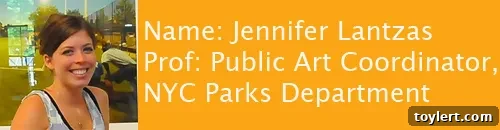
Curating the Urban Canvas: A Deep Dive into Public Art with Jennifer Lantzas of NYC Parks
Welcome to “The Hot Seat,” an exclusive series spotlighting the visionaries shaping Brooklyn’s vibrant landscape in real estate, development, architecture, and public spaces. In this edition, we’re thrilled to introduce Jennifer Lantzas, the distinguished Public Art Coordinator for the NYC Parks Department. Jennifer plays a pivotal role in transforming New York City’s parks into dynamic open-air galleries, meticulously deciding which captivating artworks grace our shared green spaces. Her work is crucial in enriching the urban environment, making art accessible to millions, and fostering a deeper connection between communities and their parks. Join us as we explore the intricate world of public art, its impact on the urban fabric, and the dedicated efforts behind bringing these cultural treasures to life.
Jennifer Lantzas: Charting a Path in Public Art Coordination
From Academic Pursuit to Curatorial Vision at NYC Parks
Brownstoner: Jennifer, your journey into the realm of public art is truly fascinating. Could you share how you transitioned into your significant role with the NYC Parks Department? What are the core responsibilities that define your impactful work there today?
Jennifer Lantzas: My academic foundation laid a strong groundwork for my current career. I pursued comprehensive studies in both art history and visual arts administration, delving into these subjects as both an undergraduate and a graduate student. This interdisciplinary approach equipped me with a deep understanding of art’s historical context, its theoretical underpinnings, and the practicalities of managing artistic endeavors. Before joining the NYC Parks Department, I gained invaluable hands-on experience working in various galleries and artist studios. These early roles provided me with direct exposure to the artistic process, the challenges artists face, and the business aspects of the art world. This diverse background ultimately prepared me for the multifaceted responsibilities of becoming the Public Art Coordinator and Curator of the Arsenal Gallery within NYC Parks.
My role is expansive and deeply engaging. Primarily, I collaborate closely with a diverse network of artists and arts organizations to facilitate the installation of compelling artworks across our public parks throughout all five boroughs of New York City. This involves everything from initial concept review and logistical planning to community engagement and final installation oversight. Beyond bringing art to outdoor spaces, I also have the privilege of curating the Parks’ public gallery space – the Arsenal Gallery – which is located in our historic Central Park headquarters. This indoor gallery provides another vital platform for artists to showcase their work and for the public to engage with diverse artistic expressions. Essentially, my work is about bridging the gap between artistic vision and public accessibility, ensuring that New Yorkers and visitors alike can experience the transformative power of art in unexpected and everyday settings.
The Art of Placement: Curating Public Spaces with Purpose
The Deliberate Process of Site Selection for Public Art in NYC
Brownstoner: The decision-making process behind placing a specific art piece in a particular park must be incredibly complex and thoughtful. Can you walk us through how these crucial choices are made? Perhaps you could use “The Well,” a notable piece that found its home in Cadman Plaza Park, as a compelling example to illustrate this intricate process.
Jennifer Lantzas: Indeed, the placement of an exhibition is one of the most critical aspects of any public art project, and it varies significantly from one endeavor to the next. Each artwork possesses its own unique narrative, scale, and material, inherently demanding a specific type of environment to truly resonate with its audience and fulfill its artistic intent. Sometimes, an artist or a collaborating organization will approach us with a specific park in mind, having already identified a strong conceptual or aesthetic connection between their artwork and a particular site. In such cases, we thoroughly evaluate the proposed location to ensure it meets all necessary criteria, from structural integrity to public accessibility and community impact.
More often, however, artists and partners rely on our expertise to identify suitable locations. The NYC Parks Department maintains an extensive portfolio of potential sites across the city, each offering distinct characteristics, historical contexts, and community demographics. We act as facilitators, guiding artists through this diverse landscape to pinpoint locations that serve as robust and impactful platforms for public exhibitions. Our aim is always to find a symbiotic relationship where the park enhances the artwork, and the artwork, in turn, enriches the park and its visitors’ experience. This involves considering factors like pedestrian flow, natural light, surrounding architecture, existing vegetation, and the historical or cultural significance of the site.
Case Study: Leonard Ursachi’s “The Well” at Cadman Plaza Park
Leonard Ursachi’s “The Well” serves as an excellent illustration of a perfectly matched artwork and site. This piece was exceptionally well-suited for Cadman Plaza Park, primarily due to its profound connection to the surrounding DUMBO (Down Under the Manhattan Bridge Overpass) neighborhood. Ursachi, whose studio is conveniently located in DUMBO, conceived “The Well” as a powerful commentary on urban existence, sustainability, and the stories embedded within discarded materials. The majority of the materials used in its construction were found and reclaimed directly from the nearby waterfront and streets of DUMBO, imbuing the artwork with a deep sense of place and local resonance.
Ursachi meticulously collected driftwood that had washed ashore along the Brooklyn waterfront, transforming these weathered pieces into integral components of his sculpture. He also gathered countless discarded water bottles from the neighborhood, repurposing them in a way that highlighted issues of consumption and environmental responsibility. Perhaps most remarkably, the artist fashioned the distinctive blocks that form the structural foundation of “The Well” from loose cobblestones unearthed during the repaving of DUMBO’s historic streets. This deliberate choice of materials not only gave the artwork a raw, tactile quality but also forged an undeniable link to the area’s industrial past and its ongoing urban evolution. For “The Well,” Cadman Plaza Park, situated on the edge of DUMBO, provided the ideal backdrop—a vibrant public space where the artwork’s narrative about found objects and urban history could truly unfold and engage its diverse audience.
Defining Success: What Makes Public Art Thrive in the Urban Environment?
Key Qualities for Engaging and Impactful Public Art
Brownstoner: Given your extensive experience, what elements of artwork do you find consistently translate well into the public sphere? What are the essential characteristics that allow a piece to not only survive but truly thrive and resonate within an urban park setting?
Jennifer Lantzas: When evaluating artwork for public spaces, particularly our diverse network of NYC Parks, several key elements consistently stand out as crucial for success. These qualities ensure that the art is not just installed, but genuinely integrated into the public consciousness and the physical environment.
- Accessibility and Inclusivity: Public art must, by its very definition, be accessible to all. This encompasses both physical accessibility – ensuring people of all mobilities can approach and experience the artwork – and intellectual accessibility. While challenging or thought-provoking art is welcome, it should ideally offer multiple layers of interpretation, allowing a broad audience to connect with it on some level, regardless of their art background. It should invite curiosity rather than alienate.
- Durability and Material Integrity: Unlike gallery pieces, public art is exposed to the elements 24/7. This means considering materials that can withstand diverse weather conditions—rain, snow, sun, and wind—as well as the wear and tear from human interaction, whether accidental or intentional. Longevity and ease of maintenance are paramount to ensure the artwork remains a lasting asset to the community and doesn’t quickly degrade or become a safety hazard.
- Contextual Relevance and Site Specificity: The most successful public artworks often have a dialogue with their immediate surroundings. Whether they reflect the history of the park, comment on the local community, or respond to the natural environment, this contextual connection enriches the experience. Art that feels deliberately placed, rather than simply dropped, resonates more deeply. It creates a sense of belonging and enhances the identity of the space.
- Engagement and Interaction: Public art thrives on engagement. This doesn’t always mean physical interaction, though interactive pieces can be highly effective. It can also mean provoking thought, sparking conversation, serving as a landmark, or providing a moment of contemplation. Art that encourages people to pause, observe, or even gather around it fulfills its purpose by fostering community and shared experience.
- Safety and Public Welfare: Above all, public safety is non-negotiable. Any artwork installed in a park must be structurally sound, free of sharp edges or hazards, and securely anchored. We rigorously assess potential risks to ensure the artwork poses no danger to visitors, especially children, who often interact with public installations in unexpected ways.
- Aesthetic Merit and Artistic Quality: While public art serves many functions beyond pure aesthetics, its artistic quality remains fundamental. The piece should demonstrate craftsmanship, originality, and a clear artistic vision. It should inspire, challenge, or simply bring beauty to the space, elevating the everyday experience of park-goers.
- Community Impact and Resonance: We strive for artworks that positively impact the local community. This can be through reflecting community identity, addressing social issues, celebrating diversity, or simply enhancing the beauty and enjoyment of a shared space. Engaging local community groups in the selection or creation process can significantly enhance an artwork’s success and longevity.
Ultimately, a successful public artwork is a thoughtful synthesis of artistic vision, practical considerations, and a deep understanding of the unique environment it inhabits. It becomes an integral part of the urban landscape, continually offering new perspectives and enriching the lives of those who encounter it.
The Enduring Impact of Public Art in NYC Parks
Jennifer Lantzas’s dedication to curating public art transforms New York City’s parks into vibrant cultural hubs, proving that art is not confined to gallery walls but is an integral part of urban life. Her meticulous process ensures that each installation not only enhances the aesthetic appeal of our green spaces but also fosters community engagement, encourages dialogue, and creates lasting memories for millions of New Yorkers and visitors. Through thoughtful placement, durable materials, and profound contextual relevance, the artworks coordinated by Jennifer and her team become timeless fixtures in the city’s ever-evolving narrative. They remind us that our parks are more than just recreational areas; they are vital spaces for cultural enrichment, reflection, and shared human experience. We extend our deepest gratitude to Jennifer Lantzas for her invaluable insights and for continually enriching the public realm with art that truly thrives.