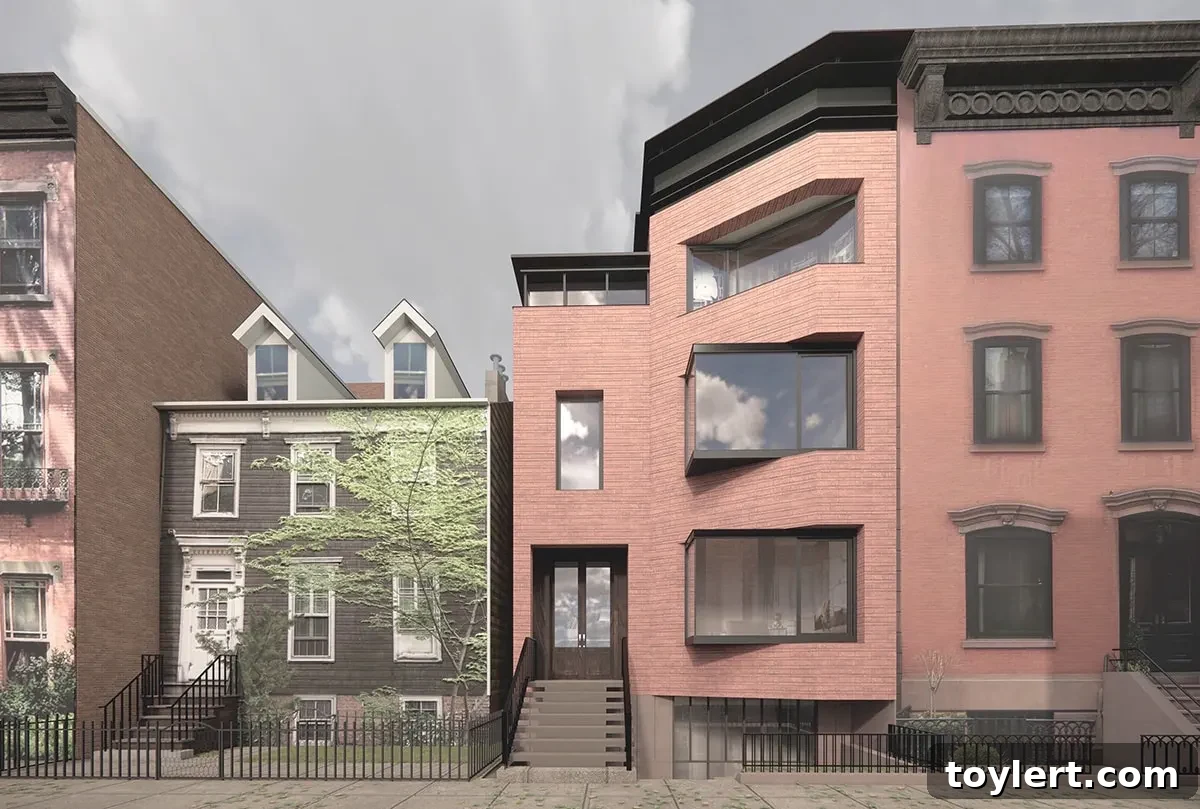
A significant milestone has been reached in Brooklyn Heights, as the city’s Landmarks Preservation Commission (LPC) has given its final approval for the construction of a unique and modern four-story brick house at 27 Cranberry Street. This decision marks the end of a protracted fifteen-year journey to develop a long-empty lot on one of the borough’s most historic and visually captivating streets, renowned for its pristine collection of some of Brooklyn’s oldest and most cherished houses. The newly approved design promises to seamlessly integrate contemporary aesthetics with the timeless charm of its historic surroundings, injecting new life into a prominent gap in the streetscape.
The Enduring Charm of Cranberry Street: A Brooklyn Heights Icon
Cranberry Street, nestled within the prestigious Brooklyn Heights Historic District, holds a special place in New York City’s architectural heritage. Lined with majestic brownstones and Federal-style homes, many dating back to the 19th century, it exemplifies an era of refined urban living. The district itself was the first in New York City to be designated a landmark in 1965, a testament to its unparalleled historical and architectural significance. Residents and visitors alike are drawn to its tranquil, tree-lined streets, stunning views of the Manhattan skyline, and a profound sense of stepping back in time. Developing any new structure within such a hallowed precinct is inherently challenging, demanding meticulous attention to context, scale, and materials to ensure harmony with the existing fabric.
The empty lot at 27 Cranberry Street has long been an anomaly on a street otherwise defined by continuous, elegant rows of residential architecture. Its redevelopment has been eagerly anticipated by the community, not just for the aesthetic completion it offers, but also for what it represents: a thoughtful bridge between historical preservation and modern architectural innovation. The approval signifies the LPC’s confidence that the proposed design not only respects the district’s character but also contributes positively to its ongoing evolution, setting a benchmark for new construction in sensitive historic areas.
A Journey Spanning Fifteen Years: The Saga of 27 Cranberry Street
The path to approval for 27 Cranberry Street has been anything but straightforward, marked by multiple proposals and extensive deliberation over more than a decade and a half. This extended timeline underscores the complexities inherent in new construction within landmarked districts, where every design element is scrutinized to uphold the integrity of the historic environment. Developers and architects must navigate a labyrinth of regulations, community input, and the exacting standards of the Landmarks Preservation Commission, ensuring that any new building stands as a respectful neighbor rather than an intrusive anomaly.
Early Aspirations: The 2011 Approval and Unfulfilled Promises
Indeed, this is not the first time a design for 27 Cranberry Street received the LPC’s blessing. Back in 2011, a previous set of plans for a new building on the site was approved. Foundations were even laid, hinting at imminent construction. However, for reasons often tied to economic shifts, changes in ownership, or unforeseen logistical hurdles, the structure never materialized beyond its base. This left the lot in a state of limbo, with visible, but incomplete, groundwork serving as a constant reminder of unfulfilled architectural aspirations. The failure of the 2011 project highlighted the precarious nature of development, particularly in a high-stakes, high-visibility location like Brooklyn Heights, where securing financing and maintaining project momentum can be as challenging as gaining regulatory approval itself.
The experience of the unbuilt 2011 project likely informed the cautious approach taken with subsequent proposals, adding another layer of scrutiny from both the LPC and local residents. The need for a project that was not only architecturally sound but also robust enough to see completion became paramount. This historical context provides essential background for understanding why the most recent approval is particularly significant, representing a fresh start and a renewed commitment to completing the street’s fabric with a structure that is both contemporary and contextually aware.
The Guardians of History: The Role of the Landmarks Preservation Commission (LPC)
The Landmarks Preservation Commission plays a pivotal role in shaping New York City’s urban landscape, entrusted with protecting the architectural, historical, and cultural heritage of designated landmark properties and historic districts. Its rigorous approval process is designed to ensure that new construction, alterations, or demolitions within these protected areas meet stringent standards. For projects like 27 Cranberry Street, this involves multiple presentations, public hearings, and detailed reviews of everything from a building’s massing and height to its material palette and window fenestration. The LPC’s mission is not to freeze neighborhoods in time but to manage change responsibly, fostering development that enhances rather than detracts from the city’s irreplaceable assets.
The commissioners, a diverse group of architects, historians, and urban planning experts, must constantly strike a delicate balance between preserving historical authenticity and accommodating modern needs and architectural expression. Their decisions are critical in guiding how historic districts evolve, ensuring that new additions contribute positively to the streetscape while respecting the visual integrity and character of the surrounding buildings. This meticulous oversight is precisely why obtaining LPC approval for any new build, especially one with a modern design in a deeply historic setting, is often a lengthy and demanding process, yet one that ultimately safeguards the unique charm of places like Brooklyn Heights.
Tom Kowalski’s Vision: Harmonizing Modernity with History at 27 Cranberry Street
The architect behind the newly approved design, Tom Kowalski, faced the formidable task of conceptualizing a structure that could stand out as “unique and modern” while respectfully blending into the venerable streetscape of Cranberry Street. His vision for the four-story brick house is a testament to careful consideration and a nuanced understanding of contextual architecture. It represents a forward-thinking approach, demonstrating that contemporary design can indeed coexist beautifully with historic preservation, creating a dialogue between different eras rather than a conflict. The emphasis on brick as the primary material is a strategic choice, connecting the new structure to Brooklyn’s rich tradition of masonry architecture while allowing for a distinctly modern interpretation.
Initial Presentation and Constructive Feedback from the LPC
Kowalski initially presented his plans to the LPC in July 2023. At that time, while the commissioners recognized the potential of the design, they requested specific refinements. Such feedback is a common and vital part of the LPC process, aimed at finessing proposals to achieve optimal integration. Likely areas of discussion would have included the subtle nuances of the building’s massing to ensure it didn’t overwhelm its neighbors, the precise rhythm and scale of its windows (fenestration) to align with the surrounding historic patterns, and the overall material palette. These detailed critiques are not rejections, but rather opportunities for the architect to further enhance the design, addressing contextual sensitivities and ensuring a harmonious fit within the designated landmark district.
The LPC’s constructive criticism would have focused on elements that affect the building’s visual impact from the street. This could involve adjustments to the facade treatment, the depth of window reveals, the integration of cornices or parapets, or even the texture and pattern of the brickwork itself. The goal is always to refine the design until it achieves a balance where it feels both contemporary and intrinsically connected to its historic setting, enriching the streetscape without resorting to mimicry or stark contrast. This iterative process, involving dialogue and revision, is fundamental to the successful development of new architecture in such sensitive environments.
The Approved Design: A Testament to Thoughtful Integration
This week’s unanimous approval by the commissioners underscores the success of Kowalski’s refined design in meeting these demanding criteria. The new four-story brick house is characterized by its “unique and modern” sensibility, which, in this context, likely translates to clean lines, thoughtful proportions, and an intelligent use of materials that respects traditional forms while embracing contemporary aesthetics. The chosen material, brick, is particularly significant. Brick is ubiquitous in Brooklyn Heights, making it an inherently contextual choice. However, the use of brick in a modern way—perhaps with innovative bonding patterns, recessed sections, or varying textures—allows the building to feel both familiar and distinctly new.
The conditions placed upon the approval, specifically regarding the “color and style of the bricks,” are a hallmark of the LPC’s detailed oversight. These conditions are not arbitrary; they are crucial for ensuring that the new building’s facade contributes appropriately to the street’s established visual harmony. The precise shade of brick, whether it’s a deep red, a muted buff, or a charcoal tone, and its style – referring to its finish, texture, and how it is laid – can dramatically alter a building’s appearance. By stipulating these details, the LPC ensures that even the most modern elements are meticulously integrated into the historic palette of Cranberry Street, preventing jarring contrasts and maintaining the street’s cherished aesthetic coherence.
Impact on Cranberry Street and Brooklyn Heights’ Future Landscape
The approval and eventual construction of 27 Cranberry Street signify much more than just the filling of an empty lot; they mark a significant moment for the entire Brooklyn Heights Historic District. The transformation of a vacant space into a thoughtfully designed residence enhances the street’s aesthetic continuity, bringing a sense of completion to an otherwise perfect row of historic homes. This project is a powerful affirmation that new, modern architecture can successfully contribute to, and even elevate, the character of a deeply historic urban fabric, without compromising its integrity.
The new building will undoubtedly spark conversations about architectural evolution in historic neighborhoods. It serves as a precedent, demonstrating that contemporary design, when executed with sensitivity and respect for context, can find its place even among the most revered historical structures. For New York City real estate, particularly in a coveted market like Brooklyn Heights, this development adds another exquisite, high-value property, potentially inspiring similar thoughtful interventions in other landmarked areas. It reinforces Brooklyn Heights’ reputation as a desirable residential enclave where history is preserved, yet progress is thoughtfully embraced, continuing to attract those who appreciate both timeless elegance and cutting-edge design.
Conclusion: A New Chapter for Cranberry Street
The journey of 27 Cranberry Street from a long-empty lot to an approved, modern architectural marvel is a testament to perseverance, thoughtful design, and the vital role of the Landmarks Preservation Commission in guiding New York City’s urban development. Architect Tom Kowalski’s vision, meticulously refined through careful dialogue with the LPC, has culminated in a design that promises to be both “unique and modern” while respecting the profound historical context of Cranberry Street. This project is a shining example of how contemporary architecture can gracefully integrate into a historic district, fostering a dynamic dialogue between past and present. As construction begins, the community of Brooklyn Heights can look forward to witnessing the completion of a streetscape that further solidifies its status as a timeless and evolving architectural gem, ushering in a new chapter of its illustrious history.