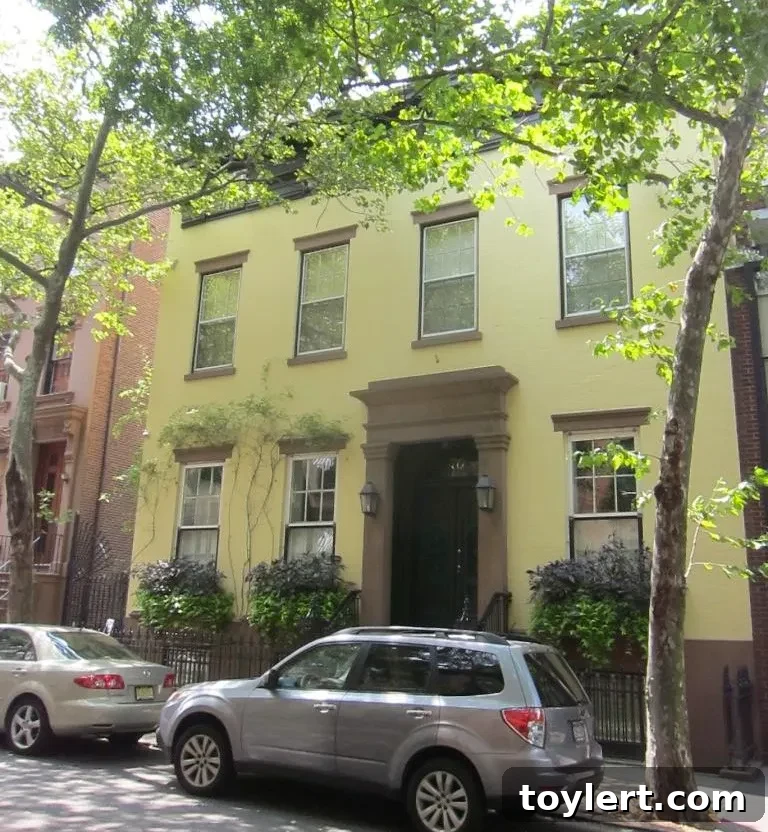
Preserving History: The Battle Over Truman Capote’s Iconic Brooklyn Heights Home at 70 Willow Street
In the heart of Brooklyn Heights, a neighborhood renowned for its picturesque brownstones and unparalleled historic charm, stands 70 Willow Street – a residence steeped in history and literary legend. This magnificent Greek Revival mansion, once home to the celebrated author Truman Capote, has recently become the focal point of a significant architectural debate. The Landmarks Preservation Commission (LPC), New York City’s guardian of historical and architectural integrity, has decisively rejected ambitious plans to extensively alter this historically significant property. This decision underscores the paramount importance of preserving the unique fabric of New York City’s designated landmark districts, especially when iconic residences are involved.
70 Willow Street: A Beacon of Brooklyn Heights’ Architectural and Literary Heritage
Constructed in 1839, 70 Willow Street is a quintessential example of Greek Revival architecture, a style that dominated American building during the early to mid-19th century. Its stately facade, grand proportions, and meticulous detailing contribute significantly to the aesthetic character of the Brooklyn Heights Historic District, the first such district designated in New York City in 1965. Beyond its architectural merits, the house gained legendary status through its most famous resident: Truman Capote. From 1955 to 1965, Capote leased the garden apartment of this grand home, a decade during which he penned some of his most enduring works, including portions of “Breakfast at Tiffany’s” and the groundbreaking “In Cold Blood.” The house itself inspired his evocative essay, “A House on the Heights,” offering readers an intimate glimpse into his life and the captivating allure of the neighborhood.
Capote’s tenancy at 70 Willow Street cemented its place in literary history. It was here that he hosted an array of cultural luminaries, entertaining guests on the very double-decker porch that now lies at the heart of the preservation controversy. The house, with its famous round interior staircase and skylight, along with its distinctive curved rear porch, represents a tangible link to a pivotal era in American literature and New York City’s cultural landscape. Protecting such properties is not merely about preserving bricks and mortar; it is about safeguarding the narratives, the inspirations, and the very essence of the creative spirits who once walked their halls.
The Proposed Alterations: A “Restoration” That Raised Eyebrows
In 2012, the Greek Revival mansion changed hands in a record-breaking transaction, selling for an astonishing $12.5 million. The new owners, Dan Houser, co-founder of the hugely successful Grand Theft Auto video game franchise, and his wife Krystyna, soon set about proposing an extensive overhaul of the property. What they billed as a “restoration” quickly drew the scrutiny of preservationists and the Landmarks Preservation Commission alike. The plans, as Curbed reported, involved a comprehensive remaking that threatened to replace much of the existing historical fabric of the 1839 house.
At the forefront of the proposed changes was the iconic double-decker porch at the rear of the house. This distinctive feature, where Capote famously wrote and entertained, was slated for replacement. The Housers’ architects put forth plans for a modern, rectangular deck that would starkly contrast with the existing curved design. The original porch, with its graceful lines, echoes the house’s unique round interior staircase and skylight, forming a cohesive architectural statement that defines the property’s character. The proposed alteration would have dismantled this harmony, replacing a historically significant, curvaceous structure with a contemporary, angular addition. This divergence from the original design immediately signaled a potential threat to the building’s authenticity and its irreplaceable charm.
The Landmarks Preservation Commission’s Role: Guardians of NYC’s Heritage
The Landmarks Preservation Commission plays a crucial role in maintaining the architectural and cultural heritage of New York City. Established in 1965 in response to the demolition of historic structures like the original Penn Station, the LPC is responsible for designating and regulating the city’s landmarks and historic districts. Any proposed exterior alteration, demolition, or new construction within a designated historic district or affecting an individual landmark must first receive approval from the Commission. Their mandate is to ensure that changes are appropriate and do not compromise the historic, aesthetic, and cultural values of the protected properties.
In the case of 70 Willow Street, the LPC meticulously reviewed the Housers’ extensive renovation plans. The Commission’s rejection was not an arbitrary decision but a testament to its commitment to upholding rigorous preservation standards. Their primary concern revolved around the proposed replacement of the existing fabric, particularly the distinctive rear porch. LPC commissioners and preservation advocates argued that the proposed modern rectangular deck would fundamentally alter the historic character of the building and its relationship to the surrounding Brooklyn Heights Historic District. The original porch is not just an old structure; it is an integral part of the house’s unique design and its literary legacy. To replace it with a contemporary structure would be to erase a significant piece of history.
The Heart of the Matter: The Iconic Porch and Its Enduring Significance
The double-decker porch at 70 Willow Street is more than just an architectural detail; it is a narrative centerpiece. Truman Capote himself celebrated it in “A House on the Heights,” describing its ambiance and the inspiration it provided. It served as his outdoor study, a place for contemplation, conversation, and creative endeavor. Architecturally, its curved form is a rare and exquisite feature, complementing the organic flow of the house’s interior spaces, particularly the elegant circular staircase and the light-filled skylight above. This curvilinear design speaks to a particular aesthetic sensibility of its era, adding to the house’s unique and irreplaceable character.
The stark contrast between the existing curved porch and the proposed modern, rectangular deck highlights the core tension between contemporary homeowner desires and the principles of historic preservation. While owners often seek to modernize their homes for comfort and functionality, preservation guidelines often prioritize maintaining original design intent and historical authenticity. The LPC’s decision firmly sided with the latter, recognizing that the integrity of landmarked properties lies in their ability to tell a continuous story through their preserved fabric. Removing a key, historically significant element like the porch would diminish the property’s cultural value and undermine the very purpose of its landmark designation.
The Broader Implications for Historic Preservation in Brooklyn Heights and Beyond
The rejection of the renovation plans for 70 Willow Street sends a clear message: the architectural and literary heritage of New York City’s landmarked properties is not to be casually overwritten. This decision is a victory for preservationists who tirelessly advocate for the protection of historic buildings from insensitive alterations. It underscores the ongoing dialogue between property owners, who naturally desire to customize their homes, and preservation commissions, whose mandate is to protect public interest in significant historic assets.
For Brooklyn Heights, a neighborhood fiercely proud of its status as New York’s first historic district, this outcome reaffirms the community’s commitment to maintaining its unique character. It highlights the delicate balance that must be struck between accommodating modern living and safeguarding the irreplaceable architectural legacy of past generations. Homeowners of landmarked properties often face unique challenges and responsibilities, as their properties are not just private residences but also public treasures. The financial investment in purchasing a historic home comes with an implicit understanding of these stewardship obligations.
The case of 70 Willow Street serves as a powerful reminder of why historic preservation matters. It’s about more than nostalgia; it’s about connecting with our past, enriching our present, and shaping a future where cultural and architectural diversity are celebrated and protected. The structures that define our cities tell stories, embody artistic periods, and serve as physical touchstones to the lives of influential figures. By preserving them, we ensure these stories continue to resonate for generations to come, allowing future residents and visitors to experience the tangible history that makes places like Brooklyn Heights so profoundly special.
The Path Forward: A Call for Sensitive Stewardship
Following the LPC’s rejection, the Housers were sent back to the drawing board. This does not necessarily mean an end to all renovation prospects, but it unequivocally demands a revised approach—one that respects the established guidelines for landmarked properties and embraces the spirit of preservation. The path forward for 70 Willow Street, and indeed for any historic home, involves collaboration, compromise, and a deep understanding of the property’s significance. Any future plans will need to demonstrate a commitment to maintaining architectural integrity, honoring Capote’s legacy, and preserving the distinctive charm that makes 70 Willow Street a jewel of Brooklyn Heights.
Ultimately, the saga of 70 Willow Street is a testament to the enduring power of history and the collective will to protect it. It is a reminder that some things are too precious to change, and that the echoes of the past, particularly those from literary giants like Truman Capote, deserve to be heard clearly and beautifully through the very walls that once inspired them.