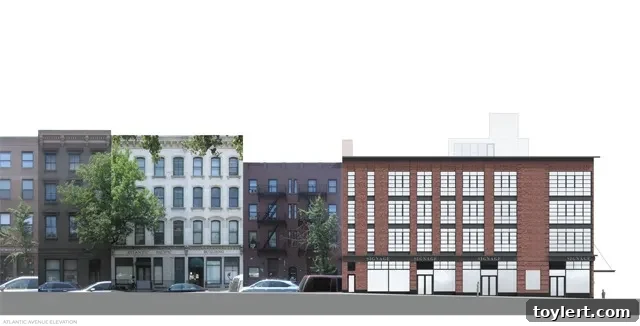
Redevelopment at 112 Atlantic Avenue: Navigating Design, Preservation, and Community in Cobble Hill
The urban landscape of New York City is a constant tapestry of change, where historical reverence often meets the demands of modern development. A prime example of this intricate dance is the proposed mixed-use building at 112 Atlantic Avenue in Brooklyn’s picturesque Cobble Hill neighborhood. This ambitious project, designed by the acclaimed BKSK Architects, aims to transform a former gas station site into a vibrant residential and commercial hub. However, its journey through the city’s rigorous approval process has brought to light the nuanced challenges of integrating contemporary architecture into a meticulously preserved historic district.
Initially, the Landmarks Preservation Commission (LPC), the city’s guardian of historic integrity, lauded BKSK Architects for their “contextual” design. This acknowledgment signified an understanding of the neighborhood’s character, a crucial first step in any development within such a sensitive area. Yet, this initial praise was quickly followed by requests for significant modifications, specifically targeting the scale of the windows and the roof’s bulkhead. The public hearing on the matter underscored a broader sentiment, with community groups and preservation advocates voicing strong concerns, highlighting the delicate balance developers and architects must strike in historic Brooklyn.
The Vision for 112 Atlantic Avenue: A BKSK Design Approach
BKSK Architects, known for their thoughtful and site-specific designs, envisioned a mixed-use structure that would breathe new life into the corner of Atlantic Avenue and Henry Street. The proposed building sought to replace a long-standing gas station, a relic of a bygone era, with a modern amenity that would serve the evolving needs of Cobble Hill residents. A mixed-use building typically combines commercial spaces on the ground floor—ideal for retail or small businesses—with residential units on the upper floors. This model is often praised for promoting walkable communities, reducing reliance on vehicles, and fostering local economic activity.
The concept presented by BKSK aimed for a design that, while contemporary, would resonate with the existing architectural fabric of Cobble Hill. This “contextual” approach usually involves a careful study of neighboring buildings’ materials, scale, rhythm, and historical detailing to ensure the new structure complements rather than clashes with its surroundings. Redeveloping a gas station site, moreover, presents a unique opportunity for urban renewal. These sites often sit underutilized, and their transformation can significantly enhance the streetscape, eliminate potential environmental hazards, and provide much-needed housing or commercial space in densely populated areas like Brooklyn.
Landmarks Preservation Commission: Balancing Modernity and Heritage
The Landmarks Preservation Commission (LPC) plays a pivotal role in shaping New York City’s built environment, particularly within its numerous historic districts. Established to protect the city’s architectural, historical, and cultural heritage, the LPC has jurisdiction over thousands of designated individual landmarks and properties within historic districts. For any new construction or significant alteration proposed in these areas, LPC approval is mandatory. Their review process is meticulous, involving public hearings, detailed architectural presentations, and a thorough assessment of how a proposed design adheres to the district’s character and guidelines.
In the case of 112 Atlantic Avenue, the LPC’s initial response encapsulated this dual responsibility: to encourage thoughtful, high-quality development while safeguarding the integrity of Cobble Hill. While acknowledging the architects’ effort to create a “contextual” design, the commission’s feedback focused on specific elements that they felt disrupted the neighborhood’s established aesthetic. This often involves a nuanced interpretation of what “contextual” truly means—is it mimicry, or a respectful modern interpretation? The discussion around the 112 Atlantic Avenue proposal highlights this ongoing debate.
Key Design Critiques: Windows and Bulkhead
The primary points of contention raised by the LPC and community members centered on two specific design elements: the windows and the roof bulkhead. Critics argued that the building’s “large, industrial-looking windows,” particularly those facing Henry Street, were out of character with Cobble Hill. This objection points to a fundamental difference in architectural styles. Cobble Hill is renowned for its charming 19th-century brownstones, brick row houses, and historic churches, characterized by smaller, more traditionally proportioned windows that contribute to a residential, human-scale feel. Large, expansive windows, while common in modern architecture for maximizing light and views, can sometimes project a commercial or industrial aesthetic that deviates from the area’s intimate streetscapes.
Similarly, the proposed bulkhead on the roof was flagged for being too prominent. A bulkhead typically houses mechanical equipment or provides access to the roof. In historic districts, the visibility and scale of such rooftop additions are critically scrutinized to ensure they do not detract from the building’s overall silhouette or the district’s skyline when viewed from the street. An oversized or poorly integrated bulkhead can appear as an unsightly intrusion, disrupting the visual harmony of the urban fabric. These details, though seemingly minor, are crucial in preservation contexts, as they collectively define the unique charm and character of neighborhoods like Cobble Hill.
Community Voices: Concerns from Cobble Heights and Beyond
The public hearing on the 112 Atlantic Avenue project revealed strong community opposition, with only a single attendee speaking in full favor of the design as presented. Organizations such as the Cobble Heights Association and numerous individual residents voiced their concerns, underscoring the powerful role community input plays in shaping urban development in New York City. Their objections often stemmed from a desire to protect the unique character and scale of their beloved neighborhood.
A particularly poignant critique came from Barbara Zay of the Historic Districts Council, who was quoted by New York YIMBY as saying that the building’s “large, industrial-looking windows…might be more appropriate in Red Hook.” This statement encapsulates the core of the preservation argument. Red Hook, another historic Brooklyn neighborhood, has a distinct industrial past, characterized by warehouses, factories, and waterfront commerce. Its architecture often features larger, more utilitarian windows and robust, exposed materials, reflecting its working-class heritage. Cobble Hill, by contrast, evolved as a residential enclave with a refined, domestic aesthetic. The architectural language suitable for one neighborhood is often seen as jarring when transplanted to another, highlighting the importance of site-specific design that respects local historical context.
The Essence of Cobble Hill’s Architectural Identity
Cobble Hill’s enduring appeal lies in its remarkably preserved 19th-century streetscapes. Tree-lined blocks are graced with elegant brownstones, stately brick townhouses, and charming smaller dwellings, many dating back to the pre-Civil War era. The architectural details—ornate cornices, detailed stoops, and, crucially, a consistent rhythm of window proportions—contribute to a cohesive and inviting streetscape. Any new construction within this district is expected to engage in a respectful dialogue with these existing elements, maintaining the human scale and residential feel that residents cherish. The introduction of design elements perceived as “industrial” can be seen as undermining this delicate balance, threatening to erode the very qualities that make Cobble Hill a desirable and historically significant place to live.
The Path Forward: Revisions and Approvals
Following the feedback from the Landmarks Preservation Commission and the robust community input, BKSK Architects were tasked with revising their design. This phase is common in the development process for historic districts, representing an opportunity for architects to refine their vision, addressing specific concerns while still striving to meet the project’s programmatic goals. Potential modifications could include reducing the individual size of the windows or altering their arrangement to create a more traditional rhythm. The roof bulkhead might be redesigned to be more recessed, clad in materials that blend seamlessly with the roofline, or reconfigured to minimize its visual impact from street level.
The revision process is a testament to the collaborative, albeit sometimes contentious, nature of urban planning in a city as dense and historically rich as New York. It requires architects to navigate a complex web of client expectations, modern design principles, and stringent preservation guidelines. The goal is to arrive at a design that satisfies the LPC’s criteria, appeases community concerns, and still delivers a functional and aesthetically pleasing building. This iterative process highlights the commitment to thoughtful development within historic contexts, ensuring that progress doesn’t come at the expense of heritage.
The Broader Context: Urban Redevelopment in Brooklyn
The debate surrounding 112 Atlantic Avenue is not an isolated incident but rather a microcosm of broader trends in urban redevelopment across Brooklyn and New York City. Atlantic Avenue itself is a major thoroughfare, serving as a vital commercial artery and a gateway to several distinct neighborhoods, including Cobble Hill, Brooklyn Heights, and Boerum Hill. Its evolving character reflects the ongoing pressures of growth and gentrification that have transformed much of Brooklyn in recent decades.
The conversion of former gas stations into residential or mixed-use developments is a particularly significant trend. As land becomes scarcer and more valuable in prime urban areas, these legacy sites offer coveted opportunities for infill development. However, their redevelopment often sparks discussions about density, traffic, environmental remediation, and crucially, how new structures will integrate into established neighborhoods. The 112 Atlantic Avenue project thus serves as an important case study, demonstrating the ongoing tension between the imperative for new housing and commercial spaces, and the deeply held desire to preserve the historical integrity and unique character of beloved urban communities. The ultimate approved design will undoubtedly shape not only the immediate street corner but also influence future discussions on contextual development in Brooklyn’s treasured historic districts.
The dialogue between architects, preservationists, and community members at 112 Atlantic Avenue embodies the dynamic evolution of urban spaces. It’s a testament to the city’s commitment to thoughtful growth—growth that respects its past while embracing its future. The eventual outcome will stand as a landmark not just for its architecture, but for the complex process it navigated to find its place within the enduring legacy of Cobble Hill.