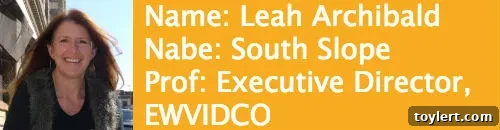
Welcome to The Hot Seat, an exclusive series where we delve into the lives and work of key figures shaping Brooklyn’s dynamic real estate, architecture, and development landscape. In this edition, we sit down with Leah Archibald, the Executive Director of the East Williamsburg Valley Industrial Development Corporation (EWVIDCO). Her organization plays a pivotal role in championing and safeguarding North Brooklyn’s vital industrial sector, fostering production, manufacturing, and essential industrial services amidst rapid urban transformation. This insightful portrait was expertly captured by Marc Koch. Join us as Leah shares her personal journey and professional insights into Brooklyn’s evolving economic tapestry.
Brownstoner: Leah, it’s great to have you. Can you tell us what neighborhood you currently call home, and how your path led you there?
Leah Archibald: Thank you for having me. I live in South Slope, and I’ve been there since my family and I made the big move to New York City from Los Angeles back in 1998. The decision to settle in South Slope was largely influenced by geography; my two closest friends from my hometown, Buffalo, had already put down roots in Windsor Terrace and Carroll Gardens, respectively. South Slope seemed to be the perfect equidistant point between them, making it easy to stay connected. Beyond logistics, affordability was a significant factor. At that time, I was working for a local elected official, earning a rather meager wage, while simultaneously pursuing graduate school full-time. My husband had just completed his PhD in History and hadn’t yet secured a job, so our financial situation was quite tight. Out of sheer necessity and a dash of desperation, our very first apartment in Brooklyn was, to put it mildly, a complete piece of garbage. It was on 15th Street between 4th and 5th Avenues—far too small for my husband, our daughter, and me. To compound the misery, our next-door neighbor was a rather creepy anti-Semite who kept a multitude of dogs, which didn’t exactly foster a welcoming atmosphere. The block itself, in those days, was truly awful. It wasn’t uncommon to find nasty medical waste and other debris illegally dumped right in front of where the Harbor Fitness stands today. It’s almost unbelievable how much that particular stretch of 15th Street has transformed. What were once a rum distillery and an old church have now been replaced by massive, gleaming condo complexes, a stark testament to Brooklyn’s relentless gentrification and development.
Brownstoner: That’s quite a story, highlighting the dramatic changes many Brooklyn residents have witnessed. Transitioning to your professional life, can you elaborate on the core goals of the East Williamsburg Valley Industrial Development Corporation (EWVIDCO) and describe your role as its Executive Director?
Leah Archibald: EWVIDCO’s mission is fundamentally about preserving and promoting the industrial heart of North Brooklyn, a critical yet often overlooked aspect of urban economic development. In an era where residential and retail development often dominates conversations about urban growth, EWVIDCO stands as a vital advocate for the development and retention of production, manufacturing, and industrial service businesses. Our goal is to ensure that North Brooklyn remains a place where goods are made, services are provided, and diverse employment opportunities thrive, contributing to a robust and multifaceted economy.
My role as Executive Director involves steering EWVIDCO’s strategic direction and overseeing its daily operations. This means a multitude of responsibilities, from direct advocacy for industrial businesses to engaging with city planners, policymakers, and community stakeholders. We work tirelessly to implement initiatives that support existing manufacturers, attract new industrial tenants, and protect industrial zoned land from conversion to other uses. This isn’t just about economic numbers; it’s about maintaining the very fabric of our community. Industrial jobs often provide stable, good-paying employment for residents across various skill levels, contributing to local prosperity and reducing economic inequality. Furthermore, having local production and manufacturing enhances regional supply chain resilience, reducing reliance on distant suppliers and fostering a more sustainable local economy.
One of our primary strategies involves business retention. We provide technical assistance, help businesses navigate regulatory challenges, and connect them with resources that facilitate growth and modernization. This might mean assisting with permit applications, helping secure financing for equipment upgrades, or even mediating disputes with landlords. We understand that industrial businesses face unique pressures, including rising property taxes and the allure of selling valuable land to residential developers. Our team works to mitigate these pressures, offering support that allows these businesses to not just survive, but to flourish in North Brooklyn.
Beyond retention, EWVIDCO is also deeply involved in promoting new industrial development. This involves identifying suitable sites for expansion, working to improve infrastructure in industrial zones—think better transportation links, utility upgrades, or modern industrial spaces—and marketing North Brooklyn as an attractive location for innovative manufacturing and production companies. We envision industrial areas not as relics of the past, but as dynamic hubs of innovation and sustainable economic activity. This includes fostering advanced manufacturing, green industries, and technology-driven production that can adapt to the demands of the 21st century economy.
My leadership also involves significant public outreach and education. Many people associate Brooklyn’s growth primarily with residential towers and trendy boutiques. It’s crucial for us to articulate the immense value of our industrial sectors—how they contribute to a diverse job market, support local businesses, and even contribute to the unique character of neighborhoods like East Williamsburg. We engage with community boards, local elected officials, and resident groups to highlight the symbiotic relationship between a thriving industrial sector and a healthy, sustainable urban environment. Advocating for appropriate zoning and land use policies is a constant battle, requiring persuasive arguments and a clear vision for how different land uses can coexist and benefit the broader community.
The challenges are considerable. The demand for housing in Brooklyn continues to exert immense pressure on all available land, often at the expense of industrial zones. EWVIDCO works to counteract this trend by demonstrating the irreplaceable economic and social benefits that industrial spaces provide. We emphasize that a balanced urban ecosystem requires not just homes and shops, but also places where people work, innovate, and create tangible goods. It’s about ensuring that Brooklyn doesn’t become a mere bedroom community but retains its identity as a place of vibrant economic activity and diverse opportunity.
Ultimately, EWVIDCO strives to ensure that North Brooklyn’s industrial valleys remain dynamic, productive spaces. This means advocating for policies that support industrial growth, providing direct services to businesses, and working collaboratively with all stakeholders to create an environment where manufacturing and production can thrive for generations to come. My role is to lead these efforts, championing a vision of a balanced and resilient Brooklyn economy that values its industrial heritage and its future potential.