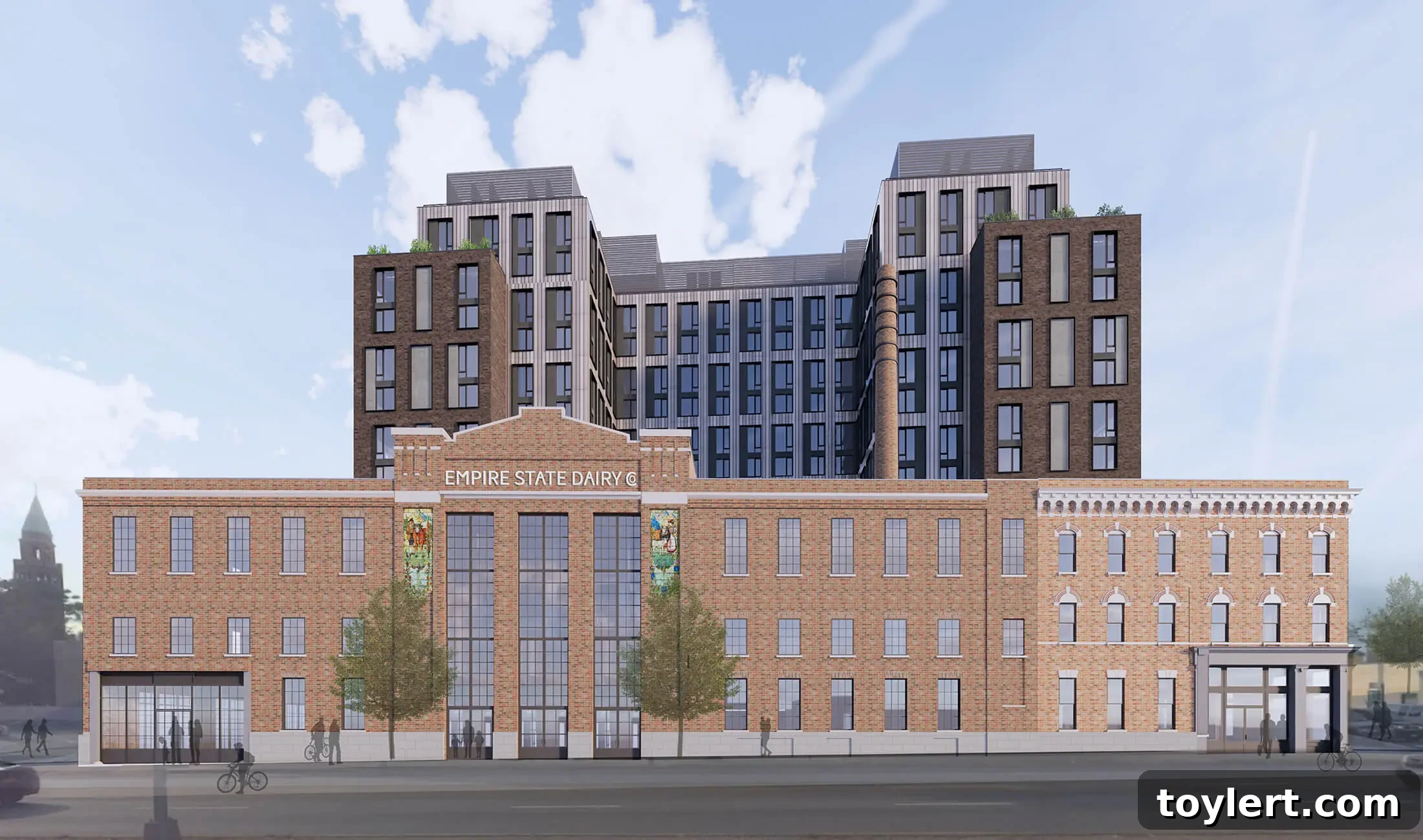
The iconic Empire State Dairy building in East New York, a beacon of Brooklyn’s architectural heritage, recently became the focal point of a significant debate regarding urban development, historic preservation, and the pressing need for affordable housing. Plans to meticulously restore the landmarked structure and concurrently construct a new, towering building adjacent to it, which promised to deliver more than 330 much-needed affordable apartments, faced a formidable hurdle: the Landmarks Preservation Commission (LPC). On a recent Tuesday morning, these ambitious proposals ultimately failed to secure the necessary approval from the commission, casting uncertainty on the future trajectory of this vital East New York site.
The commissioners’ deliberations were immediately complicated by a fundamental question of jurisdiction. When a proposed new construction is designed to abut, or even cantilever over, an existing historic structure, the boundaries of what falls under the LPC’s purview become inherently blurred. It proved exceedingly difficult, as anticipated, to discuss the merits and demerits of one component – the restoration or the new build – without intricately involving the other. This inherent interdependence underscored the complexity of the project and the nuanced responsibilities of the commission.
At the heart of the proposal was the vision for a striking 14-story building. This modern edifice was designed not merely to rise beside the historic dairy building, located at 2840 Atlantic Avenue, but to dramatically cantilever over a portion of it. The Empire State Dairy itself holds a special place in the community, having been officially landmarked in December 2017 following years of dedicated advocacy work by local preservationists and community groups. The new construction was slated to replace two existing, non-landmarked buildings and a sizable parking lot on the expansive property, as detailed in the architectural drawings presented to the commission. The ambitious scope of the project, blending a meticulous restoration with a significant new build, aimed to transform the site into a vibrant, mixed-use hub, addressing both historical conservation and contemporary housing needs.
The Enduring Legacy of the Empire State Dairy: A Glimpse into Brooklyn’s Past
To fully grasp the significance of the recent LPC decision, one must first appreciate the rich history and architectural grandeur of the Empire State Dairy. Built between 1914 and 1915, this monumental structure stands as a formidable testament to Brooklyn’s industrial past, a period when the borough was a burgeoning center for manufacturing and commerce. Designed by architects Otto Strack and Edward F. Fanning, the building showcases a distinctive blend of Neo-Classical and Renaissance Revival architectural styles. Its most iconic features include the robust red brick facade, intricate terracotta detailing, and the prominent “Empire State Dairy” signage emblazoned across its top, which has long served as a recognizable landmark for residents and commuters along Atlantic Avenue.
Originally, the Empire State Dairy was a state-of-the-art facility for processing and distributing milk across New York City. Its sheer scale and advanced design reflected the pivotal role of the dairy industry in feeding a rapidly growing urban population during the early 20th century. Beyond its utilitarian function, the building’s aesthetic appeal and robust construction spoke to the confidence and ambition of the era. Over the decades, as the industry evolved, the dairy ceased operations, leaving the impressive structure vacant for many years. Despite its disuse, its architectural integrity and historical presence continued to captivate, making it a natural candidate for preservation efforts.
The Journey to Landmark Status: A Triumph for Preservationists
The formal recognition of the Empire State Dairy as a New York City landmark in December 2017 was not merely an administrative decree; it was the culmination of relentless advocacy and dedicated groundwork laid by passionate local preservationists and community organizations. For years, these groups championed the building’s unique heritage, its architectural distinction, and its irreplaceable role in defining the character of East New York. They meticulously documented its history, highlighted its unique design elements, and articulated its cultural significance to the wider community.
The landmark designation offered a critical layer of protection, ensuring that any future development or alteration to the building would be subject to the stringent oversight of the Landmarks Preservation Commission. This status underscored the public’s vested interest in safeguarding structures that embody the city’s historical, cultural, and architectural identity. For many, the Empire State Dairy represented more than just an old building; it symbolized a tangible link to East New York’s industrial roots and a visible reminder of the neighborhood’s enduring spirit. The landmarking was celebrated as a victory, signifying a collective commitment to preserving the fabric of the city for future generations.
Unveiling the Redevelopment Proposal: A Vision for the Future
The proposed redevelopment plans for the Empire State Dairy site represented an ambitious endeavor to revitalize a long-dormant landmark while simultaneously addressing a critical urban need: affordable housing. The core of the proposal involved a dual approach: a comprehensive and sensitive restoration of the historic dairy building and the construction of a substantial new 14-story residential tower. This new building was designed to be strategically positioned on the property, replacing existing non-landmarked structures and a parking lot, thereby maximizing the use of the available space.
Perhaps the most striking architectural feature of the new construction was its planned cantilever, which would extend over a portion of the existing landmarked building. This design element, while often utilized in contemporary architecture to create distinct visual effects and optimize floor space, immediately flagged the project for intense scrutiny from preservation bodies. The inclusion of over 330 affordable housing units was a significant component of the proposal, aiming to provide much-needed residential options in a neighborhood experiencing ongoing gentrification and rising housing costs. The developers envisioned a dynamic project that would not only breathe new life into a historic gem but also contribute meaningfully to the community’s housing inventory, creating a vibrant, mixed-income living environment.
The Role and Rigor of the Landmarks Preservation Commission
The Landmarks Preservation Commission (LPC) holds a pivotal role in New York City’s urban planning and cultural heritage. Established in 1965, its primary mandate is to protect the city’s architecturally, historically, and culturally significant buildings and sites. This includes reviewing any proposed alterations, demolitions, or new constructions that could impact landmarked properties or properties located within historic districts. The commission comprises experts in architecture, history, urban planning, and real estate, tasked with balancing preservation goals with the evolving needs of a dynamic city.
When considering projects like the Empire State Dairy redevelopment, the LPC employs a rigorous review process. Commissioners meticulously assess various factors, including the proposed design’s compatibility with the historic structure’s architectural style, materials, scale, and overall character. They evaluate the visual impact of new construction on the landmark, scrutinize how well a new addition integrates with the existing historic fabric, and consider potential implications for the landmark’s integrity and context. The challenge becomes particularly acute when a new building directly abuts or, as in this case, cantilevers over a protected site. Such scenarios demand an even greater level of sensitivity and design excellence to ensure the historic building’s prominence and character are not diminished or overwhelmed.
The LPC’s Deliberation and Concerns: Why the Proposal “Did Not Pass Muster”
The statement that the proposal “did not pass muster” with the Landmarks Preservation Commission signals that, despite its laudable goals, critical aspects of the design failed to meet the LPC’s stringent standards for preserving historic sites. While specific detailed reasons for the rejection are not explicitly stated in the initial report, typical concerns for a project of this nature involving a significant landmark would likely revolve around several key areas:
- Scale and Massing: A 14-story new building adjacent to, and particularly cantilevering over, a multi-story but historically scaled industrial building can present significant challenges. Commissioners often assess whether the new construction’s height, width, and overall bulk are appropriate and do not visually overwhelm or diminish the landmark’s presence.
- Visual Impact and Material Compatibility: The design, materials, and fenestration of the new building must be carefully considered to ensure they are compatible with the historic structure without mimicking it. An overly imposing or stylistically discordant new building can detract from the landmark’s aesthetic integrity.
- The Cantilever Feature: The cantilever itself would have been a major point of contention. While innovative, extending a modern structure over a historic one raises questions about structural integrity, visual intrusion, and whether it respects the physical and visual autonomy of the landmarked building below. The LPC prioritizes maintaining the historic building’s distinct identity and its relationship with its immediate surroundings.
- Context and Setting: Landmarks are not isolated objects; they exist within a historical and urban context. The LPC evaluates whether the new development would disrupt this context, alter historic sightlines, or negatively impact the landmark’s setting and visual prominence within the streetscape.
- Precedent: Decisions made by the LPC often set precedents. Approving a design that significantly alters the context or impacts a landmark with a large, cantilevering new structure could open the door for similar, potentially detrimental, proposals elsewhere in the city.
In essence, the commission likely found that, while the restoration component was undoubtedly positive, the design of the new building, particularly its scale and the controversial cantilever, created an unacceptable visual and physical imposition on the historic Empire State Dairy, thus compromising its integrity and the principles of historic preservation.
Community Voices and Preservation Principles: The Ongoing Debate
The debate surrounding the Empire State Dairy redevelopment is a microcosm of a larger, ongoing dialogue in rapidly developing urban centers like New York City: how to balance the urgent need for new housing, especially affordable housing, with the equally vital imperative to protect irreplaceable historic assets. Community groups, local residents, and preservation advocates consistently play a crucial role in these discussions. Their long-standing efforts ensured the Empire State Dairy’s landmark status, and their continued vigilance shapes the narrative around its future.
Preservation principles emphasize respecting the past, maintaining architectural authenticity, and ensuring that development enhances, rather than detracts from, the character of a neighborhood. However, developers often face immense pressure to maximize density and deliver on housing goals, especially when public subsidies or affordable housing mandates are involved. The LPC’s decision highlights the power of these preservation principles and the commission’s commitment to upholding them, even when faced with proposals that offer significant community benefits like affordable housing.
The Intersection of Affordable Housing and Historic Preservation
The Empire State Dairy project strikingly illustrates the complex intersection of affordable housing and historic preservation. In East New York, like many parts of Brooklyn, the demand for affordable housing is immense and critical. Projects that promise hundreds of affordable units are eagerly anticipated and often represent a significant win for residents struggling with housing insecurity. However, when these housing initiatives converge with landmarked sites, the planning process becomes inherently intricate.
The challenge lies in finding innovative design solutions that honor the historic context without sacrificing the potential for new housing, or conversely, providing housing without overwhelming the historic resource. This often requires creative architectural approaches, sensitive massing, appropriate material selection, and sometimes, a willingness to scale back development aspirations to better integrate with the existing heritage. The Empire State Dairy outcome serves as a reminder that while affordable housing is a paramount concern, its delivery cannot come at the expense of irrevocably altering or diminishing the city’s protected architectural heritage. It underscores the need for ongoing dialogue and collaboration between developers, preservationists, community groups, and regulatory bodies to craft solutions that serve both imperatives.
Looking Ahead: What’s Next for the Empire State Dairy?
With the Landmarks Preservation Commission’s decision to reject the current proposal, the future of the Empire State Dairy site remains a subject of considerable speculation and ongoing interest. This rejection does not necessarily signify the end of redevelopment plans but rather mandates a revision and resubmission of the project. The developers will likely need to revisit their architectural designs, particularly focusing on the aspects that drew the most scrutiny from the LPC – namely, the scale and massing of the new building and the controversial cantilever.
Potential next steps could involve significant modifications to the new building’s height or footprint, a re-evaluation of its relationship to the historic dairy, and perhaps a complete reimagining of the cantilever element. Future iterations of the proposal might explore alternative design strategies that are more deferential to the landmark, ensuring its visual prominence and integrity are maintained. The developers may also engage in further consultations with preservation experts and community stakeholders to refine their plans. This process, while potentially extending the timeline for the project, offers an opportunity to craft a solution that better harmonizes the dual goals of historic preservation and affordable housing delivery in East New York. The ultimate outcome will serve as an important precedent for how New York City navigates the delicate balance between urban growth and safeguarding its irreplaceable architectural treasures.