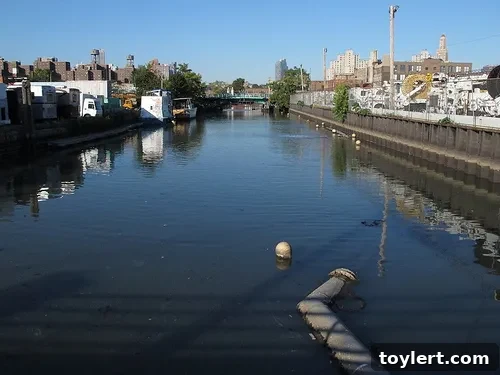
Gowanus Canal Transformation: A New Era for Brooklyn’s Waterway Cleanup
A historic federal mandate is poised to revolutionize the notorious Gowanus Canal, bringing an end to decades of environmental degradation and paving the way for a cleaner, healthier urban ecosystem. Local activists and residents are celebrating a monumental victory as the comprehensive cleanup plan not only targets the legacy of industrial chemical pollutants but also crucially addresses the persistent problem of biohazardous overflow from the city’s sewer system during severe storms. This ambitious undertaking marks a pivotal moment for one of Brooklyn’s most infamous waterways, promising a future where the “Lavender Lake” sheds its toxic past.
From Industrial Hub to Environmental Burden: The Canal’s Troubled History
The Gowanus Canal, a 1.8-mile-long navigable waterway in northwestern Brooklyn, has a rich yet troubled history. Originally a tidal creek flowing into Gowanus Bay, it was dredged and straightened in the mid-19th century to serve as a vital artery for industrial development. Its banks quickly became lined with bustling factories, gas plants, tanneries, chemical works, and numerous other industries that fueled Brooklyn’s growth. For over a century, the canal bore the brunt of this industrial activity, becoming a dumping ground for untreated waste, a practice that led to its infamous moniker, “Lavender Lake,” a sardonic nod to the oily sheen and foul odors that often permeated its surface.
Over time, this relentless pollution transformed the canal into one of America’s most contaminated waterways. Sediments at the bottom of the canal are a toxic soup of heavy metals, PCBs, pesticides, volatile organic compounds, and, most notably, large deposits of coal tar—a carcinogenic byproduct from the manufactured gas plants that once thrived along its shores. Beyond the chemical legacy, the canal has also been plagued by continuous discharges of raw sewage, especially during rain events, when the city’s antiquated combined sewer system becomes overwhelmed.
A Decisive Federal Intervention: The Superfund Designation
The severity of the contamination prompted the U.S. Environmental Protection Agency (EPA) to declare the Gowanus Canal a federal Superfund site in 2010. This designation marked a critical turning point, mandating a comprehensive and federally supervised cleanup process. The Superfund program, established under the Comprehensive Environmental Response, Compensation, and Liability Act (CERCLA), is designed to clean up hazardous waste sites throughout the country, ensuring that responsible parties bear the costs of remediation.
The EPA’s meticulous planning phase culminated in a detailed cleanup proposal, which gained widespread community support for its ambitious scope. This plan outlines a multi-pronged approach, including dredging highly contaminated sediments, capping the canal bottom, and controlling sources of ongoing pollution. Crucially, the federal mandate for this cleanup explicitly includes the mitigation of biohazardous overflows, a significant win for environmental advocates who have long championed a holistic solution for the canal’s woes.
Tackling the Biohazardous Threat: State-of-the-Art Sewer Overflow Tanks
One of the most celebrated aspects of the federally mandated cleanup is the inclusion of measures to drastically reduce the flow of raw sewage into the canal during storms. The Brooklyn Paper recently reported on the innovative engineering solutions designed to achieve this. The core of this strategy involves the construction of two massive underground catch basins, strategically located at critical points along the waterway.
- Location 1: Near Butler Street, positioned at the head of the canal.
- Location 2: In the middle of the canal, close to Third Street.
Each of these colossal basins is projected to cost $78 million, bringing the total investment for this aspect of the cleanup to $156 million. These state-of-the-art facilities are engineered to hold an impressive eight million gallons of raw sewage and stormwater runoff during periods of heavy precipitation. When the city’s combined sewer system (CSS) is overwhelmed, instead of overflowing directly into the canal, the excess glop will be diverted into these underground tanks. Once the storm subsides and the wastewater treatment plants have regained capacity, the stored sewage will then be pumped to modern wastewater treatment facilities in Red Hook and Bay Ridge for proper processing.
This ingenious system is estimated by federal authorities to reduce the discharge of raw sewage into the Gowanus Canal by a significant margin, ranging from approximately 58 to 74 percent. This reduction is paramount not only for improving the canal’s water quality but also for mitigating the severe public health risks associated with exposure to untreated wastewater. It represents a fundamental shift in how the city manages its aging infrastructure in relation to environmental protection.
Holding Polluters Accountable: The “Polluter Pays” Principle
While the city grapples with its sewer infrastructure, another critical component of the Superfund cleanup is holding industrial polluters accountable for their historical impact. The EPA’s plan identifies dozens of entities responsible for the chemical contamination. Among these, National Grid has inherited a significant share of responsibility for the coal tar—a legacy of the manufactured gas plants it once operated or acquired. National Grid, along with approximately three dozen other industrial polluters, will be compelled to contribute financially to the massive cleanup effort, upholding the “polluter pays” principle central to the Superfund program.
The process of addressing these legacy pollutants involves extensive dredging of the canal’s highly contaminated sediments. Specialized equipment will carefully remove millions of cubic yards of toxic sludge from the canal bottom. This material will then be transported off-site to approved facilities for safe disposal. Following dredging, a multi-layer cap will be installed at the bottom of the canal. This cap, composed of clean materials like sand, gravel, and an active layer to treat residual contaminants, will prevent any remaining subsurface pollutants from migrating into the water column, effectively sealing them in place.
A Community’s Enduring Fight and Triumphant Outcome
For decades, the residents and environmental activists of the Gowanus community have been at the forefront of the fight for a cleaner canal. Groups like Friends and Residents of the Greater Gowanus have tirelessly advocated for comprehensive solutions, pushing authorities at all levels to acknowledge and address the severe environmental degradation. Their efforts have been instrumental in shining a spotlight on the canal’s plight and mobilizing public support for its restoration.
Linda Mariano, co-founder of Friends and Residents of the Greater Gowanus, articulated the community’s profound relief and satisfaction: “We have been trying to get the city to do something about the [sewer] pollution forever. It’s a very good thing that they are going to make the effort. That’s what we have been advocating for, for all of these years — I’m happy.” Her words encapsulate the culmination of years of tireless work, petitions, meetings, and protests that have finally yielded tangible results. This cleanup is not just an environmental project; it is a testament to the power of persistent community advocacy.
The Road Ahead: Challenges and a Vision for the Future
While the approval of this comprehensive cleanup plan represents a monumental stride forward, the journey to a fully revitalized Gowanus Canal is still long and complex. The project is expected to span several years, requiring meticulous execution, continuous monitoring, and substantial financial commitment. Challenges may arise in coordinating the numerous stakeholders, managing the intricate engineering tasks, and ensuring the long-term sustainability of the cleanup efforts.
However, the vision for the Gowanus Canal extends beyond merely removing pollutants. The ultimate goal is to transform it into a vibrant urban waterway that supports aquatic life, offers recreational opportunities, and enhances the quality of life for surrounding communities. This includes potential for green infrastructure projects along its banks, improved public access, and ecological restoration efforts that will allow the canal to once again thrive as a natural asset. The Gowanus Canal cleanup serves as a powerful example of how sustained environmental activism, coupled with robust federal intervention, can bring about profound positive change in even the most challenging urban environments. It offers hope and a blueprint for other polluted waterways seeking a path to restoration and renewal.