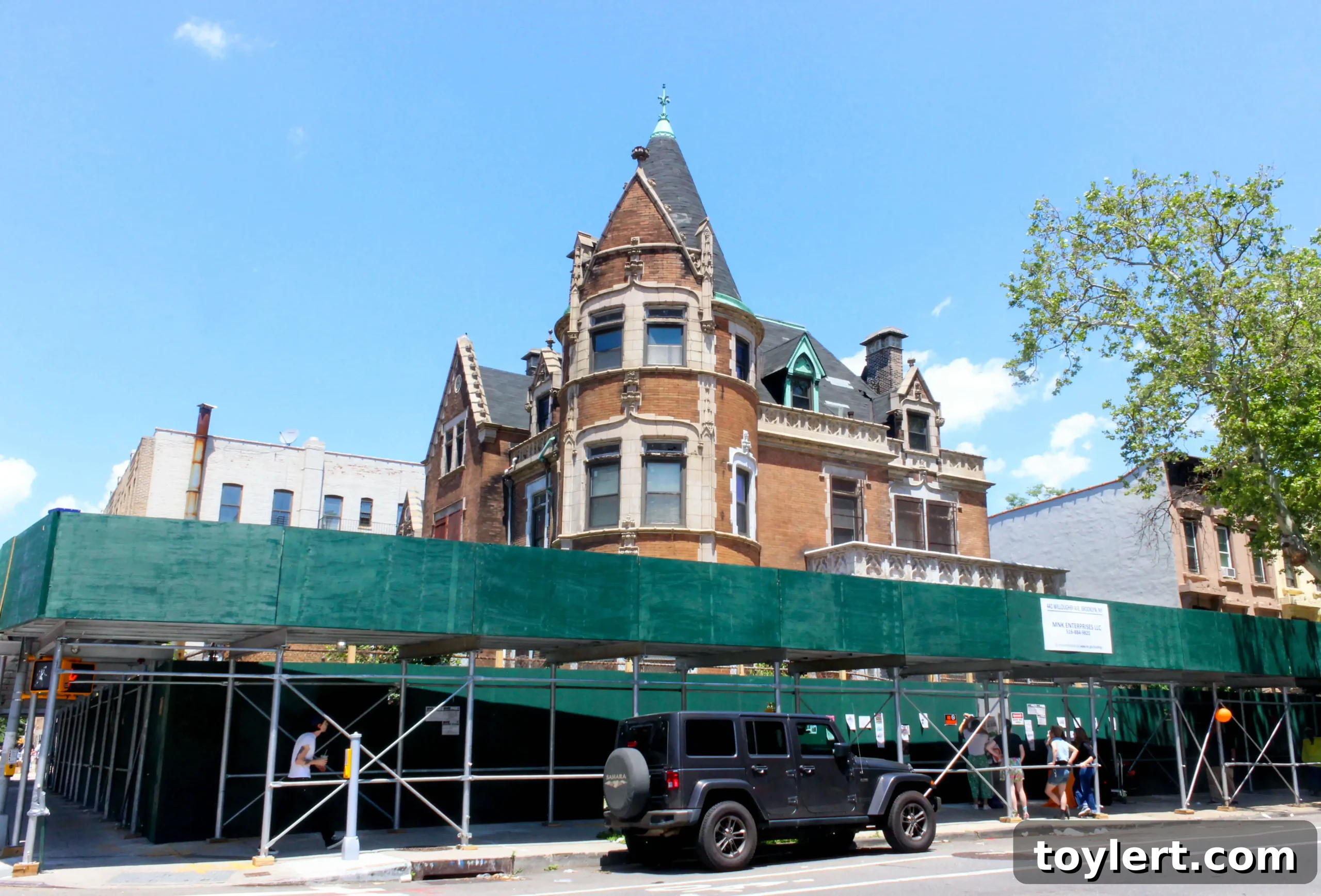
The Eleventh-Hour Effort to Landmark Bed-Stuy’s Historic Jacob Dangler Mansion
In a compelling race against time, the magnificent 122-year-old Jacob Dangler Mansion, located at 441 Willoughby Avenue in the heart of Bed-Stuy, Brooklyn, faces an imminent threat of demolition. As the community rallies to preserve this irreplaceable piece of history, a powerful new ally has emerged: Council Member Chi Ossé. His recent and decisive communication to the Landmarks Preservation Commission (LPC) unequivocally champions the landmarking of the historic building, breathing new hope into the urgent campaign to save this architectural treasure from destruction.
Council Member Ossé’s public declaration comes at a pivotal moment, amplifying the passionate pleas of local residents and dedicated community advocates who have tirelessly championed the mansion’s protection. His message underscores a widespread belief that preserving this unique structure is not merely about retaining an old building, but about safeguarding the rich cultural and historical essence of Bed-Stuy. This high-stakes effort vividly illustrates the enduring tension between the pressures of rapid urban development and the crucial imperative to protect significant heritage sites that contribute to the distinct identity of New York City’s diverse neighborhoods.
Council Member Chi Ossé’s Pivotal Intervention
The gravity of the situation was made clear in Council Member Chi Ossé’s direct and forceful appeal to the Landmarks Preservation Commission. “I wanted to reach out to you to let you know that I am in full support of landmarking 441 Willoughby. After discussing with community advocates and residents of the block, I believe that this is the best decision for all,” Ossé articulated in his email, sent on a critical day for the mansion’s fate. This public and official endorsement from a prominent local figure provides immense political leverage and significantly bolsters the landmarking campaign, signaling strong governmental backing for the preservation efforts.
The backing of a local council member is frequently a crucial element in swaying the LPC’s deliberation. Such support substantially increases the probability for the LPC to “calendar” the building – an essential administrative action that initiates a temporary halt to demolition permits. Calendaring is, in fact, the only official mechanism that can delay demolition once permits have already been sought by a developer. Without this vital intervention, the process of demolition could proceed rapidly and irrevocably, forever erasing a significant chapter of Brooklyn’s architectural and social history.
The Jacob Dangler Mansion: A French Gothic Masterpiece in Bed-Stuy
The edifice at 441 Willoughby Avenue is far more than just an antiquated dwelling; it is a remarkable and well-preserved example of French Gothic Revival architecture, a stylistic rarity amidst the characteristic brownstones and row houses that define much of Bed-Stuy. This grand residence, constructed around the turn of the 20th century, specifically between 1899 and 1900, was originally commissioned as the impressive family home for Jacob Dangler. Dangler, an immigrant who achieved considerable success as a prominent meat purveyor, chose this opulent architectural style to express his affluence and refined taste, ensuring the mansion was a landmark of sophistication even in its nascent years.
French Gothic Revival architecture is distinguished by its intricate stonework, dramatic pointed arches, steep, ornate gables, and often asymmetrical, castle-like facades. The Dangler Mansion splendidly embodies these characteristic features, making it a conspicuous and elegant anomaly within its urban setting. Its distinctive design, meticulous craftsmanship, and enduring presence signify a pivotal period in Brooklyn’s architectural lineage, offering a tangible link to the borough’s Gilded Age prosperity and the ambitious aspirations of its most influential citizens. The mansion stands as a testament to an era when architecture was a profound statement of status and cultural value.
For over 122 years, this magnificent residence has silently observed and endured the myriad transformations and extensive developments within the Bed-Stuy neighborhood. Its intrinsic historical and architectural value extends far beyond its aesthetic appeal; it serves as a powerful narrative of the individuals who helped forge the community, their invaluable contributions, and the enduring legacies they bequeathed. Safeguarding such a structure ensures that these compelling stories continue to resonate and educate for countless future generations, preserving a vital piece of collective memory.
The Imminent Threat of Demolition and Developer Interests
Despite its profound historical resonance and undeniable architectural splendor, the Jacob Dangler Mansion currently faces an existential peril. Developer Tomer Erlich initiated the process by applying for demolition permits in March of this year, signaling a clear intention to clear the site for prospective new construction. While the precise details of the proposed development remain largely undisclosed to the public, such undertakings typically involve replacing historic buildings with contemporary residential or commercial complexes, frequently designed to maximize property density and financial returns in a competitive real estate market.
The escalating property values and intense demand for housing in vibrant Brooklyn neighborhoods, such as Bed-Stuy, render historic properties particularly susceptible to redevelopment pressures. Developers often perceive older structures, irrespective of their significant architectural merit, as obstacles to optimizing investment returns. The process of acquiring demolition permits can regrettably be swift and streamlined, leaving scant time for preservationists and community members to effectively organize and intervene. This is precisely why Council Member Ossé’s timely email, described as an “eleventh-hour” plea, is so critically important – it represents one of the final, crucial opportunities to halt the demolition process before it reaches an irreversible point.
The prospective loss of the Dangler Mansion would entail more than just the physical obliteration of a historical artifact; it would also contribute to an unwelcome homogenization of Bed-Stuy’s distinctive streetscapes, thereby eroding the unique character that inherently attracts both residents and visitors. The community profoundly understands that once a building of this extraordinary stature is lost, it can never be authentically replicated, making the stakes astronomically high in this deeply significant preservation battle.
Understanding the Landmarks Preservation Commission (LPC) Process
The Landmarks Preservation Commission (LPC) is New York City’s dedicated municipal agency tasked with the vital responsibility of protecting the city’s architecturally, historically, and culturally significant buildings and sites. Its essential mandate is to meticulously maintain the unique character and rich heritage that define New York’s diverse and iconic neighborhoods. The comprehensive process of landmarking involves several distinct and crucial stages, each demanding extensive research, robust public input, and careful deliberation by the commission.
The initial and most critical step, and the immediate objective for the Dangler Mansion’s advocates, is “calendaring.” When a building is calendared, it signifies that the LPC has formally acknowledged its potential historical or architectural significance and has officially placed it on its public hearing calendar for comprehensive consideration. This pivotal action automatically triggers a temporary moratorium on any demolition permits, thereby providing a crucial window for further meticulous review and extensive public engagement. Without the calendaring step, a developer possessing approved permits would legally be able to proceed with demolition without further delay.
Subsequent to calendaring, the LPC convenes a public hearing. During this crucial event, community members, ardent preservation advocates, property owners, and other pertinent stakeholders are given the opportunity to present their compelling arguments either in favor of or in opposition to the designation. This stage ensures a thorough and transparent airing of all perspectives and furnishes the commissioners with comprehensive information essential for their informed decision-making. Should the LPC determine, following the hearing and its subsequent rigorous review, that the building unequivocally satisfies the stringent criteria for designation, it proceeds to cast a vote. A positive vote culminates in the building being officially “designated” as a New York City Landmark.
Landmark designation confers significant legal protections and imposes specific regulations governing how a property can be altered or developed. This ensures that its significant architectural features are meticulously preserved. While it does not outright prohibit all changes, it mandates that any proposed alterations undergo rigorous review and approval by the LPC, thus safeguarding the building’s historical integrity. This entire process is inherently complex and frequently contentious, yet it remains the most potent tool New York City possesses to protect its irreplaceable architectural heritage for future generations.
Community Advocacy: The Driving Force Behind Preservation
The vigorous campaign to preserve the Jacob Dangler Mansion stands as a powerful testament to the undeniable efficacy of community advocacy. For many weeks, dedicated local residents, esteemed historical societies, and tenacious preservation groups have been actively mobilizing, acutely aware of the profound and irreversible impact that the mansion’s demolition would inflict upon their beloved neighborhood. These concerted efforts encompass a broad spectrum of actions, including widespread online petitions, meticulously organized rallies, expansive social media campaigns designed to raise awareness, and direct, strategic outreach to elected officials and the Landmarks Preservation Commission.
These grassroots movements are absolutely indispensable in drawing much-needed attention to endangered historical sites that might otherwise be overlooked or succumb swiftly in the relentless tide of rapid urban development. Community advocates frequently possess an intimate, invaluable understanding of a building’s specific history and its deep-rooted significance to the local populace, thereby providing crucial contextual information that significantly complements official architectural assessments. Their unwavering passion and relentless persistence are paramount in galvanizing public opinion and emphatically demonstrating to policymakers the profound emotional and cultural connections residents harbor for their built environment.
The “chorus” referenced in the original report is composed of these devoted individuals and dedicated organizations who possess an unshakeable conviction that Bed-Stuy’s vibrant future must respectfully honor its storied past. Their collective voice, now considerably strengthened by the influential support of Council Member Ossé, delivers an unequivocal message to the LPC: the Jacob Dangler Mansion is not merely a structure; it is an integral component of the community’s identity and cherished heritage, one that must be protected at all costs.
The Broader Significance of Historic Preservation in Urban Landscapes
The intense struggle to save the Jacob Dangler Mansion transcends the fate of a single building; it profoundly reflects a much broader and essential commitment to historic preservation within the dynamically evolving urban landscapes of our cities. Preserving historic structures like the Dangler Mansion is fundamentally crucial for a multitude of compelling reasons that confer significant benefits, not only upon the immediate community but also on the wider urban environment and beyond.
Firstly, historic buildings contribute immeasurably to the unique character, intrinsic identity, and rich tapestry of a neighborhood. They offer a tangible sense of place, serving as visual anchors to the past, and providing a welcome counterpoint to the often-monotonous and uniform modern developments. The loss of these unique structures inevitably results in the erosion of what makes a neighborhood distinct, charming, and intrinsically appealing to its residents and visitors alike.
Secondly, the act of preservation is inherently sustainable. By reusing and adapting existing buildings, we significantly reduce the demand for new construction materials, minimize construction waste that would otherwise end up in landfills, and often require substantially less energy than building entirely new structures from the ground up. The “embodied energy” – the total energy consumed for materials, construction, and disposal – within an old building is immense; demolishing it not only releases that accumulated energy but also necessitates the consumption of even more energy to rebuild.
Thirdly, historic sites function as invaluable educational resources, offering future generations profound lessons about architecture, local history, and the intricate evolution of urban life. They also serve as powerful magnets for heritage tourism, thereby contributing positively to local economies and fostering a deeper, more widespread appreciation for cultural heritage. Maintaining these vital connections to the past enriches the present experience and provides essential context for understanding and shaping the future.
Finally, historic preservation frequently plays a crucial role in fostering robust community cohesion. Campaigns dedicated to saving beloved local landmarks often unite diverse groups of residents, cultivating a shared sense of purpose and collective responsibility for their immediate surroundings and broader urban environment. The fervent battle for 441 Willoughby Avenue stands as a prime example of how a single, architecturally significant building can transform into a powerful rallying point for community identity, pride, and collective action.
The Path Forward: What’s Next for 441 Willoughby Avenue?
With the explicit and influential endorsement from Council Member Ossé, all attention is now intently focused on the Landmarks Preservation Commission. The most immediate and critically important next action is for the LPC to formally calendar the Jacob Dangler Mansion. This specific procedural step would effectively halt any ongoing demolition proceedings, thereby securing precious time for a thorough and comprehensive review of its undeniable historical and architectural merits.
If successfully calendared, the LPC would then proceed to convene a public hearing. This vital hearing would provide a platform for further testimony, presentation of expert opinions, and compelling arguments detailing why the Dangler Mansion is unequivocally deserving of landmark status. The outcome of this hearing, combined with the LPC’s diligent internal assessment and detailed research, will ultimately determine whether the property advances towards formal designation as a New York City Landmark.
Should the mansion be successfully designated, it would acquire substantial legal protection under city law, rendering it exceedingly difficult for the developer to proceed with demolition or undertake any significant alterations without obtaining prior approval from the LPC. This outcome would represent a monumental triumph for preservationists and the entire Bed-Stuy community, guaranteeing the continued existence of this magnificent and cherished structure for generations to come, preserving its grandeur and historical significance.
Conversely, if the LPC decides against calendaring the building or subsequently denies its designation, the outlook for the mansion becomes dire. Without the crucial shield of landmark protection, the developer would be legally free to act upon the previously secured demolition permits, potentially leading to the rapid and irreversible destruction of the 122-year-old mansion. The community, however, remains steadfastly hopeful that the compelling arguments for preservation, now substantially bolstered by official political support, will decisively persuade the Commission towards a positive and protective outcome for 441 Willoughby Avenue.
Conclusion: A Battle for Bed-Stuy’s Enduring Soul
The fervent struggle to save the iconic Jacob Dangler Mansion at 441 Willoughby Avenue is far more than an isolated local preservation conflict; it stands as a profound testament to the enduring value placed on history, magnificent architecture, and robust community identity within the vibrant tapestry of New York City. Council Member Chi Ossé’s timely and decisive intervention has powerfully reignited hope, underscoring the critical and indispensable role that strong political will plays in conjunction with dedicated grassroots activism in the vital mission of safeguarding our shared heritage.
As the esteemed Landmarks Preservation Commission undertakes its meticulous deliberations, the ultimate fate of this extraordinary French Gothic masterpiece hangs precariously in the balance. The outcome of this pivotal decision will not only determine the future of a single, cherished building but will also transmit a powerful and resonant message about how Brooklyn, and indeed New York City as a whole, navigates the delicate balance between the pressures of relentless urban development and the imperative to cherish, protect, and honor its irreplaceable past. The Bed-Stuy community stands united and resolute, profoundly determined to ensure that the rich legacy of the Jacob Dangler Mansion continues to enrich the vibrant and diverse tapestry of its neighborhood for centuries to come.