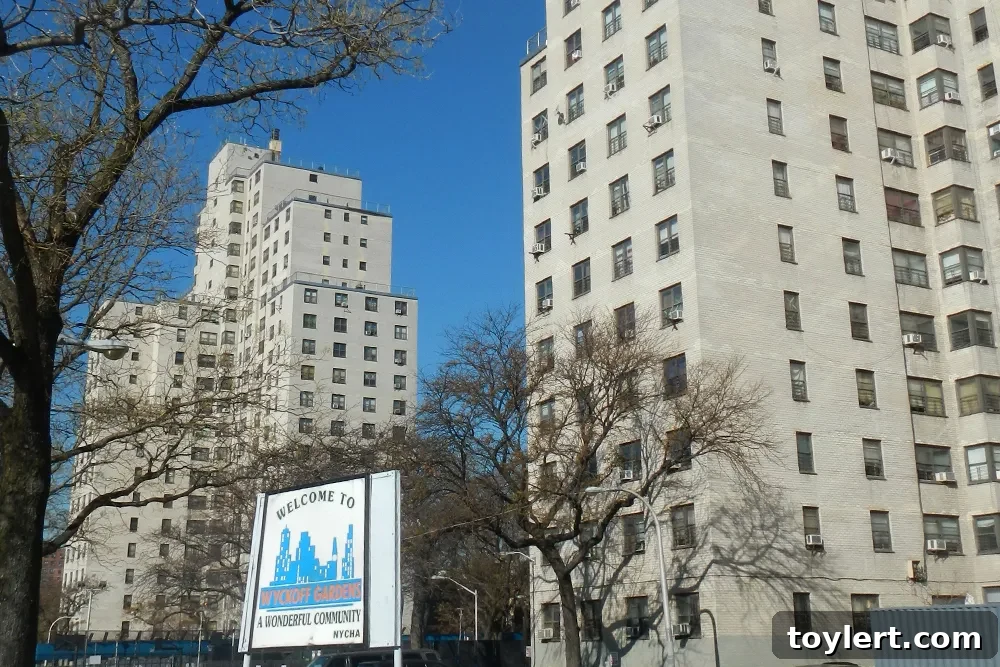
Wyckoff Gardens: Pioneering Mixed-Income Development in Boerum Hill, Brooklyn
A significant shift in urban housing strategy is underway in Boerum Hill, Brooklyn, as city officials confirm plans for a groundbreaking development at Wyckoff Gardens. This New York City Housing Authority (NYCHA) property is slated to become home to a pioneering mixed-income residential building, featuring a unique blend of market-rate and affordable rental units. This ambitious project, selected by the de Blasio administration, marks a pivotal moment in addressing New York City’s complex housing crisis and signals an innovative approach to urban revitalization.
Situated at the strategic intersection of 3rd Avenue and Wyckoff Street, this development embodies the Mayor’s experimental building model. The vision is clear: a structure where fifty percent of the units will be offered at market rates, while the remaining half will be dedicated to affordable housing. This initiative, first reported by Capital New York, is poised to reshape the landscape of public housing and community integration in one of Brooklyn’s most sought-after neighborhoods.
The Vision for Wyckoff Gardens: A New Era of Mixed-Income Living
The proposed development at Wyckoff Gardens is more than just a new building; it represents a commitment to creating diverse and economically integrated communities. By blending market-rate and affordable housing, the project aims to foster a vibrant residential environment where people from various income brackets can live side-by-side. This model is often lauded for its potential to reduce the stigma associated with public housing, encourage social cohesion, and provide sustainable funding mechanisms for ongoing maintenance and improvements.
The strategic location in Boerum Hill, a neighborhood renowned for its charming brownstones, tree-lined streets, and burgeoning cultural scene, adds another layer of significance to this project. As property values in this area continue to soar, the inclusion of affordable housing units becomes increasingly critical to maintaining the neighborhood’s diversity and accessibility. The development, which is expected to house between 550 to 650 units, seeks to capitalize on 5.1 acres of currently underutilized NYCHA land – an area roughly equivalent to seven football fields – to maximize residential density and community amenities.
Understanding NYCHA’s Challenges and the Imperative for Innovation
The New York City Housing Authority, the largest public housing authority in North America, faces immense financial and structural challenges. Decades of underfunding have left its vast portfolio of buildings in dire need of repair, threatening the quality of life for hundreds of thousands of New Yorkers. With an aging infrastructure and a multi-billion dollar capital needs backlog, NYCHA has been compelled to explore alternative strategies to secure the necessary resources for its residents.
The Wyckoff Gardens project emerges directly from this pressing need. By leasing public land to private developers, NYCHA aims to generate revenue that can be reinvested into its existing properties, while simultaneously creating new housing opportunities. This public-private partnership model represents a departure from traditional funding approaches, acknowledging that government subsidies alone are often insufficient to address the scale of the housing crisis. It’s a calculated risk, designed to unlock the potential of underutilized assets and breathe new life into communities that have long been underserved.
Boerum Hill: A Community in Evolution
Boerum Hill has undergone a remarkable transformation over the past few decades, evolving from a quieter, working-class enclave into one of Brooklyn’s most desirable and affluent neighborhoods. Its proximity to Manhattan, excellent transit options, and vibrant retail and dining scene have attracted a diverse array of residents, from young professionals to established families. This growth, while bringing prosperity, has also intensified the demand for housing, pushing rents and property prices to unprecedented levels.
In this context, the Wyckoff Gardens development is poised to become a significant landmark. It introduces a substantial number of new residential units into a high-demand area, potentially alleviating some of the market pressure. However, its presence in a rapidly gentrifying neighborhood also underscores the delicate balance between urban development and community preservation. The success of this project will largely depend on its ability to integrate seamlessly into the existing fabric of Boerum Hill, respecting the needs of both new and long-standing residents.
The Controversial Infill Housing Plan: A Balancing Act
This development is a critical component of the Mayor’s controversial infill housing plan for NYCHA, a strategy that has sparked considerable debate and community activism across the city. The core of the controversy revolves around the decision to lease public land, traditionally reserved for low-income housing, to private developers for the construction of mixed-income buildings. Critics often voice concerns about the potential for further gentrification, the loss of open recreational spaces for current NYCHA residents, and the perceived privatization of public assets.
Community groups and tenant associations have raised legitimate questions regarding the long-term impact on existing residents, fearing displacement, changes in neighborhood character, and the dilution of community bonds. They advocate for robust community engagement, transparency in decision-making, and guaranteed benefits for current residents, such as improved facilities and direct access to new affordable units. Proponents, including city officials and housing advocates, argue that these infill projects are essential for generating the desperately needed funds to repair NYCHA’s deteriorating buildings, improve living conditions for current tenants, and create additional housing stock in a city facing an acute affordability crisis. They emphasize that without new revenue streams, the quality of life for hundreds of thousands of NYCHA residents will continue to decline.
The Mixed-Income Model: Bridging Socioeconomic Divides
The mixed-income model, as proposed for Wyckoff Gardens, is a housing strategy designed to bring together residents from different economic backgrounds within the same development. The theoretical benefits are manifold: it can create more stable and diverse communities, reduce the concentration of poverty, and generate revenue from market-rate units to subsidize the affordable ones. This cross-subsidization is particularly attractive for financially strapped public housing authorities like NYCHA, as it offers a sustainable path to funding maintenance and services without solely relying on volatile government allocations.
Moreover, mixed-income developments often aim to provide residents with access to better amenities, services, and educational opportunities that might otherwise be concentrated in more affluent neighborhoods. By diversifying the income levels within a building, the hope is to foster a stronger sense of shared community and mutual support. However, implementing such a model successfully requires careful planning, sensitive design, and proactive management to ensure that residents from all income levels feel equally valued and have equitable access to all facilities.
Unlocking Underutilized Space: The 5.1-Acre Opportunity
The identification of 5.1 acres of underused space within the Wyckoff Gardens complex highlights a broader strategy in urban planning: maximizing the utility of existing land parcels in densely populated areas. Infill development, as this process is known, involves developing vacant or underutilized land within already established areas, rather than expanding into undeveloped “greenfield” sites. This approach can reduce urban sprawl, leverage existing infrastructure, and bring new life to older neighborhoods.
For NYCHA, these 5.1 acres represent not just empty space, but a valuable asset that can be leveraged to address its profound financial challenges and housing shortages. The decision to develop these parcels is rooted in the belief that every square foot of public land must serve a purpose, especially in a city as space-constrained as New York. The scale of the proposed 550- to 650-unit building signifies a substantial investment in increasing the housing supply, addressing a critical need in the city’s ongoing battle against housing unaffordability. While critics lament the loss of open space, proponents argue that strategic development can be balanced with the creation of new, enhanced public areas and amenities within the new complex.
Looking Ahead: The Future of Urban Development in NYC
The Wyckoff Gardens project serves as a crucial test case for the future of public housing and urban development in New York City. Its success or failure will undoubtedly influence similar initiatives across NYCHA’s vast portfolio and beyond. The ongoing dialogue surrounding such projects reflects the complex interplay of economic necessity, social equity, and community preservation that defines urban planning in a dynamic metropolis.
As New York City continues to grapple with an ever-growing population and persistent housing challenges, innovative solutions like the Wyckoff Gardens model will become increasingly prevalent. The project underscores the shift towards public-private partnerships as a viable mechanism for financing crucial infrastructure and services. It also reignites the essential conversation about how best to integrate new development with existing communities, ensuring that growth benefits all residents. The lessons learned from Wyckoff Gardens will be invaluable in shaping a more inclusive, sustainable, and affordable future for New Yorkers.
In conclusion, the Wyckoff Gardens mixed-income development represents a bold step forward in New York City’s efforts to tackle its housing crisis. By combining market-rate and affordable units on underutilized public land, it offers a pragmatic yet ambitious model for urban revitalization. While challenges and controversies persist, this project stands as a testament to the city’s commitment to finding creative solutions for housing its diverse population and revitalizing its essential public infrastructure.