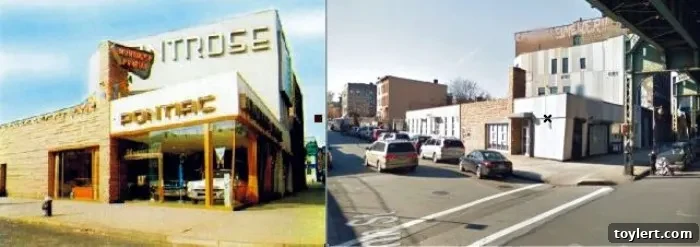
Brooklyn’s Broadway: A Journey Through Time – From Montrose Pontiac to Modern Metropolis
Every street corner in Brooklyn holds a story, a whisper of the past echoing through the present. We often navigate our bustling commercial thoroughfares, heading to our favorite cafes, boutiques, or offices, without pausing to consider the countless lives and businesses that once occupied these very spaces. This holds particularly true for Broadway, a monumental artery that slices through some of Brooklyn’s most dynamic neighborhoods: Williamsburg, Bushwick, and Bedford-Stuyvesant. Its transition over the decades is a captivating narrative of urban evolution, economic shifts, and enduring community spirit. Delving into its history reveals a remarkable blend of change and continuity, offering a profound appreciation for Brooklyn’s vibrant past and its ever-evolving future.
The Ghost of Montrose Pontiac: A Glimpse into Automotive History
Among the myriad businesses that once lined Broadway, a name like Montrose Pontiac resonates with a particular era. Imagine Broadway in the mid-20th century: a bustling boulevard where the automobile was king, and dealerships were symbols of aspiration and American ingenuity. Montrose Pontiac, likely situated at a prominent intersection like 450 Broadway at Penn, would have been a significant landmark. It wasn’t just a place to buy a car; it was a hub of activity, a destination where families chose their next sedan, coupe, or convertible, dreaming of Sunday drives and newfound freedom. The showroom, gleaming under bright lights, would have displayed the latest models, their chrome accents sparkling, inviting passersby to envision themselves behind the wheel of a brand-new vehicle.
During the post-World War II economic boom, car dealerships like Montrose Pontiac flourished. They were vital components of the local economy, providing jobs for salesmen, mechanics, and administrative staff. The dealership would have buzzed with customers discussing trade-ins, negotiating prices, and perhaps even celebrating a new purchase with a handshake and a photograph. It represented a tangible piece of the American dream, a symbol of prosperity and the burgeoning car culture that defined the era. The business model was straightforward: selling new vehicles, maintaining a robust service department, and offering used cars to a diverse clientele. For many years, such establishments were anchors of their commercial districts, attracting customers from both within and beyond the immediate neighborhood, contributing significantly to the street’s character and economic pulse.
However, as decades passed, the automotive landscape began to shift. Suburbanization drew many dealerships to larger, more accessible plots away from dense urban centers. Changing consumer habits, rising land values, and the consolidation of auto brands led to the gradual disappearance of many inner-city dealerships. Montrose Pontiac, like countless others, eventually faded from Broadway, its once-vibrant showroom likely repurposed into something entirely different. Today, the building that housed Montrose Pontiac might be an apartment complex, a chain retailer, a supermarket, or even a collection of smaller businesses, its automotive past often forgotten by newer generations. Yet, for those who remember, the name evokes a powerful sense of nostalgia for a bygone era when Broadway was a grand avenue of American ambition and automotive marvels.
Broadway’s Enduring Legacy: A Historical Panorama
Broadway’s journey through time is a microcosm of Brooklyn’s broader urban story. It has witnessed profound shifts in demographics, commerce, and culture, constantly adapting to the needs and aspirations of its inhabitants across Williamsburg, Bushwick, and Bedford-Stuyvesant.
Early 20th Century: The Foundation of a Thoroughfare
At the turn of the 20th century, Broadway was already a vital artery. Electric streetcars clanged their way down its tracks, connecting neighborhoods and ferrying commuters. Horse-drawn carriages shared the road with the earliest automobiles. The street was lined with local businesses – grocers, butchers, dry goods stores, pharmacies, and small manufacturing shops – catering to the dense working-class populations of the surrounding areas. Grand commercial buildings, often adorned with intricate brickwork and elaborate cornices, were constructed to house banks, department stores, and entertainment venues. This was a time of rapid growth for Brooklyn, and Broadway stood as a testament to its burgeoning commercial power, a bustling lifeline for its diverse communities.
Mid-20th Century Boom: Post-War Prosperity and Automotive Dominance
The decades following World War II brought unprecedented prosperity to the United States, and Brooklyn’s Broadway felt its effects. The post-war baby boom and economic expansion led to increased consumerism. This was the golden age for businesses like Montrose Pontiac, as car ownership became widespread and a symbol of middle-class status. Broadway teemed with shoppers frequenting larger retail outlets, movie theaters, and eateries. While suburbanization began to draw some residents and businesses away from the city, Broadway remained a significant commercial hub, albeit one that was starting to experience the first subtle shifts in its retail landscape. The architectural fabric of this era reflected a blend of older, ornate structures alongside newer, more functional commercial designs.
Late 20th Century Shifts: Decline, Resilience, and the Seeds of Renewal
The latter half of the 20th century presented significant challenges for many urban centers, including parts of Brooklyn. Economic downturns, factory closures, and social changes led to a period of decline along Broadway. Storefronts became vacant, and some buildings fell into disrepair. However, even in challenging times, the street maintained its inherent resilience. Local businesses, often family-owned, continued to serve the steadfast communities that called these neighborhoods home. In areas like Bushwick and Bedford-Stuyvesant, Broadway remained a crucial commercial corridor, supporting residents with essential services and goods. Towards the end of the century, early signs of revitalization began to appear, especially in Williamsburg, as artists and young professionals seeking affordable spaces started to move in, laying the groundwork for future transformation.
21st Century Renaissance: Gentrification, Diversity, and Modernity
The 21st century has brought a dramatic renaissance to Broadway. Fueled by waves of gentrification, particularly in Williamsburg and Bushwick, the street has been revitalized with an influx of new businesses, including trendy cafes, upscale restaurants, art galleries, and modern retail outlets. Old storefronts have been meticulously restored or entirely reimagined. While this transformation has brought economic vibrancy and new amenities, it has also sparked discussions about affordability, displacement, and the preservation of community character. Today, Broadway is a fascinating mosaic: historic buildings stand shoulder to shoulder with sleek new developments, traditional long-standing businesses coexist with cutting-edge enterprises, and a diverse tapestry of residents and visitors animates its sidewalks. It’s a dynamic street that beautifully encapsulates the ongoing dialogue between past and present in Brooklyn.
Architectural Narratives: Buildings That Bear Witness
The buildings lining Broadway are silent chroniclers of its history. From the robust, pre-war brick structures with their intricate facades and detailed cornices to the more functional, mid-century commercial blocks, and the sleek, minimalist designs of contemporary developments, each edifice tells a part of the story. Many older buildings, once homes to banks, theaters, or large retail establishments, have been repurposed for new uses. Their historical details, though sometimes weathered, offer glimpses into the craftsmanship and aesthetic values of earlier eras. A walk along Broadway reveals a fascinating architectural palimpsest, where layers of history are visible in the materials, forms, and adaptations of the structures. Observing these buildings allows one to trace the economic prosperity, the periods of decline, and the waves of reinvestment that have shaped the street. They are not merely backdrops but active participants in Broadway’s continuous narrative, reminding us that urban spaces are constantly being rewritten.
Community and Culture: The Human Element of Change
Beyond the bricks and mortar, Broadway’s true story resides in its people. Over the decades, successive waves of immigrants and migrants have made these neighborhoods their home, each group contributing to the unique cultural fabric of Broadway. From the early 20th-century European immigrants in Williamsburg to the strong African American and Latino communities that shaped Bushwick and Bedford-Stuyvesant, Broadway has always been a place where diverse cultures meet, interact, and thrive. The street has served as a social and economic anchor, a place for celebration, protest, and everyday life. The recent waves of gentrification have introduced new populations and businesses, leading to a rich, albeit sometimes complex, cultural landscape. The challenge and beauty of modern Broadway lie in its ability to balance the preservation of its deep-rooted community identities with the embrace of new influences, fostering a truly unique Brooklyn experience.
Walking Broadway Today: A Living Museum
To walk Broadway today is to embark on a journey through a living museum of urban transformation. The vestiges of Montrose Pontiac, though unseen, are part of the larger narrative. You might pass a century-old building that once housed a bustling department store, now home to a trendy boutique or a modern co-working space. A former theater could be reimagined as a concert venue, while old manufacturing facilities have been converted into loft apartments or artist studios. The street is a sensory experience, filled with the aromas of diverse cuisines, the sounds of different languages, and the visual tapestry of street art juxtaposed against historic architecture. It’s a place where every block offers a new discovery, a new reflection on how cities evolve and reinvent themselves.
The story of Brooklyn’s Broadway is a powerful reminder that urban landscapes are never static. They are fluid, dynamic entities shaped by economic forces, social movements, and the relentless march of time. From the heyday of Montrose Pontiac to its current incarnation as a vibrant, multifaceted commercial and cultural corridor, Broadway continues to be a testament to Brooklyn’s enduring spirit of change, resilience, and irresistible charm. It encourages us to look beyond the immediate present and appreciate the layers of history that pave the streets beneath our feet, understanding that every step is taken on ground that has witnessed countless transformations.