By Paul Frangipane and Kirstyn Brendlen
Morgan Avenue: A Dangerous Thoroughfare Demanding Immediate Redesign for Pedestrian Safety
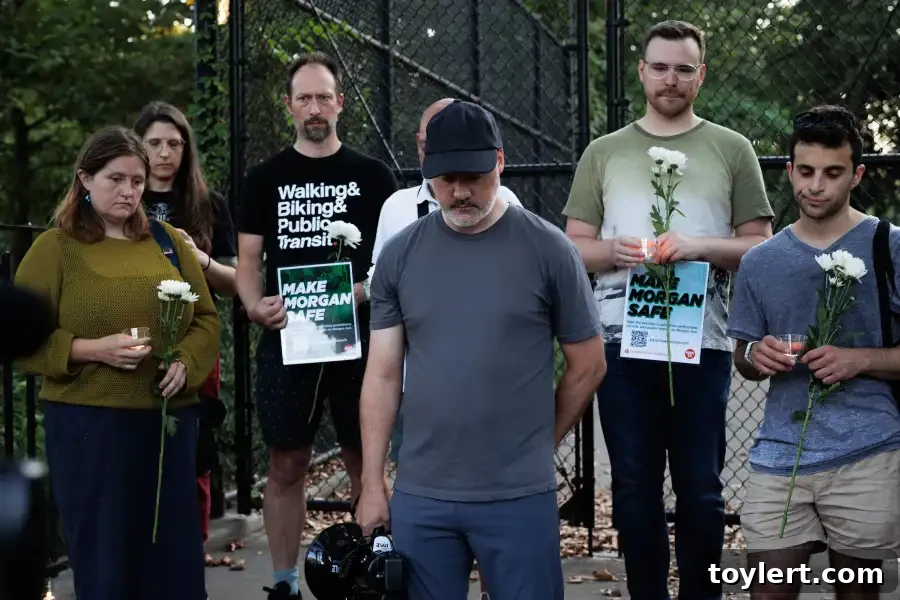
Another life tragically lost on Morgan Avenue has reignited urgent calls from local residents and advocacy groups for a comprehensive redesign of this notoriously perilous thoroughfare in Williamsburg, Brooklyn. The recent fatal collision underscores a long-standing pattern of danger, forcing the community to demand concrete action from city officials before more lives are senselessly cut short.
The latest tragedy occurred just before 8 a.m. on August 6, when a 56-year-old man was struck and killed by the driver of a large Freightliner truck while attempting to cross Morgan Avenue near Sharon Street. The victim, whose identity has not yet been publicly released, suffered “severe trauma” and was tragically pronounced dead at the scene. Police confirmed that the truck driver remained at the site of the accident, and as of August 11, no charges had been filed. This incident is not an isolated event but a stark reminder of the persistent and severe risks pedestrians face daily on Morgan Avenue.
A History of Hazards: Why Morgan Avenue Is a Death Trap
Morgan Avenue, a major artery weaving through Williamsburg, has long been identified by residents and urban planners alike as a significant safety concern. Its wide lanes, often encouraging high speeds, coupled with inadequate pedestrian infrastructure, create a hostile environment for anyone navigating the street on foot or by bicycle. The thoroughfare’s function as a critical commercial and industrial route means it sees a constant flow of heavy truck traffic, further exacerbating the dangers for vulnerable road users.
Community members recount numerous near-misses and previous accidents that have plagued Morgan Avenue for years. The broad, multi-lane design, characteristic of an era when vehicle throughput was prioritized over human safety, makes it challenging and terrifying for pedestrians to cross, especially at intersections lacking proper signals, reduced crossing times, or protective elements. The absence of dedicated, protected bike lanes also forces cyclists into direct conflict with fast-moving vehicles, increasing the likelihood of severe incidents.
Data from city agencies often confirms what locals already know: Morgan Avenue is a crash hot-spot. Analyzing collision reports typically reveals a disturbing trend of pedestrian and cyclist injuries, often involving large vehicles. These statistics paint a grim picture, highlighting the urgent need for systemic changes rather than relying solely on individual driver or pedestrian vigilance, which is often insufficient to overcome inherently dangerous street designs.
Community United: A Resounding Call for Change
In the wake of this latest fatality, the collective grief and frustration within the Williamsburg community have galvanized into renewed calls for immediate action. Local residents, businesses, and community organizations have been vocal for years about the imperative to transform Morgan Avenue from a hazardous corridor into a safe, walkable, and bikeable street. Petitions are circulating, demanding that the Department of Transportation (DOT) expedite comprehensive redesign plans.
Community Board 1, representing the interests of Williamsburg residents, has consistently advocated for traffic calming measures, improved pedestrian crossings, and safer bicycle infrastructure along Morgan Avenue. Their resolutions and recommendations often cite the critical need for pedestrian islands, curb extensions, leading pedestrian intervals (LPIs) at traffic lights, and clearer, more visible crosswalks. Activists argue that these modifications are not merely aesthetic improvements but life-saving interventions.
Local advocacy groups, such as Transportation Alternatives and Families for Safe Streets, have also joined the chorus, organizing rallies and public forums to pressure city officials. They emphasize that the current design of Morgan Avenue exemplifies the systemic failures that undermine New York City’s Vision Zero initiative, which aims to eliminate all traffic fatalities and serious injuries. The community’s message is clear: the time for studies and delayed proposals is over; what is needed now is immediate implementation of proven safety solutions.
Vision Zero’s Unfulfilled Promise on Morgan Avenue
New York City’s Vision Zero program, launched with much fanfare in 2014, pledged a commitment to ending traffic deaths through engineering, enforcement, and education. While the initiative has seen some successes across the city, areas like Morgan Avenue present a stark contrast to its aspirational goals. For many residents, the continued fatalities on streets designated as priority corridors highlight the program’s uneven application and the bureaucratic hurdles that delay life-saving infrastructure upgrades.
Critics argue that despite the city’s stated commitment, infrastructure changes often come only after a fatality, rather than proactively preventing them. This reactive approach leaves communities like Williamsburg feeling frustrated and vulnerable. The specific challenges of Morgan Avenue, including its classification as a truck route and its historical design, demand a dedicated and accelerated approach from city planners and engineers to truly align with Vision Zero’s principles.
The Department of Transportation has conducted studies and implemented minor changes in the past, but these have largely been deemed insufficient by the community. Residents point to the lack of substantial reconfigurations that would fundamentally alter the street’s dangerous character. The urgency of the current situation demands a radical shift in strategy, prioritizing pedestrian and cyclist safety above vehicle speed and capacity, particularly in a dense urban environment like Williamsburg.
Comprehensive Redesign: Engineering a Safer Future
So, what would a safer Morgan Avenue look like? The consensus among urban planners, safety advocates, and residents points towards a multi-faceted redesign that prioritizes vulnerable road users. Key proposals typically include:
- Lane Reductions and Narrowing: Reducing the number of travel lanes or narrowing existing ones can significantly reduce vehicle speeds and create space for other essential infrastructure.
- Protected Bike Lanes: Implementing physically separated bike lanes would provide a safe corridor for cyclists, removing them from direct conflict with motor vehicles.
- Pedestrian Islands and Curb Extensions: These features shorten crossing distances for pedestrians, provide a safe refuge in the middle of wide streets, and improve visibility at intersections.
- Enhanced Crosswalks: Brighter, highly visible crosswalks, potentially elevated or textured, coupled with leading pedestrian intervals (LPIs) that give pedestrians a head start before vehicles, can dramatically improve safety.
- Traffic Calming Measures: Speed humps, chicanes, and rumble strips can be strategically placed to force drivers to reduce speed, particularly in residential zones or near community hubs.
- Improved Lighting and Signage: Better illumination at intersections and clear, unambiguous signage can enhance visibility for all road users, especially during nighttime hours.
- Freight Management Solutions: Exploring dedicated times for truck deliveries or alternative routing strategies could mitigate the impact of heavy vehicle traffic on pedestrian-heavy areas.
These interventions are not theoretical; they have been successfully implemented in other parts of New York City and around the world, proving their effectiveness in reducing collisions and fatalities. The blueprint for a safer Morgan Avenue exists; the political will and timely execution are now paramount.
The Human Cost: Impact on Daily Life and Community Well-being
Beyond the tragic statistics, the perpetual danger on Morgan Avenue exacts a heavy toll on the quality of life for Williamsburg residents. Parents fear for their children crossing the street to school or local parks. Seniors find navigating the busy thoroughfare a daunting and often impossible task. The constant threat of accidents fosters a sense of anxiety and limits mobility, discouraging walking and cycling—modes of transportation that are vital for urban health and sustainability.
Businesses along Morgan Avenue also feel the impact. A street perceived as dangerous is less inviting for foot traffic, potentially deterring customers and reducing economic vitality. A redesign that prioritizes safety and walkability could, conversely, revitalize the commercial strip, making it a more pleasant and accessible destination for residents and visitors alike. Investing in street safety is not just about preventing deaths; it’s about fostering vibrant, healthy communities where people feel secure and connected.
The community’s unwavering advocacy stems from a deep understanding that street safety is a fundamental right. Every resident deserves to walk, cycle, and live without the constant fear of being involved in a preventable collision. The death on August 6 serves as yet another painful reminder that the current design of Morgan Avenue is incompatible with this basic expectation.
Urgent Action Required: A Plea for a Safer Tomorrow
The tragic death of a 56-year-old man on Morgan Avenue is a somber reiteration of a crisis that has long plagued Williamsburg. It is a critical moment for New York City to demonstrate its commitment to Vision Zero not just in rhetoric, but through decisive, transformative action on one of its most dangerous streets. The community’s patience has worn thin, replaced by a resolute determination to see meaningful change.
City officials, particularly the Department of Transportation, must heed these urgent calls. A comprehensive, community-informed redesign of Morgan Avenue is no longer an option but an absolute necessity. It requires swift planning, transparent communication, and rapid implementation to prevent further senseless loss of life. Only then can Morgan Avenue shed its reputation as a death trap and become a safe, integral part of the vibrant Williamsburg community it serves.