By Jada Camille, amNY
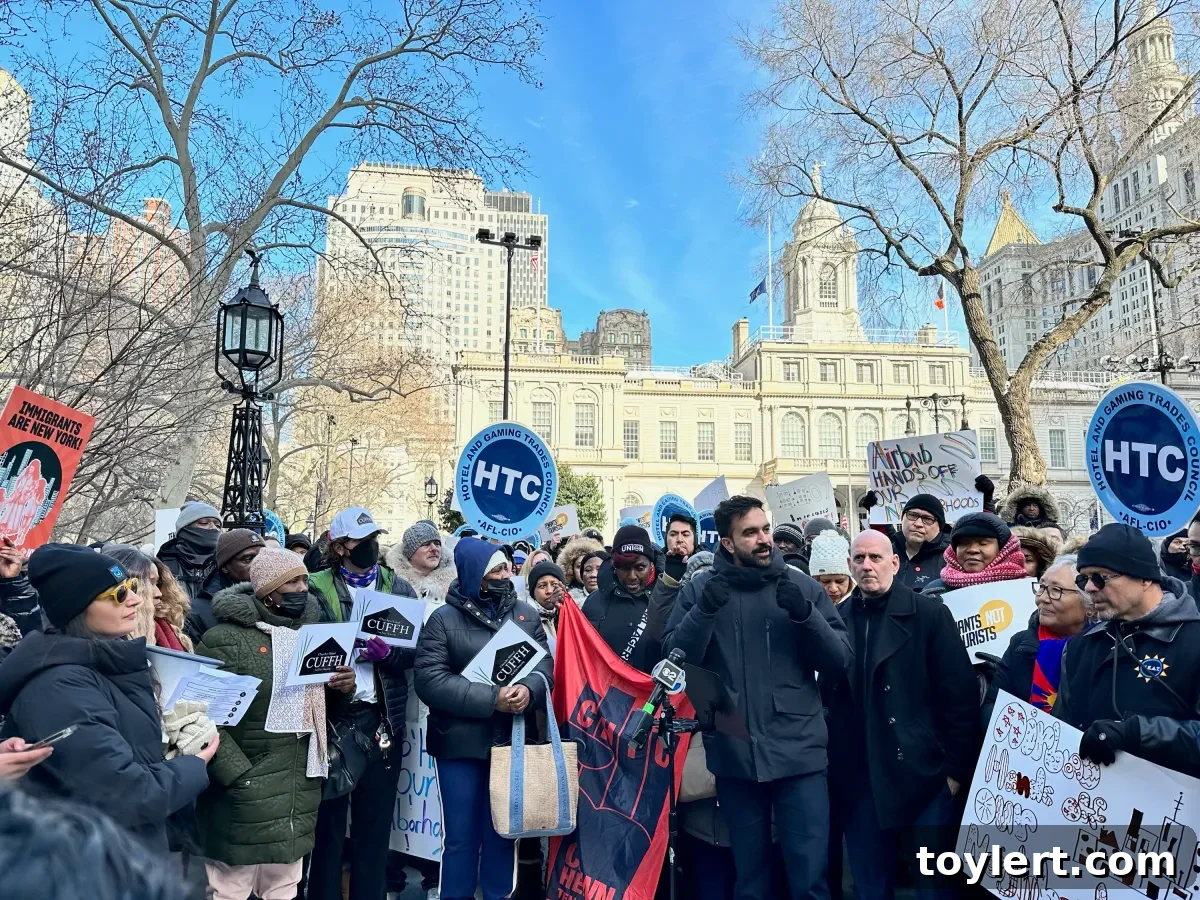
New York City’s dynamic urban landscape is continually shaped by competing interests, especially within its fiercely contested housing market. A critical flashpoint in this ongoing struggle recently emerged as over 300 tenants and dedicated housing advocates convened outside City Hall. Their powerful demonstration served as a unified rejection of Intro 1107, a proposed legislative bill backed by the global short-term rental behemoth, Airbnb. Opponents of the bill contend that its passage could severely imperil tens of thousands of essential rental units across the city, further destabilizing an already fragile housing ecosystem.
This impactful rally, meticulously orchestrated by the influential grassroots coalition known as Tenants Not Tourists, garnered significant support from a diverse group of elected officials, including several prominent NYC Council members and local assembly members. Their solidarity underscored the widespread political concern surrounding Intro 1107. Adding weight to the growing opposition, a comprehensive letter was disseminated, bearing the signatures of 43 distinct organizations tirelessly advocating for tenant rights. This collective appeal urged lawmakers to unequivocally reject the bill, arguing that its implementation would critically undermine existing enforcement mechanisms designed to regulate short-term rentals in the five boroughs.
New York City’s Precarious Housing Market: The Threat from Short-Term Rentals
New York City stands at the forefront of a severe housing affordability crisis, characterized by an acute shortage of available units and skyrocketing rental prices. For millions of residents, securing and maintaining stable, affordable housing is a relentless uphill battle. In such a high-stakes environment, every residential unit holds immense value. The proliferation of short-term rental platforms, spearheaded by companies like Airbnb, has introduced a significant complicating factor, progressively converting residential apartments from the long-term rental market into transient accommodations—effectively functioning as unregulated hotel rooms. This trend directly diminishes the city’s overall housing supply, exerts upward pressure on rents, and fundamentally alters the community character of residential neighborhoods.
Consequently, the proposed Intro 1107 bill is not merely a technical amendment to existing legislation; it represents a potentially seismic shift in New York City’s foundational housing policy. Critics vociferously argue that by easing restrictions or weakening the enforcement framework surrounding short-term rentals, the bill would, in essence, legitimize and accelerate the conversion of vital housing stock into transient tourist lodgings. Such a move, they contend, would deliver a devastating blow to the city’s families, essential service workers, and long-term residents who are already struggling to afford a place to call home.
Deconstructing Intro 1107: Implications for NYC’s Rental Landscape
While the precise legal language of Intro 1107 can be intricate, its stated purpose, according to its proponents, is to clarify and simplify the regulatory framework governing short-term rentals. However, those opposing the bill fear these proclaimed “clarifications” and “streamlining efforts” are thinly disguised maneuvers to dismantle crucial existing tenant protections. The bill is widely perceived as an attempt to circumvent, dilute, or even undermine the efficacy of Local Law 18, the city’s comprehensive short-term rental registration law, which came into full force in September 2023. Local Law 18 mandates that all short-term rental hosts must register with the Mayor’s Office of Special Enforcement (MOSE) and adhere to stringent regulations, including a pivotal requirement that hosts must be physically present in the unit during any rental period shorter than 30 days, unless specific, narrowly defined exemptions apply.
The primary concern is that Intro 1107 aims to introduce new loopholes or less stringent operational requirements that would make it considerably easier for property owners to operate illicit short-term rentals without facing meaningful penalties. This could manifest in several critical ways: by subtly altering the legal definition of “host presence,” by creating new categories of exempted properties that bypass current regulations, or by shifting the primary burden of enforcement away from powerful platforms like Airbnb and onto individual hosts or the city itself, thereby complicating and weakening the overall oversight process. Any legislative action that weakens these critical enforcement mechanisms would directly empower commercial operators whose primary objective is to profit from converting residential units into lucrative tourist accommodations, inevitably at the expense of New Yorkers desperately searching for permanent homes.
Airbnb’s Stance: Advocating for Economic Flexibility and Choice
Airbnb and its fervent supporters often frame short-term rentals as an indispensable economic opportunity for property owners, enabling them to generate supplementary income to offset the escalating costs of living, property taxes, or mortgage payments. They consistently argue that overly strict governmental regulations stifle this vital economic activity, thereby limiting consumer choice for visitors and unfairly penalizing responsible hosts who genuinely wish to share their homes. From Airbnb’s strategic perspective, a more permissive and flexible regulatory environment, such as that potentially offered by Intro 1107, would not only foster a more robust and dynamic tourism economy but also support small-scale entrepreneurs and provide a wider array of diverse accommodation options for visitors to New York City.
Furthermore, proponents might assert that the Airbnb platform primarily facilitates genuine home-sharing—where residents temporarily rent out a spare room or their entire apartment while they are away—rather than promoting large-scale commercial conversions of residential buildings. However, this assertion is vehemently disputed by critics, who point to extensive evidence of professional operators managing multiple listings across various properties, effectively running unregulated hotels that directly displace long-term residents and significantly distort local housing markets, contributing to gentrification and unaffordability.
Tenants Not Tourists: A Formidable Coalition for Community and Housing Justice
The Tenants Not Tourists coalition has rapidly ascended as a preeminent voice in this complex and often heated debate. It represents a broad, powerful alliance encompassing numerous tenant organizations, grassroots community groups, and housing justice advocates from across New York City. Their mission is unequivocally clear: to safeguard and preserve the city’s precious residential housing stock specifically for its permanent residents. The coalition consistently argues that the city’s housing resources must unequivocally prioritize stable homes for New Yorkers over transient accommodations for tourists. Their multifaceted efforts involve extensive grassroots organizing, impactful public education campaigns designed to raise awareness, and direct, persistent lobbying of policymakers at all levels of government.
The large-scale protest held outside City Hall in January 2025 served as a potent and visible manifestation of their relentless, ongoing advocacy. Chants of “Homes Not Hotels!” and “No to Intro 1107!” resonated powerfully through the civic plaza, amplified by a sea of hand-held signs bearing similar, urgent messages. Numerous speakers, representing various tenant unions, community boards, and neighborhood associations, articulated deeply personal and moving stories of displacement, unmanageable rent hikes, and the pervasive anxiety fueled by an increasingly speculative and hostile housing market. The visible presence of several NYC Council members and local assembly members at the rally further underscored the significant political weight of the coalition’s arguments and the widespread concern among elected officials regarding the bill’s potentially devastating impact on their constituents.
The Broader Socioeconomic Impact: Beyond Just Housing Numbers
The potential consequences of weakened short-term rental enforcement extend far beyond simply reducing the number of available long-term rental units. They deeply impact the very fabric and quality of life within New York City’s diverse neighborhoods:
- Community Erosion and Disruption: Residential buildings, specifically designed and intended for long-term residents, often struggle to cope with the transient nature and frequent turnover of short-term guests. This can lead to increased foot traffic, heightened noise complaints, pressing security concerns, and a general erosion of the sense of community cohesion, thereby diminishing the quality of life for permanent residents.
- Safety and Security Concerns: The constant influx of unfamiliar individuals into residential buildings can create significant security vulnerabilities within specific buildings and their surrounding neighborhoods. Without adequate vetting and vigilant oversight, long-term residents may feel a heightened sense of insecurity and vulnerability.
- Accelerated Displacement: When landlords are incentivized to convert residential apartments into more lucrative short-term rentals, existing tenants frequently face non-renewal of leases, exorbitant rent increases, or aggressive buyout offers, often forcing them out of their long-standing homes and established communities. This phenomenon disproportionately affects vulnerable populations and exacerbates existing trends of gentrification.
- Strain on Public Infrastructure: An unregulated or weakly regulated expansion of short-term rentals places significant additional strain on essential local infrastructure, including waste management services, public utilities, and transportation networks. Crucially, these operations often do not contribute adequately to local tax revenues in the same manner as traditional hotels, creating an imbalance.
- Economic Fairness and Local Businesses: Local businesses, ranging from neighborhood laundromats to independent bodegas, thrive on the stable patronage of resident populations. A significant shift towards transient visitors can drastically alter local spending patterns, potentially undermining the economic viability of neighborhood mainstays and favoring more tourist-oriented businesses, thus changing the economic character of the community.
The Path Forward: Sustained Advocacy and Rigorous Legislative Scrutiny
The unified and powerful opposition to Intro 1107, masterfully spearheaded by the Tenants Not Tourists coalition and supported by a diverse array of allies, unequivocally demonstrates a deep-seated and unwavering commitment to preserving New York City’s residential character and ensuring housing stability for all its residents. The recent rally outside City Hall served as a poignant and timely reminder that while innovative tech platforms offer undeniable convenience, they must operate strictly within a regulatory framework that inherently safeguards foundational community values and protects essential housing rights.
The legislative journey for Intro 1107 is expected to be characterized by continued intense debate, vigorous lobbying from both sides of the issue, and thorough public scrutiny. Housing advocates and tenant organizations have vowed to maintain their relentless pressure, urging City Council members to meticulously consider the profound long-term ramifications of any bill that compromises the city’s fundamental ability to effectively regulate short-term rentals. They consistently emphasize that strong, enforceable regulations are not merely about controlling a particular market segment; rather, they are about safeguarding cherished homes, fostering stable and vibrant communities, and upholding the fundamental right to affordable housing in one of the world’s most dynamic, yet immensely challenging, urban environments.
The ultimate outcome of Intro 1107 will serve as a critical barometer of New York City’s commitment to prioritizing the needs and well-being of its long-term residents over the formidable financial interests of the short-term rental industry. For the hundreds who rallied passionately and the tens of thousands of New Yorkers they represent, the message is stark, clear, and absolutely unequivocal: homes for New Yorkers must always come first.