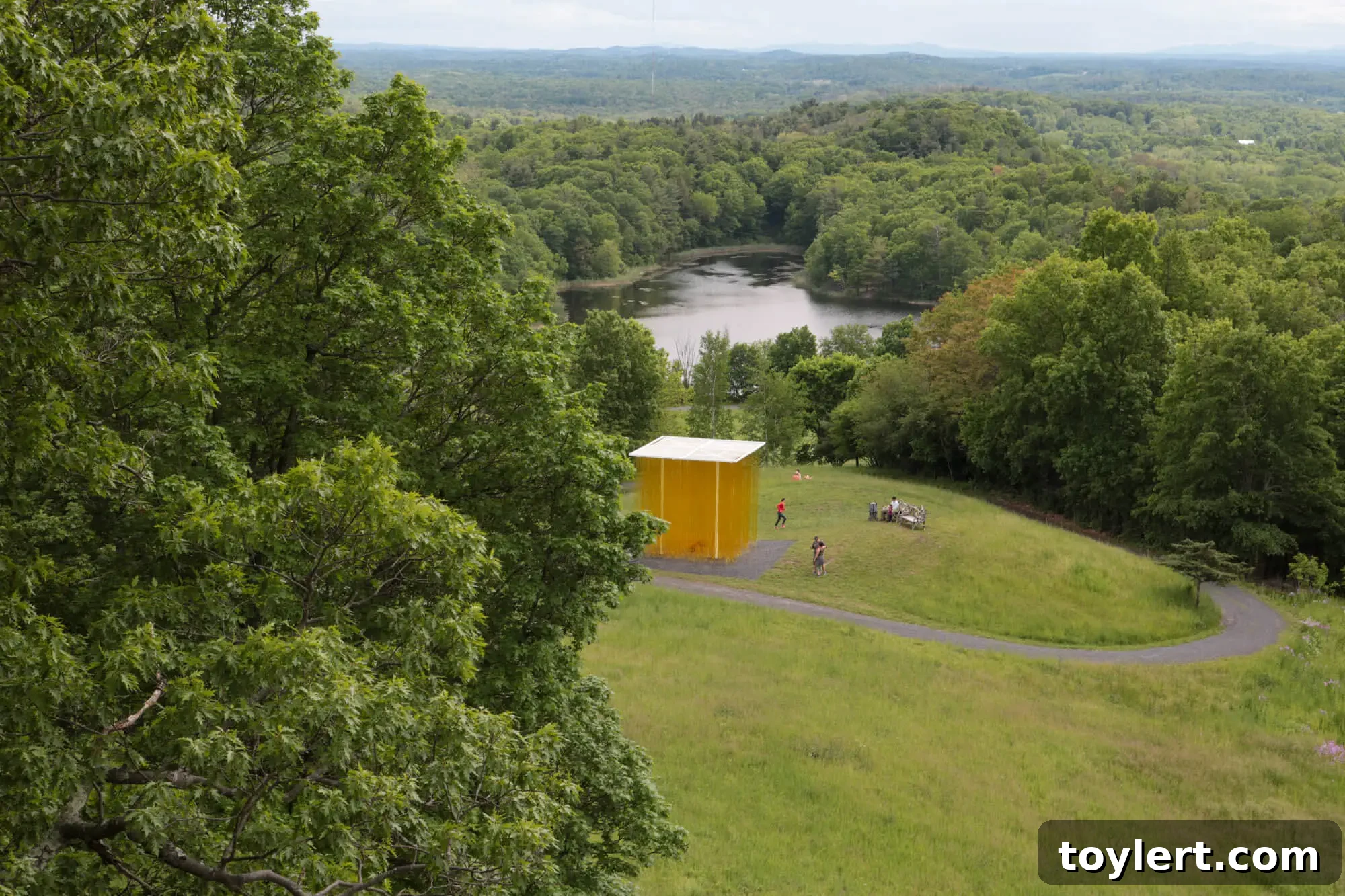
Overlook: Teresita Fernández Confronts Frederic Church at Olana – A Timeless Dialogue on Landscape and Perception
Nestled in the breathtaking Hudson Valley, Olana State Historic Site, the opulent 19th-century masterpiece and former home of Hudson River School luminary Frederic Church, serves as the evocative backdrop for a truly groundbreaking exhibition. “Overlook: Teresita Fernández Confronts Frederic Church at Olana” orchestrates a compelling dialogue between past and present, challenging established notions of landscape, observation, and colonial history through the lens of contemporary Brooklyn artist Teresita Fernández.
This meticulously curated show is far more than a simple display of art; it’s an immersive experience that interweaves the inherent artistry of Olana itself – its lush, meticulously designed landscape and the exuberantly patterned house in Hudson, N.Y. – with a profound selection of historic and contemporary landscape art from the esteemed Colección Patricia Phelps de Cisneros (CPPC), culminating in eighteen bespoke pieces Fernández crafted expressly for this unique installation. The result is a multi-layered exploration that invites visitors to re-evaluate their own perceptions of the natural world and humanity’s place within it.
Teresita Fernández: Challenging Perspectives on Landscape and Identity
Teresita Fernández is renowned for her conceptually rich installations that often explore themes of perception, place, and the material manifestation of nature, culture, and history. Her work frequently invites viewers to contemplate the psychological and social dimensions embedded within landscapes, transforming passive observation into active engagement. In this exhibition, Fernández, in collaboration with guest curator Sara Meadows, meticulously “reexamines Frederic Church and his contemporaries’ response to the cultures and landscapes experienced during their Latin American travels,” as the exhibition narrative elucidates.
Fernández’s artistic practice is characterized by a sophisticated understanding of materials and a deep commitment to exploring complex socio-political narratives. She often uses seemingly simple elements—such as mirrors, glass, charcoal, or gold—to create immersive environments that question our relationship to vision, light, and the physical world. Her interventions at Olana are not merely additions but rather carefully considered responses that speak directly to Church’s legacy, dissecting and reinterpreting the narratives woven into his art and life. Her work typically encourages a critical stance, prompting viewers to consider how landscapes are not neutral but are imbued with power dynamics, historical contexts, and often, silenced voices. By placing her contemporary creations within Church’s historic home, Fernández creates a compelling tension that highlights both continuity and divergence in artistic thought across centuries.
Frederic Church and the Romantic Ideal of the American Landscape
Frederic Church stands as one of the towering figures of the Hudson River School, a 19th-century American art movement celebrated for its majestic landscape paintings. Church’s canvases often depicted vast, awe-inspiring natural scenes, imbued with a sense of the sublime and a spiritual reverence for the American wilderness. His travels, particularly to Latin America in the mid-19th century, profoundly influenced his artistic vision, leading him to capture the exotic grandeur of volcanic peaks, tropical forests, and distant horizons. These expeditions were not merely artistic pilgrimages; they were part of a broader cultural moment where artists and explorers from the global North ventured into lands often seen through a romanticized and sometimes colonial gaze.
Olana, Church’s extraordinary estate, is perhaps his greatest masterpiece, a holistic creation that blurs the lines between art, architecture, and landscape design. Perched majestically overlooking the Hudson River, the Persian-inspired villa and its surrounding designed landscape were meticulously conceived by Church as a living work of art, reflecting his travels and aesthetic philosophies. Every vista from Olana was carefully framed, every path deliberately planned, transforming the natural environment into an extension of his artistic canvas. Olana, therefore, is not just a site for the exhibition but an active participant, its history and design informing and responding to Fernández’s contemporary interventions. It is within this deeply personal and historically charged space that Fernández embarks on her thoughtful “confrontation,” prompting a re-evaluation of the ideals Church embodied.
Bridging Eras: Fernández’s Contemporary Lens on Historical Legacies
The core of “Overlook” lies in how Fernández’s art actively confronts and recontextualizes Church’s romanticized vision. While Church sought to capture the awe-inspiring beauty of nature, often from a Eurocentric perspective, Fernández’s work delves into the complex layers of history, colonialism, and environmental impact that underlie such grand narratives. Her new pieces for Olana are designed to engage with the site’s unique architectural elements and the expansive views that Church himself meticulously framed. These installations often challenge the viewer’s fixed point of view, introducing elements of reflection, fragmentation, and immersion that disrupt conventional modes of landscape observation.
By juxtaposing her contemporary installations with Church’s legacy, Fernández invites visitors to question the very act of “overlooking”—both in the sense of a vantage point and of ignoring crucial historical and cultural narratives. She prompts a critical examination of how landscapes are perceived, represented, and owned, especially in the context of Church’s Latin American expeditions. Were these journeys merely about aesthetic appreciation, or did they also reflect prevailing imperialistic attitudes? Fernández’s art, with its emphasis on questioning and re-framing, encourages a more nuanced understanding of these historical encounters, drawing attention to indigenous perspectives, resource exploitation, and the lasting impact of colonialism on both land and people. Her pieces serve as conceptual mirrors, reflecting back not just the landscape, but the viewer’s own assumptions and the historical layers embedded within the scenic beauty.
The Colección Patricia Phelps de Cisneros: A Global Tapestry of Landscape Art
An integral component of “Overlook” is the inclusion of significant works from the Colección Patricia Phelps de Cisneros (CPPC). Renowned for its unparalleled collection of Latin American art, the CPPC provides a crucial historical and contemporary framework for the exhibition. Its works allow for a broader understanding of how landscape has been depicted and interpreted across diverse cultures and time periods, particularly within Latin America—the very regions that captivated Church.
The CPPC’s contribution helps to decenter the traditional Euro-American narrative of landscape art, presenting alternative perspectives and artistic traditions that existed concurrently with, or in response to, European and North American movements. By integrating these works, the exhibition not only illuminates the artistic context that Church might have encountered or been influenced by, but also highlights the artistic richness and complexity of Latin American cultures. This inclusion is vital for Fernández’s “reexamination,” allowing for a richer, more polyphonic conversation about representation, appropriation, and cultural exchange. The historical depth provided by the CPPC pieces, ranging from indigenous representations of land to modern interpretations, amplifies the dialogue between Church’s 19th-century vision and Fernández’s 21st-century critique, offering a comprehensive look at the evolution of landscape art through a global lens.
Olana: More Than a Venue, A Participant in the Artistic Discourse
Olana, with its idiosyncratic architecture and painstakingly crafted views, transcends its role as a mere exhibition space to become an active participant in the artistic discourse. The house itself is a fusion of Church’s personal vision and his global travels, a physical manifestation of his artistic and intellectual journey. Fernández’s installations are strategically placed to interact with Olana’s existing architecture, its unique interior spaces, and the panoramas of the Hudson Valley that Church so cherished and framed.
This dynamic interplay transforms Olana into a living canvas where past and present continuously inform each other. A visitor walking through the historic rooms might encounter a contemporary installation that reflects or refracts the light in a way that challenges Church’s original intent, or a piece that encourages a different way of seeing the landscape just beyond the window. This approach ensures that the exhibition is deeply site-specific, creating an experience that could only unfold within the hallowed, yet now reinterpreted, halls of Olana. The interplay between the permanent collections of Olana and the temporary interventions by Fernández forces a confrontation with how we preserve and interpret historical sites, making the visit a truly unique and thought-provoking journey.
Unpacking the Themes: Landscape, Perception, and Identity in a New Light
At its heart, “Overlook” delves into the profound themes of landscape, perception, and identity. Both Church and Fernández manipulate the viewer’s perception, though with vastly different intentions. Church sought to evoke the sublime, a sense of awe and spiritual connection to untouched nature, often creating compositions that were idealized and grand. Fernández, conversely, often uses her art to deconstruct these very ideals, revealing the constructed nature of landscape and the subjective biases inherent in its representation.
The exhibition critically examines how the identity of the “observer” shapes what is seen and understood. Church, as a 19th-century American artist, saw Latin American landscapes through a specific cultural and historical lens. Fernández, as a contemporary artist with a keen awareness of postcolonial discourse, challenges this gaze, inviting viewers to consider whose stories have been prioritized and whose have been “overlooked.” This dynamic interplay fosters a deeper understanding of how landscapes are not just physical spaces, but also cultural constructs, political territories, and repositories of memory. The exhibition thus becomes a powerful platform for discussing environmental stewardship, cultural heritage, and the evolving understanding of identity in a globalized world.
In conclusion, “Overlook: Teresita Fernández Confronts Frederic Church at Olana” is an essential exhibition that transcends mere art display to become a profound contemporary intervention. It offers an unparalleled opportunity to engage with complex themes of landscape, history, and perception through the innovative dialogue between two pivotal artists. Visitors are invited not just to witness, but to actively participate in a critical re-evaluation of our historical legacies and our ongoing relationship with the natural world. This show is a testament to the enduring power of art to provoke thought, challenge assumptions, and inspire new ways of seeing, making it a must-visit for anyone interested in American art, contemporary discourse, and the timeless allure of the Hudson Valley.